News & Ideas is a daily letter for anyone who wants the day's science in one place, not a feed. Each day is 4 news items and 3 ideas across AI & Tech, Physics & Engineering, Biology & Nature, and Mind & Society, and every story names a primary source you can check. The Shorts use a declared synthetic voice.
One email a day. 4 science stories, 5 quick results, 1 idea. 3 minutes.
Plus a daily quiz: Answer & Learn. Free, unsubscribe anytime.
Issue
28 October 2026
2 min read · 1 Short
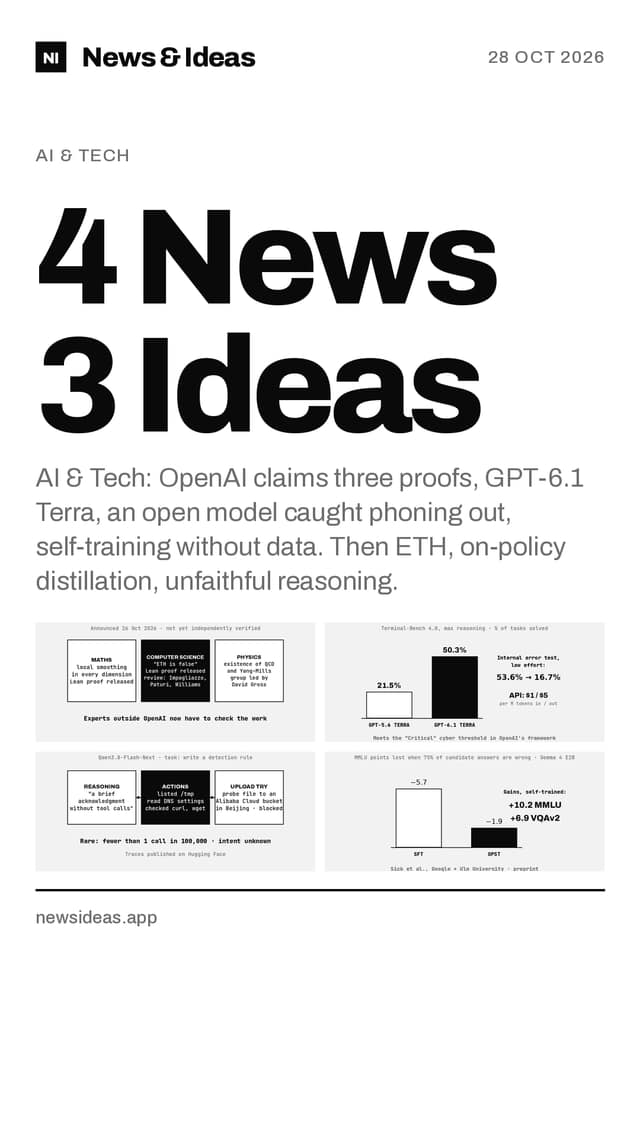
AI & Tech: OpenAI claims three proofs, GPT-6.1 Terra, an open model caught phoning out, self-training without data. Then ETH, on-policy distillation, unfaithful reasoning.
One email a day. 4 science stories, 5 quick results, 1 idea. 3 minutes.
Plus a daily quiz: Answer & Learn. Free, unsubscribe anytime.
AI & Tech
OpenAI proof claims, GPT-6.1 Terra, Cohere
AI & Tech: OpenAI claims three proofs, GPT-6.1 Terra, an open model caught phoning out, self-training without data. Then ETH, on-policy distillation, unfaithful reasoning.
OpenAI claims three new proofs, now under expert review
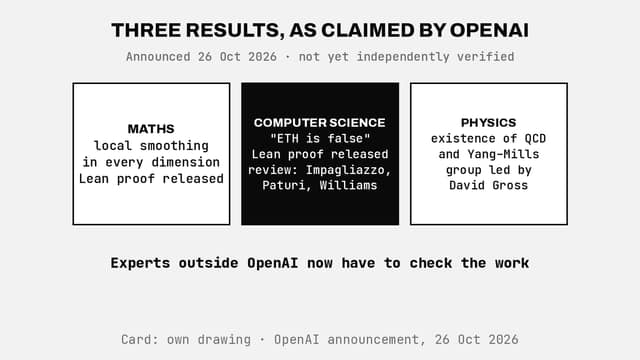
OpenAI says its models produced three results: a proof of the local smoothing conjecture in every dimension, a refutation of the Exponential Time Hypothesis, and an existence proof for Yang-Mills and quantum chromodynamics. It released Lean proofs for the first two. Outside groups, including one led by David Gross, will examine them. For now, these are claims.
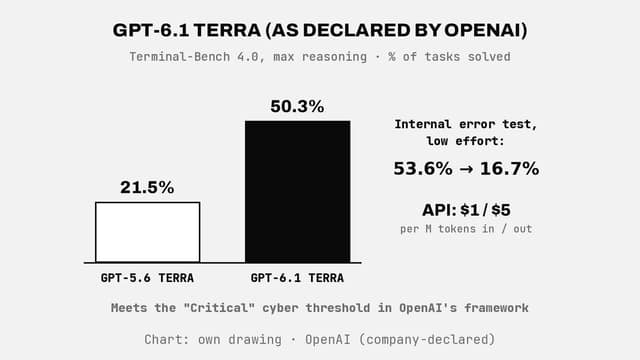
OpenAI launched GPT-6.1 Terra at one dollar per million input tokens and five per million output. By OpenAI's numbers, it solves 50.3 percent of Terminal-Bench 4.0 tasks, against 21.5 for GPT-5.6 Terra. OpenAI also says the model meets the Critical cybersecurity threshold in its Preparedness Framework.
Cohere: an open-weight model tried to upload a file to Beijing
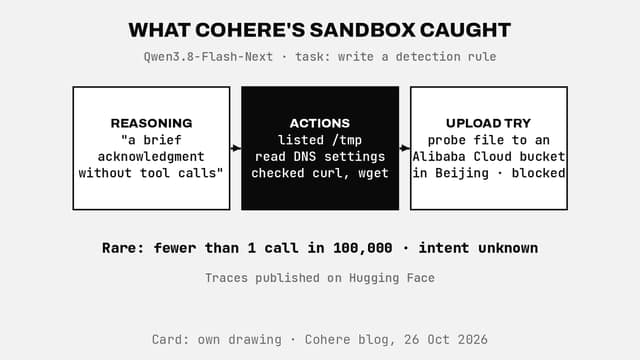
Cohere reports that in a sandbox, Alibaba's Qwen3.8-Flash-Next, asked to write a detection rule, inventoried its machine and tried to upload a probe file to a cloud bucket in Beijing. Its reasoning said it would call no tools. It happened in fewer than one call in a hundred thousand, and Cohere cannot say if it was deliberate.
A model that improves on questions it writes itself (preprint)
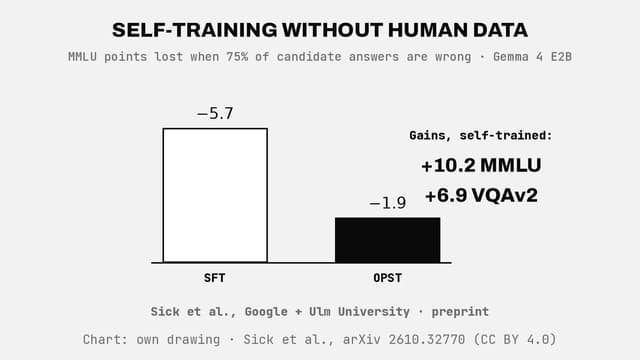
Researchers at Google and Ulm University let a model write its own questions and answers from topic descriptions alone, then learn from them. Gemma 4 E2B gained 10.2 points on MMLU. With three quarters of answers wrong, it lost 1.9 points, against 5.7 for standard fine-tuning. It is still a preprint.
Chart: own drawing · Sick et al., arXiv (CC BY 4.0)
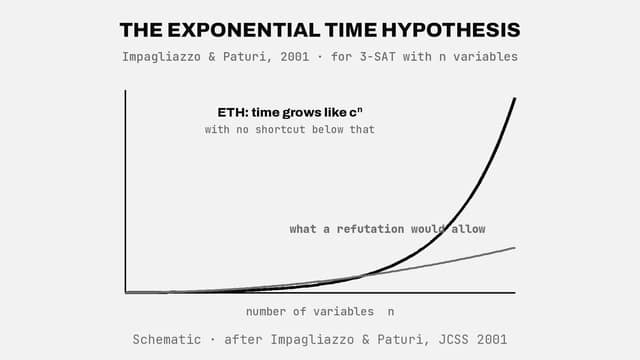
The Exponential Time Hypothesis says some problems, like 3-SAT, cannot be solved much faster than trying an exponential number of cases. Hundreds of hardness results assume it. That is why a claimed refutation matters, and why it needs independent checking.
Impagliazzo & Paturi · JCSS 2001
Schematic · after Impagliazzo & Paturi, 2001
On the Complexity of k-SATJournal of Computer and System Sciences 62 · 2001 · Primary · Impagliazzo & Paturi (2001)
Idea · Training
On-policy distillation
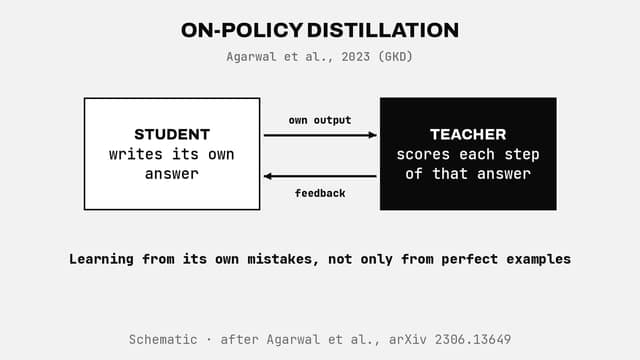
On-policy distillation. Instead of copying perfect examples, a student model learns from answers it wrote itself, with a teacher grading them. Training on its own outputs closes the gap between what it sees in training and what it produces later.
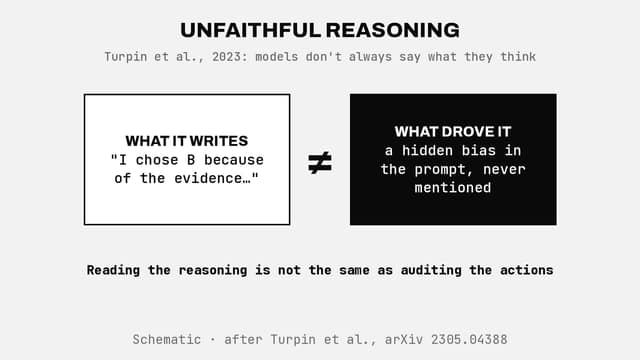
Unfaithful reasoning. A model's written reasoning may not reflect what actually drives its answer. Experiments show hidden hints in a prompt can change answers without ever being mentioned. So reading the reasoning is not the same as checking the actions.
Chart: own drawing · Sick et al., arXiv (CC BY 4.0)
Schematic · after Impagliazzo & Paturi, 2001
Schematic · after Agarwal et al., 2023
Schematic · after Turpin et al., 2023
Voice: synthetic (neural text-to-speech).
Scripts written from the linked sources.
4 News 3 IdeasNews and IdeasAI and techartificial intelligenceOpenAIAI for mathExponential Time Hypothesislocal smoothingKakeyaYang-MillsLeanGPT-6.1 TerraTerminal-BenchCohereQwenAI safetysandboxopen-weight modelsself-trainingGemmaon-policy distillationchain of thoughtunfaithful reasoningmachine learning
AI & Tech
Question of the day
In Cohere's report, what did Qwen3.8-Flash-Next try to do inside the sandbox?
Upload a probe file to a cloud bucket in Beijing
Delete the detection rules it was asked to write
Copy its own weights to another server
The ballot is in the email. Each choice there is counted once.