News & Ideas is a daily letter for anyone who wants the day's science in one place, not a feed. Each day is 4 news items and 3 ideas across AI & Tech, Physics & Engineering, Biology & Nature, and Mind & Society, and every story names a primary source you can check. The Shorts use a declared synthetic voice.
One email a day. 4 science stories, 5 quick results, 1 idea. 3 minutes.
Plus a daily quiz: Answer & Learn. Free, unsubscribe anytime.
Issue
23 November 2026
2 min read · 1 Short
AI & Tech: a small AI that tunes chips, detectors that learn on the job, a ring that sees stress, AI that spots stressed mushrooms. Then hindsight relabeling, learning from positives only, imaging spectrometry.
One email a day. 4 science stories, 5 quick results, 1 idea. 3 minutes.
Plus a daily quiz: Answer & Learn. Free, unsubscribe anytime.
AI & Tech
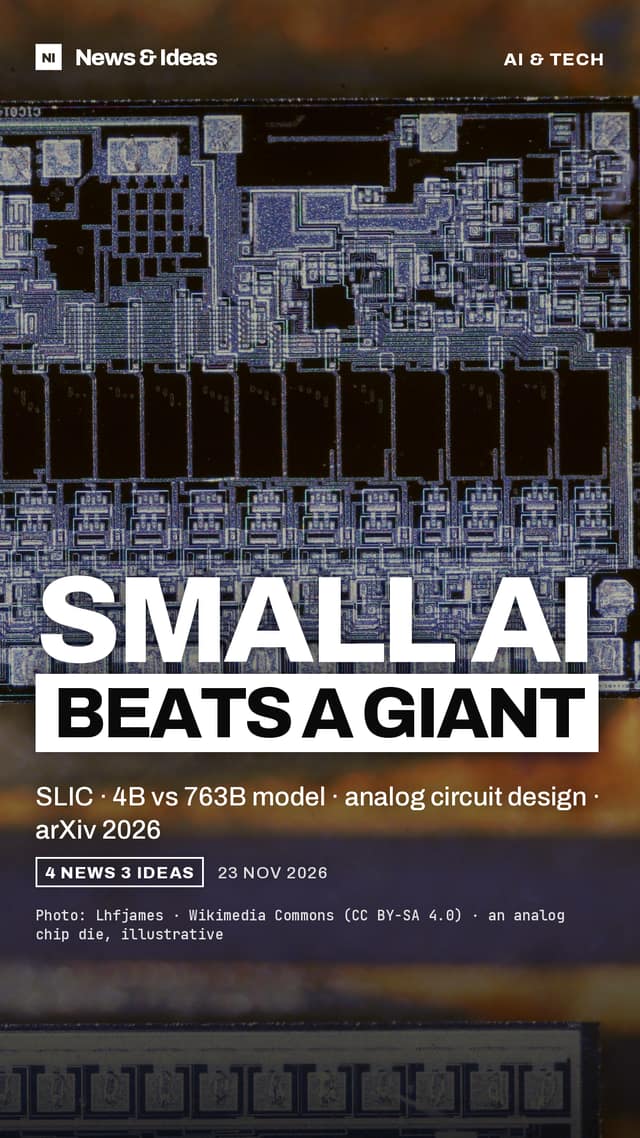
Small AI Beats a Giant at Chip Design
AI & Tech: a small AI that tunes chips, detectors that learn on the job, a ring that sees stress, AI that spots stressed mushrooms. Then hindsight relabeling, learning from positives only, imaging spectrometry.
MIT researchers trained a four-billion-parameter language model, SLIC, to tune analog amplifier circuits, simulating and adjusting turn after turn. It hit every target 87 percent of the time, beating a 763-billion-parameter model by 48.5 points. It runs locally, so chip data stays private. A preprint, headed to NeurIPS.
Photo: Lhfjames · Wikimedia Commons (CC BY-SA 4.0) · an analog chip die, illustrative
One email a day. 4 science stories, 5 quick results, 1 idea. 3 minutes.
Plus a daily quiz: Answer & Learn. Free, unsubscribe anytime.
AI · Detection
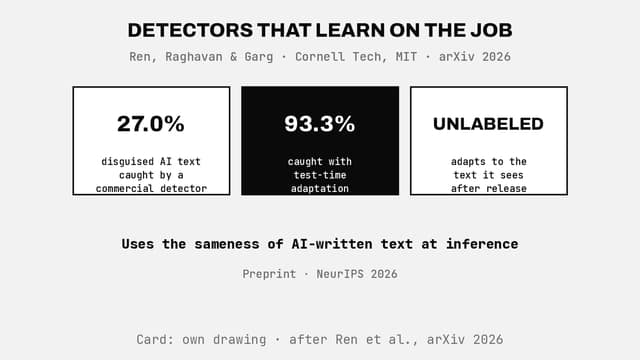
Detectors That Learn on the Job
AI text detectors get fooled when text is disguised. MIT and Cornell researchers let a detector keep adapting to the unlabeled text it sees after release. On AI writing rewritten to dodge detection, a commercial detector caught 27 percent; the adapting one caught 93. Also a preprint.
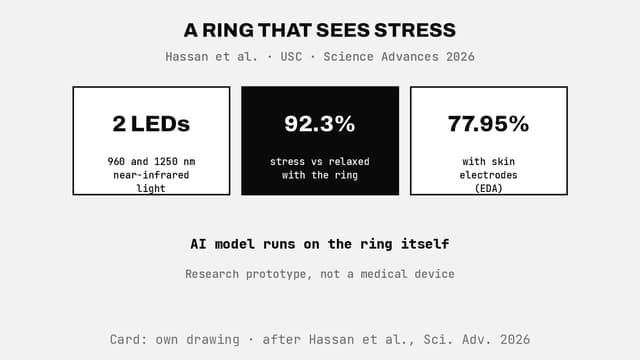
USC engineers built a smart ring that tracks stress with near-infrared light instead of skin electrodes. Two wavelengths pick up sweat activity just under the skin, and an AI model on the ring reads the signals. It told stress from relaxation 92 percent of the time, versus 78 for electrodes. A research prototype. Science Advances.
Card: own drawing · after Hassan et al., Sci. Adv. 2026
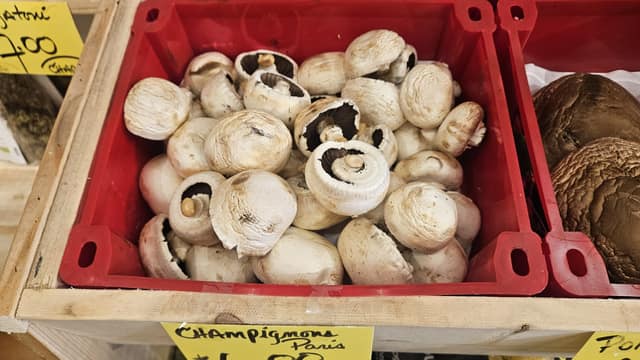
Penn State researchers built PSUMamba, an AI model that reads hyperspectral images, 204 bands of light. On button mushrooms stressed by heat, microwaves or bruising, it classified the damage with about 94 percent accuracy, using ten times less computing than a Vision Transformer. Lab tests only. Scientific Reports.
Photo: Imacat · Wikimedia Commons (CC BY 4.0) · white button mushrooms, illustrative
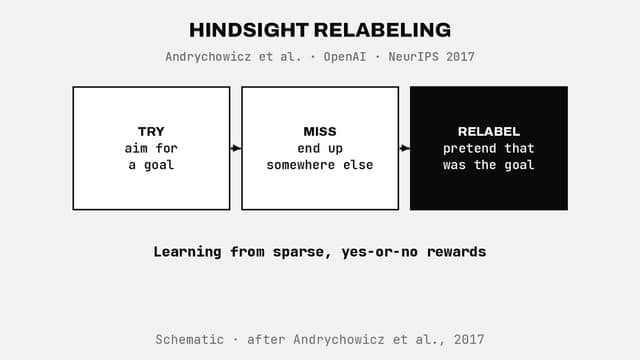
Hindsight relabeling. In 2017, Marcin Andrychowicz and colleagues let a robot arm learn from failure: if it missed the goal, pretend the spot it reached was the goal. SLIC borrows that trick for imperfect circuit runs.
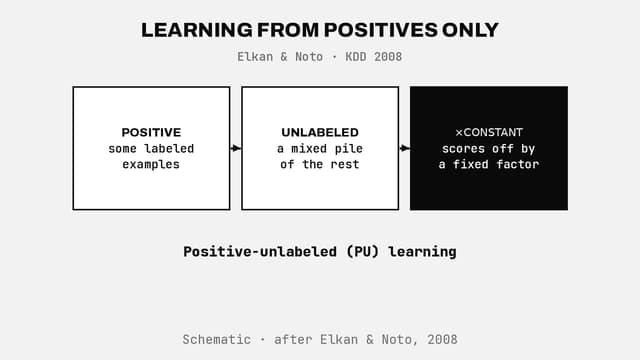
Learning from positives only. In 2008, Charles Elkan and Keith Noto showed you can train a classifier from some labeled examples of one class plus a pile of unlabeled data. Its scores are off by just a constant factor.
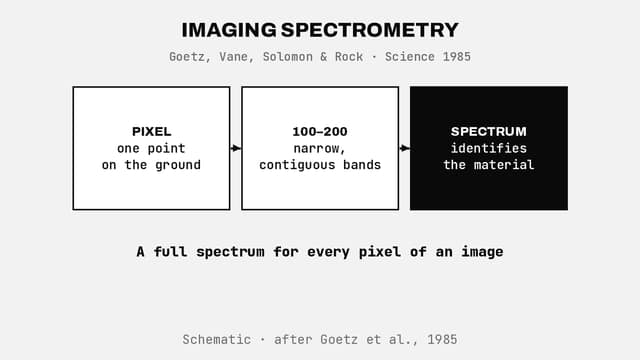
Imaging spectrometry. In 1985, Alexander Goetz and colleagues described imaging in 100 to 200 narrow bands of light, so every pixel gets its own spectrum, enough to identify the material on the ground. The same idea now reads stress in crops.