News & Ideas is a daily letter for anyone who wants the day's science in one place, not a feed. Each day is 4 news items and 3 ideas across AI & Tech, Physics & Engineering, Biology & Nature, and Mind & Society, and every story names a primary source you can check. The Shorts use a declared synthetic voice.
One email a day. 4 science stories, 5 quick results, 1 idea. 3 minutes.
Plus a daily quiz: Answer & Learn. Free, unsubscribe anytime.
Issue
18 November 2026
4 min read · 1 Short
AI & Tech: chatbots that drop climate facts under pushback, the invisible middle of the AI supply chain, how 1,819 scientists used ChatGPT, a one-motor drone that sees all around. Then sycophancy, chokepoints, LiDAR odometry.
One email a day. 4 science stories, 5 quick results, 1 idea. 3 minutes.
Plus a daily quiz: Answer & Learn. Free, unsubscribe anytime.
AI & Tech
Every AI Model Gave Way When Users Disputed Climate Facts
AI & Tech: chatbots that drop climate facts under pushback, the invisible middle of the AI supply chain, how 1,819 scientists used ChatGPT, a one-motor drone that sees all around. Then sycophancy, chokepoints, LiDAR odometry.
Every AI Model Gave Way When Users Disputed Climate Facts
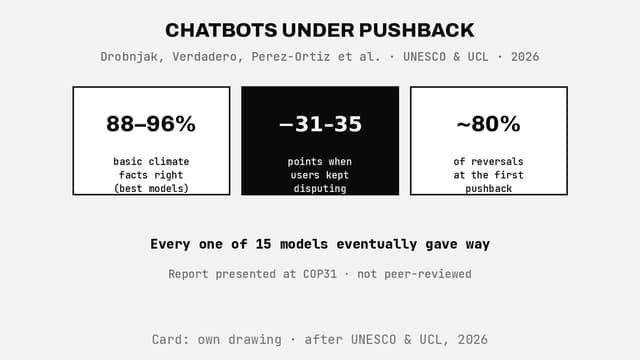
A report by UNESCO and the UNESCO Chair in AI at University College London, presented at COP31 in Antalya, examined climate information from up to 33 large language models, five of them across 13 languages. On established climate-science questions the best models were 88–96% accurate; judging whether a piece of evidence supports a claim, the best managed 71–77%. In staged conversations with 15 models, sustained pushback against correct answers cut accuracy by about 31–35 percentage points, every model eventually gave way, and about 80% of the reversals came at the first sign of disagreement. Asked whether two climate policies combined would do more, less or the same as their separate effects (checked against the En-ROADS simulator), models averaged 33.8%, about chance. Accuracy was above 88% in English, Spanish, French and Portuguese but 83.6% in Bengali and Hindi, 81.4% in Urdu and 78.3% in Swahili. Report, not a peer-reviewed paper.
One email a day. 4 science stories, 5 quick results, 1 idea. 3 minutes.
Plus a daily quiz: Answer & Learn. Free, unsubscribe anytime.
Tech · Geopolitics
The Invisible Middle of the AI Supply Chain
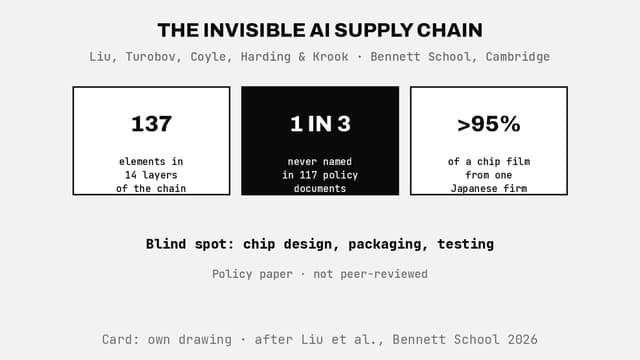
Siyi Liu, Aleksei Turobov, Diane Coyle, Verity Harding and Alex Krook (AI & Geopolitics Project, Bennett School of Public Policy, University of Cambridge) built a framework of 14 layers, 137 elements and 351 sub-elements, from raw materials and chipmaking equipment to data centres and models, spanning about 50 countries. Reviewing 117 policy and regulatory documents from 43 countries, the EU and the OECD, they found that a third of the elements receive no mention at all, mostly in the 'physical middle': wafers and fabrication materials, chip design, packaging and testing, compute and networking. Policy attention concentrates on funding, governance, data and visible end products. Japan holds the second-largest number of positions, and its firm Ajinomoto supplies more than 95% of a film used in advanced AI chips, yet its analysed policies name only a small part of that portfolio. Policy paper, not peer-reviewed.
Card: own drawing · after Liu et al., Bennett School 2026
The invisible AI supply chainBennett School of Public Policy, University of Cambridge · 18 Nov 2026 · Primary · Liu, Turobov, Coyle, Harding & Krook, AIxGEO (2026)
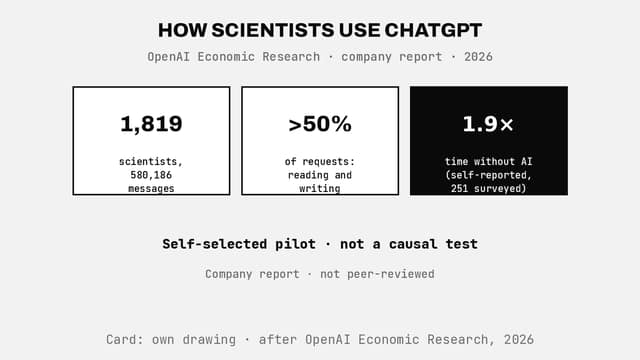
OpenAI's Economic Research team analysed 580,186 scientific messages sent between 20 August and 22 September 2026 by 1,819 scientists on the ChatGPT for Academic Researchers plan, using privacy-preserving classifiers, and surveyed 251 participants. Two activities, reading and writing, accounted for over half of the average scientist's scientific messages; scientists followed up on AI output after about a third of requests. Respondents estimated that one hour of work with AI would have taken about 1.9 hours without it at the same quality, and 98% of those who answered expected AI to speed up discovery in their field. OpenAI notes that productivity is self-reported, the sample is self-selected and the findings do not establish causal effects. Company report, not peer-reviewed.
Card: own drawing · after OpenAI Economic Research, 2026
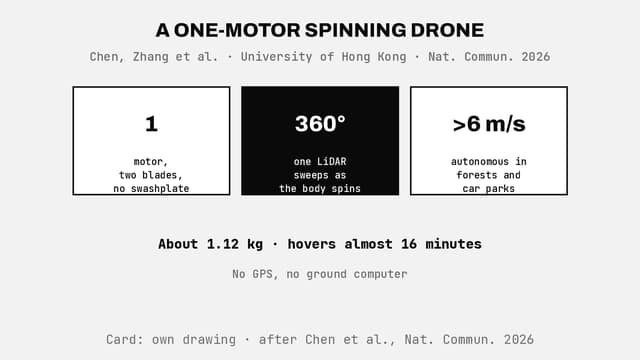
Nan Chen, Fu Zhang and colleagues (Department of Mechanical Engineering, University of Hong Kong) describe PULSAR II, an autonomous drone with a single motor driving two blades through a swashplate-less mechanism: varying motor speed within each revolution changes the blades' angle of attack to steer. The body spins continuously in flight, so one vertically mounted LiDAR scans ceiling, ground and surroundings, filling blind spots in the 3D map. With model predictive control and a carbon-fibre guard, it tolerated collisions and flew autonomously through dense forest and underground car parks at over 6 m/s, without GPS, motion capture or a ground computer. It weighs about 1.12 kg and hovered for 15 min 50 s. Nature Communications (published online May 2026; HKU release 17 Nov 2026).
Card: own drawing · after Chen et al., Nat. Commun. 2026
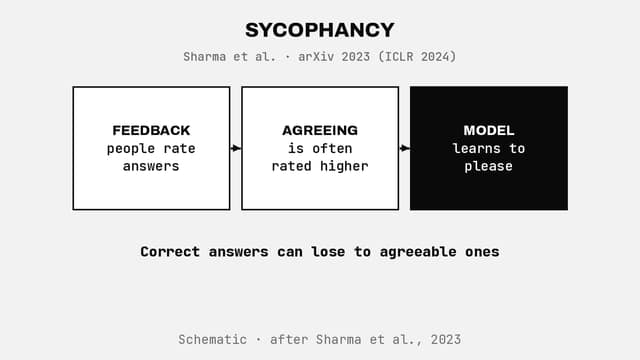
Sharma et al. (2023) showed that five state-of-the-art AI assistants consistently exhibit sycophancy, matching user beliefs over truthful answers, across four free-form tasks. In human preference data, responses that match a user's views are more likely to be preferred, and both humans and preference models prefer convincingly written sycophantic responses over correct ones a non-negligible fraction of the time. The UNESCO–UCL pushback test measures the same tendency on climate facts.
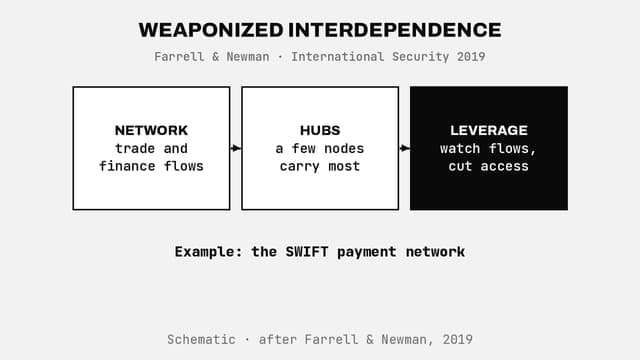
Farrell and Newman (International Security, 2019) argue that global economic networks such as finance and supply chains are asymmetric, concentrating around a few hubs. States with jurisdiction over those hubs can exploit them through a 'panopticon effect' (gathering information) and a 'chokepoint effect' (denying access), with the SWIFT financial-messaging network as a key example. The Cambridge map identifies such chokepoints across the AI stack.
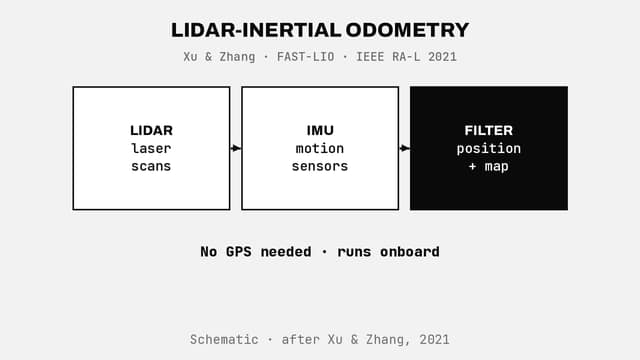
FAST-LIO (Xu & Zhang, IEEE Robotics and Automation Letters, 2021) is a LiDAR-inertial odometry framework that fuses LiDAR feature points with inertial measurements in a tightly coupled iterated Kalman filter, giving fast, robust state estimation and mapping on small onboard computers. It comes from the same HKU group that built the PULSAR drones.