News & Ideas is a daily letter for anyone who wants the day's science in one place, not a feed. Each day is 4 news items and 3 ideas across AI & Tech, Physics & Engineering, Biology & Nature, and Mind & Society, and every story names a primary source you can check. The Shorts use a declared synthetic voice.
One email a day. 4 science stories, 5 quick results, 1 idea. 3 minutes.
Plus a daily quiz: Answer & Learn. Free, unsubscribe anytime.
Issue
16 November 2026
4 min read · 1 Short
AI & Tech: agents that work with a short memory, Italy's €805M fine on Meta, a curved bionic eye, self-taught AI for particle jets. Then the KV cache, state space models, event cameras.
One email a day. 4 science stories, 5 quick results, 1 idea. 3 minutes.
Plus a daily quiz: Answer & Learn. Free, unsubscribe anytime.
AI & Tech
AI Agents Barely Need Long Context
AI & Tech: agents that work with a short memory, Italy's €805M fine on Meta, a curved bionic eye, self-taught AI for particle jets. Then the KV cache, state space models, event cameras.
NVIDIA researchers tested whether language-model agents really need long contexts. Generating later tokens costs more than earlier ones; on frontier open-weight models served on H100 GPUs the gap can reach about 7x. Using frequent compaction, where the model rewrites its history into a short task-relevant summary, they report little to no loss of accuracy across long-horizon and long-input tasks. In the most extreme setting, compaction after every single action, Claude Opus 4.5 scored 70.2% on SWE-bench Verified versus 70.0% with full history (median peak context about 8K instead of 32K tokens), while GPT 5.6 Sol dropped 2.0 points (82.4% vs 84.4%). The authors propose 'semantic state space models' and argue the case for long-context models is weaker than assumed, while not ruling out tasks that benefit from long context. arXiv technical report, not peer-reviewed.
Photo: Carl Lender · Wikimedia Commons (CC BY 2.0) · server racks; illustrative
You don't need long contextarXiv (NVIDIA technical report, not peer-reviewed) · 3 Nov 2026 · Primary · Belcak, Muralidharan et al. (NVIDIA), arXiv 2611.05306 (2026)
One email a day. 4 science stories, 5 quick results, 1 idea. 3 minutes.
Plus a daily quiz: Answer & Learn. Free, unsubscribe anytime.
Tech · Privacy
Italy Fines Meta €805 Million Over Phone Galleries
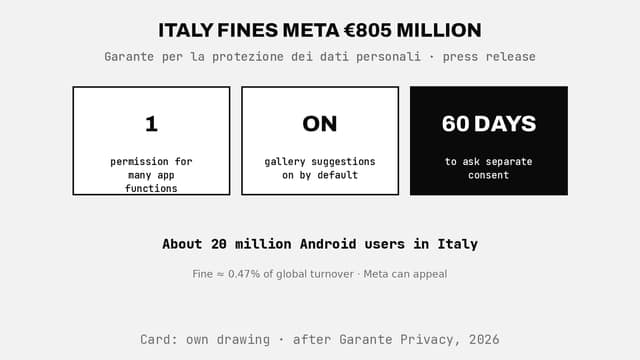
Italy's data protection authority (Garante per la protezione dei dati personali) fined Meta Platforms Ireland €805 million. Through the Facebook app for Android, the feature 'Get suggestions from gallery when browsing Facebook', available since 2023, accessed photos, videos and metadata on users' phones without specific consent or adequate information: gallery access was requested through a single permission valid for many app functions, after a generic notice, and the feature was on by default. The authority applied the Italian rule implementing the EU ePrivacy directive and rejected Meta's claim that the Irish authority was competent. Within 60 days Meta must ask for separate, specific consent and keep the feature off by default. The fine, about 0.47% of global turnover, reflects about 20 million Android users in Italy, a 2019 precedent and poor cooperation. The case did not cover AI training, which Meta denies. Regulatory decision; Meta can appeal.
Card: own drawing · after Garante Privacy press release, 2026
A team led by Fan Zhiyong at the Hong Kong University of Science and Technology built a bionic eye around a hemispherical 'tandem' artificial retina, made with a 3D laser fabrication process on a curved surface. The sensor has 367,500 pixels at 1,905 pixels per inch (their 2020 device had 100), full-colour response from 300 to 800 nm and an aberration-corrected field of view above 160 degrees. Its tandem layers also detect motion inside the sensor: compared with frame-based imaging, this cut bandwidth demand by over 99.95% in the tested tasks, with 98.6% motion-recognition accuracy. Nature Materials (2026).
Photo: Matt Ming · Wikimedia Commons (CC BY 2.0) · human eye; illustrative
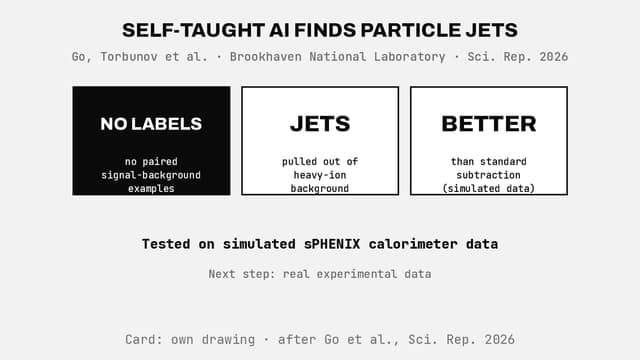
Researchers led by Brookhaven National Laboratory, with Columbia University and the University of Colorado Boulder, built an unsupervised, unpaired image-to-image neural network (based on cycle consistency) that splits calorimeter 'images' of heavy-ion collisions into jet signal and background, without paired signal-background training examples, which cannot be obtained from real experiments. On simulated sPHENIX calorimeter data it outperformed conventional subtraction methods in fidelity, especially for larger jets, and kept high fidelity on a more realistic, modified-jet test it was not trained on. Tested on simulations only; the team plans to apply it to real sPHENIX data. Scientific Reports, open access (CC BY 4.0).
Card: own drawing · after Go et al., Sci. Rep. 2026
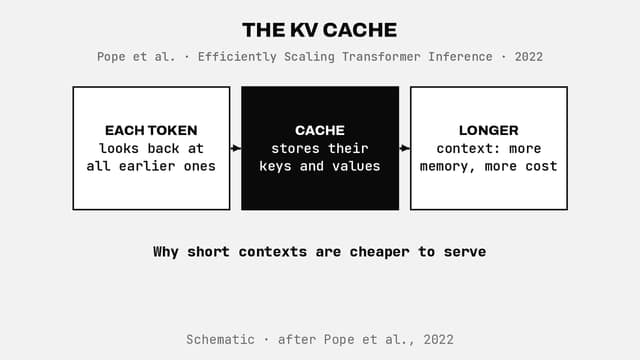
Transformers generate text one token at a time, and each new token attends to all previous ones. To avoid recomputing, inference stores each earlier token's attention keys and values in a KV cache. Its memory grows linearly with context length and so does the attention work per new token, which is why serving long contexts is slower and costlier; Pope and colleagues analyse these trade-offs for large-model inference. It is the cost that NVIDIA's compaction study tries to avoid.
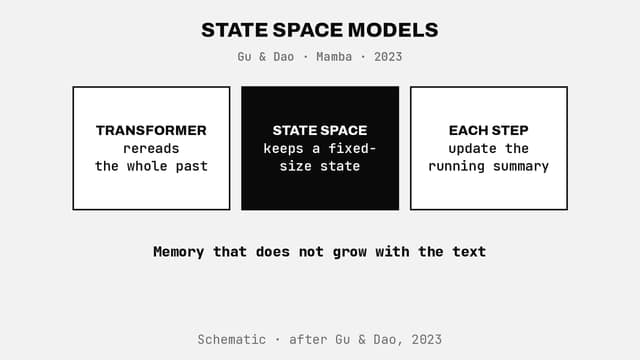
State space models process a sequence by updating a fixed-size hidden state at each step, so memory does not grow with the length of the text. Gu and Dao's Mamba (2023) added input-dependent 'selective' state updates and reported language-modelling quality competitive with transformers, with linear-time scaling. NVIDIA's report uses the idea as an analogy: 'semantic state space models' carry a compact text summary between actions.
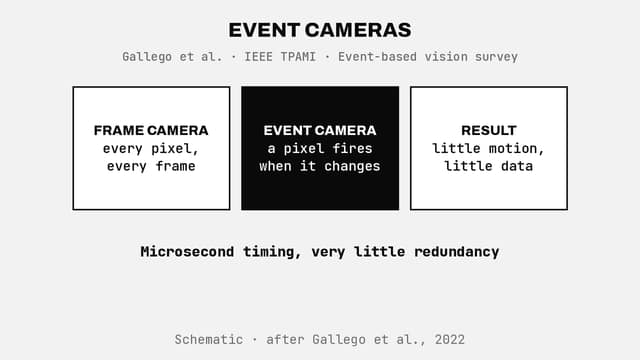
Event cameras are bio-inspired sensors: each pixel works independently and outputs an 'event' only when its brightness changes, with timing in the order of microseconds, high dynamic range and low power. A static scene produces almost no data. Gallego and colleagues' survey describes the principle and applications; the HKUST bionic eye uses a related in-sensor, event-driven approach to motion detection.
Gallego et al. · IEEE TPAMI
Schematic · after Gallego et al., 2022
Event-Based Vision: A SurveyIEEE Transactions on Pattern Analysis and Machine Intelligence · 1 Jan 2022 · Primary · Gallego et al., IEEE TPAMI 44, 154 (2022)
Credits
Photo: Carl Lender · Wikimedia Commons (CC BY 2.0) · server racks; illustrative
Card: own drawing · after Garante Privacy press release, 2026
Photo: Matt Ming · Wikimedia Commons (CC BY 2.0) · human eye; illustrative
Card: own drawing · after Go et al., Sci. Rep. 2026
Schematic · after Pope et al., 2022
Schematic · after Gu & Dao, 2023
Schematic · after Gallego et al., 2022
Voice: synthetic (neural text-to-speech).
Scripts written from the linked sources.
News and Ideas4 News 3 IdeasscienceresearchAI & TechAI agentslong contextcontext compactionNVIDIAKV cachestate space modelsMambaMetaprivacyGDPRbionic eyeevent camerasparticle physicsmachine learning
AI & Tech
Question of the day
Under Italy's ruling, what must Meta do within 60 days?
Delete all users' photos
Ask separate consent for gallery suggestions
Remove Facebook from Android
The ballot is in the email. Each choice there is counted once.