News & Ideas is a daily letter for anyone who wants the day's science in one place, not a feed. Each day is 4 news items and 3 ideas across AI & Tech, Physics & Engineering, Biology & Nature, and Mind & Society, and every story names a primary source you can check. The Shorts use a declared synthetic voice.
One email a day. 4 science stories, 5 quick results, 1 idea. 3 minutes.
Plus a daily quiz: Answer & Learn. Free, unsubscribe anytime.
Issue
22 November 2026
2 min read · 1 Short
AI & Tech: AI agents that order like humans, one sensor for nine touch points, fine-tuning with less memory, a robot lab that learns. Then the beer game, light in a loop, trading compute for memory.
One email a day. 4 science stories, 5 quick results, 1 idea. 3 minutes.
Plus a daily quiz: Answer & Learn. Free, unsubscribe anytime.
AI & Tech
AI Agents That Order Like Humans
AI & Tech: AI agents that order like humans, one sensor for nine touch points, fine-tuning with less memory, a robot lab that learns. Then the beer game, light in a loop, trading compute for memory.
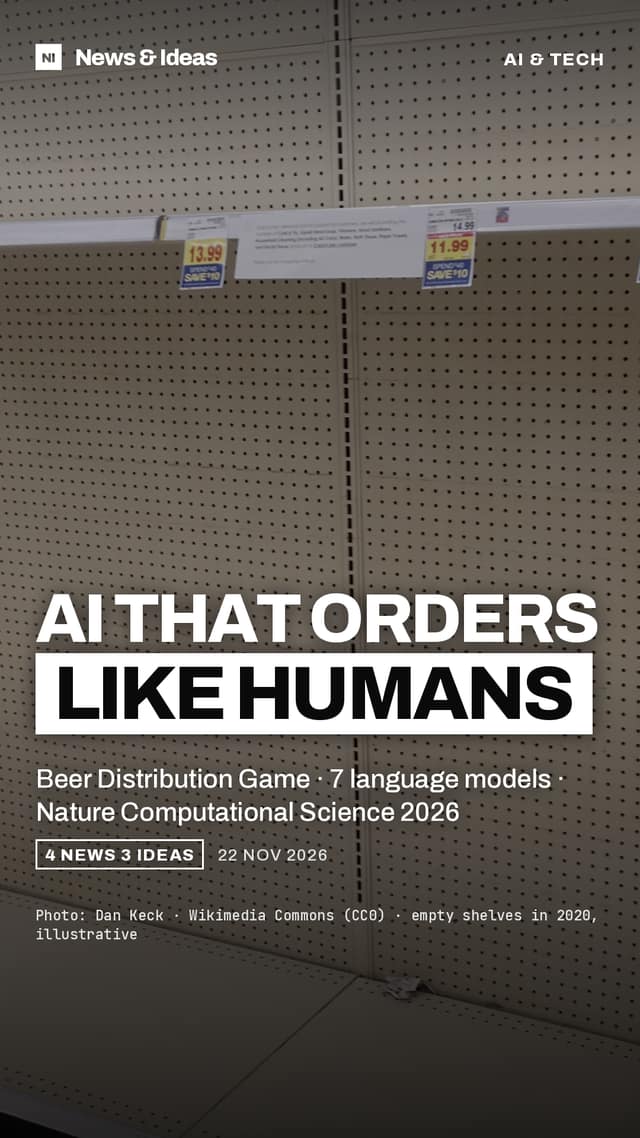
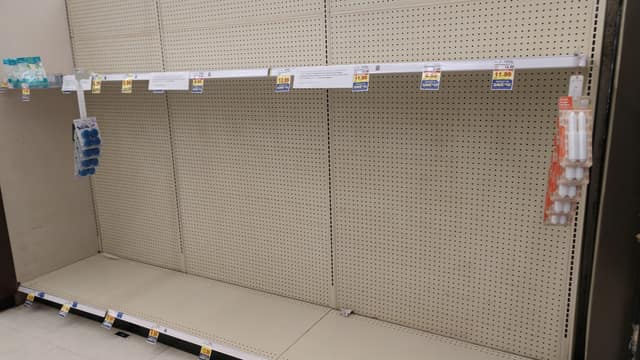
Northeastern researchers had agents from seven language models play the beer game, a supply chain where every order ripples down the line. On their own, the agents reproduced the chaos, but not its size or timing. Given a plain description of how people decide, every model moved closer to real players. Published in Nature Computational Science.
Photo: Dan Keck · Wikimedia Commons (CC0) · empty shelves in 2020, illustrative
One email a day. 4 science stories, 5 quick results, 1 idea. 3 minutes.
Plus a daily quiz: Answer & Learn. Free, unsubscribe anytime.
Tech · Sensors
One Sensor, Nine Touch Points
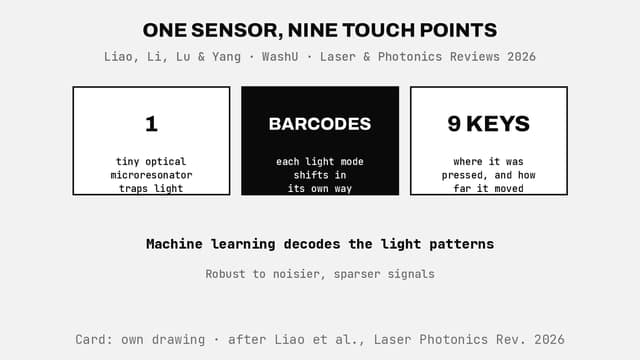
Engineers at Washington University in St. Louis trapped light inside one tiny device, an optical microresonator. Each light mode shifts in its own way when the surface moves, like an optical barcode. Machine learning decodes it, so one sensor told where a nine-key pad was pressed, and how far it moved. Published in Laser and Photonics Reviews.
Card: own drawing · after Liao et al., Laser Photonics Rev. 2026
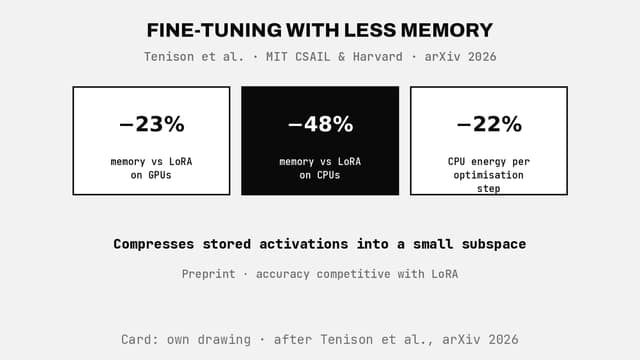
MIT and Harvard researchers tackled a hidden memory cost in fine-tuning language models: stored activations. Their method, LARS, squeezes them into a small subspace, cutting memory versus LoRA by 23 percent on GPUs and about 48 percent on CPUs. An arXiv preprint.
Card: own drawing · after Tenison et al., arXiv 2026
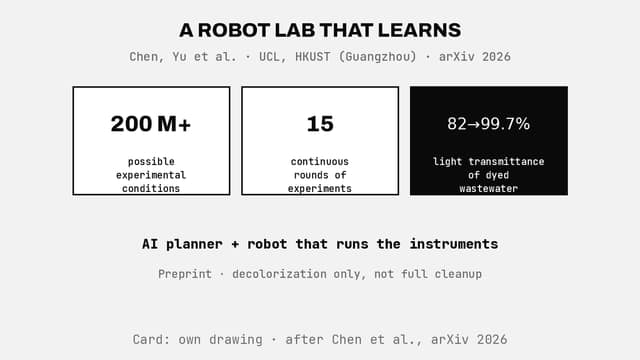
A team from UCL and HKUST Guangzhou linked an AI planner, using Bayesian optimization, to a robot that runs the instruments. Asked to clean dyed wastewater, it searched over 200 million possible conditions. In 15 rounds, light transmission rose from 82 to 99.7 percent. A preprint, and decolorizing isn't a full cleanup.
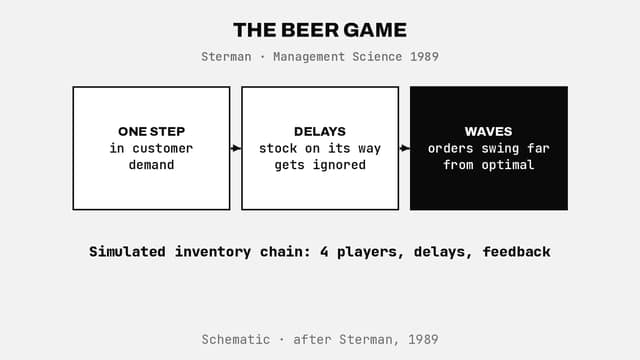
The beer game. In 1989, John Sterman had people run a simulated beer distribution chain with delays. A single step in customer demand set off big swings, because players kept underweighting the stock already on its way.
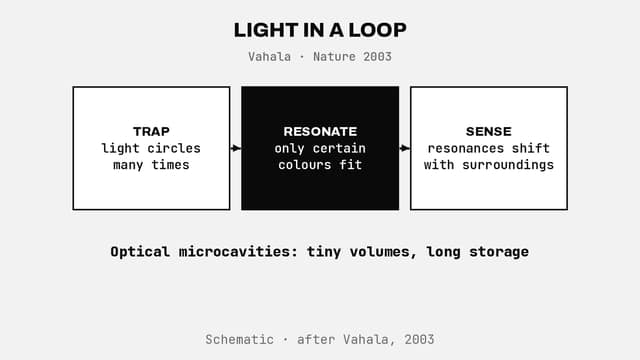
Light in a loop. Optical microcavities, reviewed by Kerry Vahala in 2003, trap light so it circles many times in a tiny space. Only certain colors resonate, and they shift when the surroundings change.
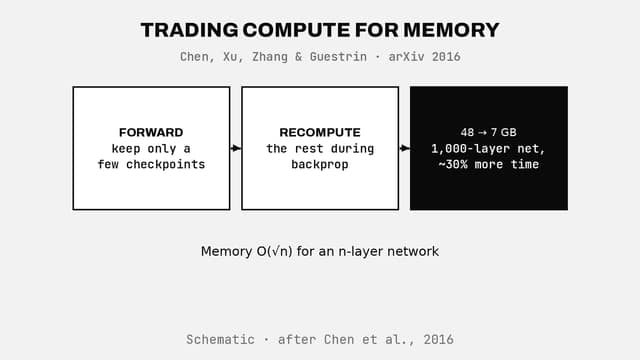
Trading compute for memory. In 2016, Tianqi Chen and colleagues showed a deep network can train without storing every intermediate result: keep checkpoints, recompute the rest. One 1,000-layer network fell from 48 to 7 gigabytes.