News & Ideas is a daily letter for anyone who wants the day's science in one place, not a feed. Each day is 4 news items and 3 ideas across AI & Tech, Physics & Engineering, Biology & Nature, and Mind & Society, and every story names a primary source you can check. The Shorts use a declared synthetic voice.
One email a day. 4 science stories, 5 quick results, 1 idea. 3 minutes.
Plus a daily quiz: Answer & Learn. Free, unsubscribe anytime.
Issue
27 November 2026
2 min read · 1 Short
AI & Tech: night vision without the vacuum tube, a crane that runs itself, a screen that holds an image without power, AI that extrapolates. Then the Kalman filter, covariate shift, phase-change memory.
One email a day. 4 science stories, 5 quick results, 1 idea. 3 minutes.
Plus a daily quiz: Answer & Learn. Free, unsubscribe anytime.
AI & Tech
Night Vision, 10,000 Times Thinner
AI & Tech: night vision without the vacuum tube, a crane that runs itself, a screen that holds an image without power, AI that extrapolates. Then the Kalman filter, covariate shift, phase-change memory.
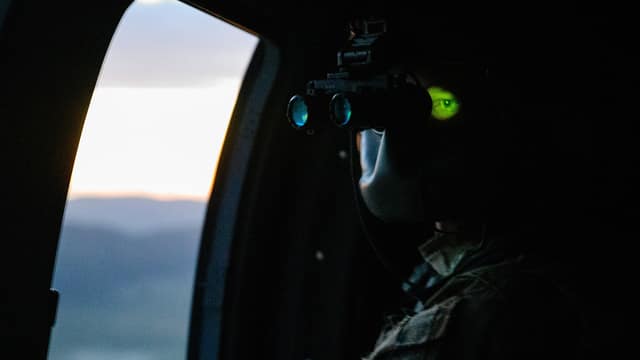
Night vision goggles amplify light with a vacuum tube a few inches long. A University of Washington team replaced it with a solid-state device a few micrometers thick. It made an amber LED shine over 17,000 times brighter than the faint infrared hitting it, on less voltage than two AA batteries.
Photo: Sgt. 1st Class Garrick Morgenweck, U.S. Army · Wikimedia Commons (public domain) · today’s night vision goggles, illustrative
One email a day. 4 science stories, 5 quick results, 1 idea. 3 minutes.
Plus a daily quiz: Answer & Learn. Free, unsubscribe anytime.
Robotics · Ports
A Crane That Runs Itself
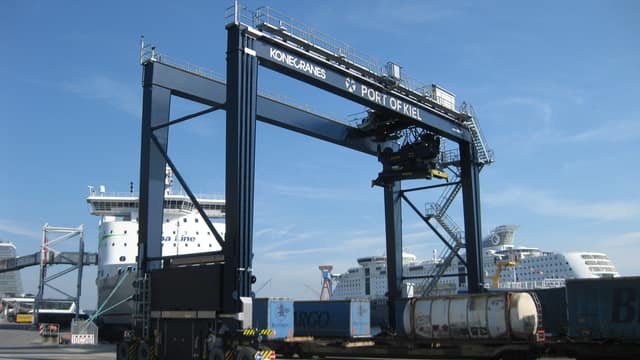
Stacking containers takes centimeter precision with a heavy, swaying load. Researchers in China built Autane, which drives existing port cranes using lidar, cameras, satellite positioning and live mapping. Deployed in several ports, it runs full days and has handled more than two million standard containers.
Photo: KarleHorn · Wikimedia Commons (CC BY 3.0) · a container gantry crane, Port of Kiel, illustrative
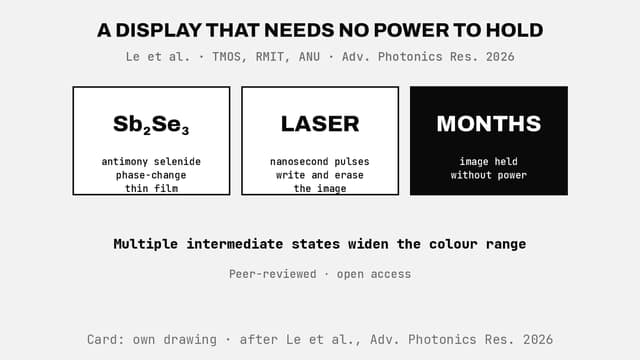
Your phone needs power just to keep an image on screen. Australian researchers built a reflective display from antimony selenide, a phase-change material. Laser pulses switch it between ordered and disordered states, and states in between for more colors. Images lasted months without power, and could be rewritten.
Card: own drawing · after Le et al., Adv. Photonics Res. 2026
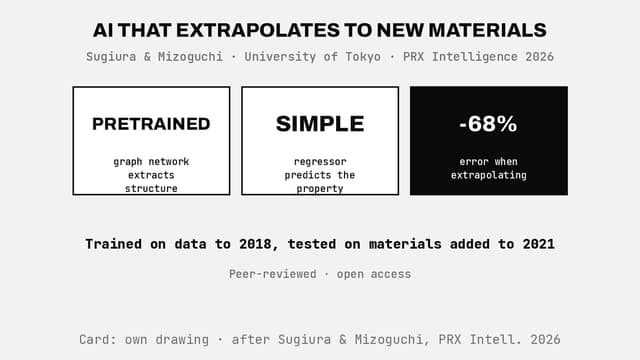
Machine learning interpolates well, but new materials sit outside the training data. A University of Tokyo team split the job: a pretrained graph network describes the structure, and a simple regressor predicts the property. In a tough extrapolation test, error fell 68 percent versus a standard end-to-end network.
Card: own drawing · after Sugiura & Mizoguchi, PRX Intell. 2026
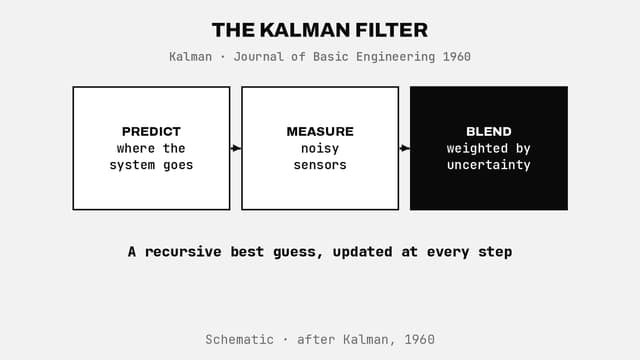
The Kalman filter. In 1960, Rudolf Kalman described a recursive way to track a moving system from noisy measurements: predict, measure, then blend the two, weighted by how uncertain each is. It became a standard tool for fusing sensors in navigation and robotics.
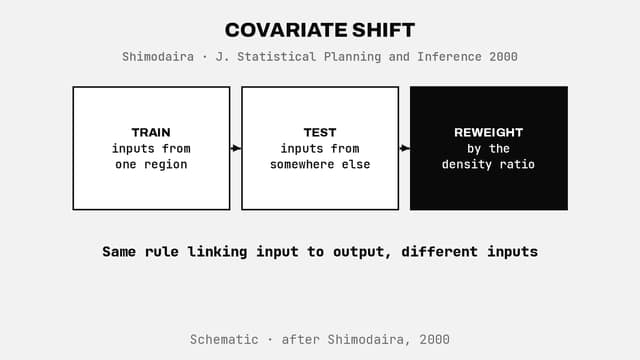
Covariate shift. In 2000, Hidetoshi Shimodaira studied what happens when test inputs come from a different region than training inputs, while the input-output rule stays the same. His fix: reweight training examples toward the new distribution. New materials are exactly that kind of shift.
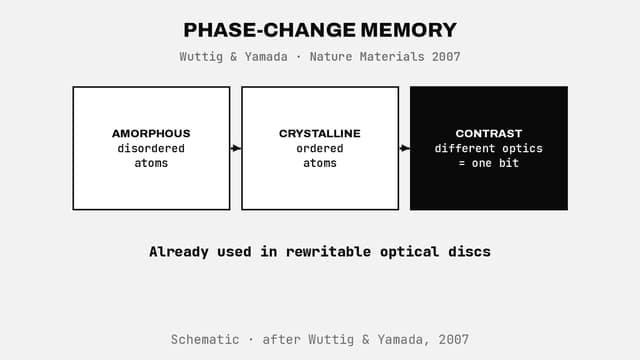
Phase-change memory. In a 2007 review, Matthias Wuttig and Noboru Yamada explained how some alloys flip fast between a disordered state and an ordered crystal, with very different optics. That contrast stores bits, already used in rewritable optical discs. The new display paints with it.