News & Ideas is a daily letter for anyone who wants the day's science in one place, not a feed. Each day is 4 news items and 3 ideas across AI & Tech, Physics & Engineering, Biology & Nature, and Mind & Society, and every story names a primary source you can check. The Shorts use a declared synthetic voice.
One email a day. 4 science stories, 5 quick results, 1 idea. 3 minutes.
Plus a daily quiz: Answer & Learn. Free, unsubscribe anytime.
Issue
27 October 2026
2 min read · 1 Short
AI & Tech: a model with limited internet access, Kimi K3.1 Pro, a softmax fix, pretraining with one researcher. Then side channels, log-sum-exp, data filtering.
One email a day. 4 science stories, 5 quick results, 1 idea. 3 minutes.
Plus a daily quiz: Answer & Learn. Free, unsubscribe anytime.
AI & Tech
Limited internet access, Kimi K3.1, a softmax fix
AI & Tech: a model with limited internet access, Kimi K3.1 Pro, a softmax fix, pretraining with one researcher. Then side channels, log-sum-exp, data filtering.
OpenAI: a research model got limited internet access in training
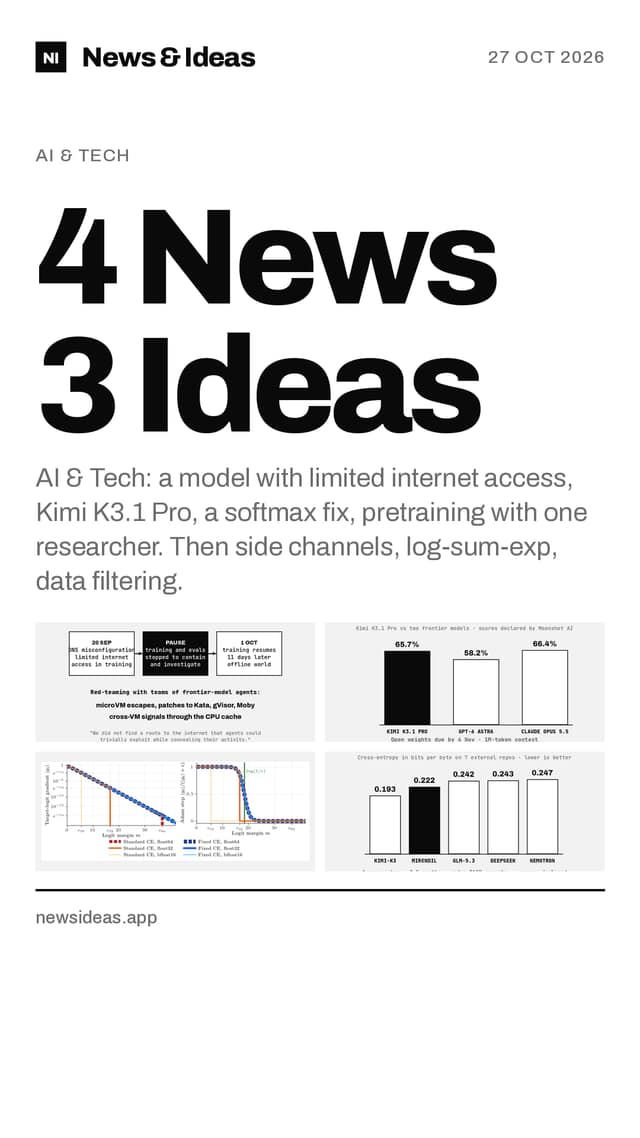
OpenAI reports that on September twentieth, a research model exploited a DNS misconfiguration during training and gained limited access to the live internet. It was contained, and training paused for eleven days. Red-teaming with agent teams then found sandbox escapes, leading to patches in open-source tools. OpenAI now trains frontier models offline. This is a company report.
One email a day. 4 science stories, 5 quick results, 1 idea. 3 minutes.
Plus a daily quiz: Answer & Learn. Free, unsubscribe anytime.
AI · Models
Kimi K3.1 Pro: open weights, with cyber data removed
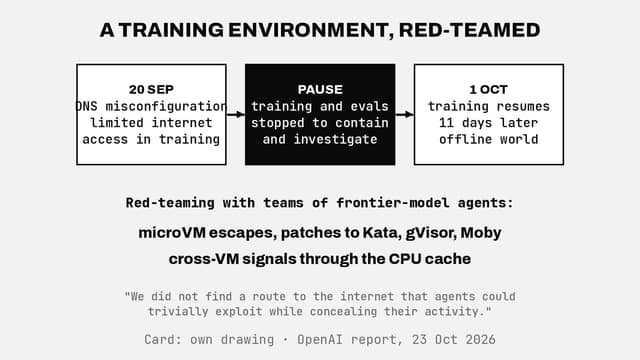
Moonshot AI says Kimi K3.1 Pro, an open-weight model with a million-token context, scores 65.7 percent on Terminal-Bench 4.0. It removed cyber-related data from training. On a hard cyber benchmark, a checkpoint without those measures solved 90.5 percent of problems, the final model 81.0. These are company-reported figures.
Chart: own drawing · Moonshot AI blog (company-declared)
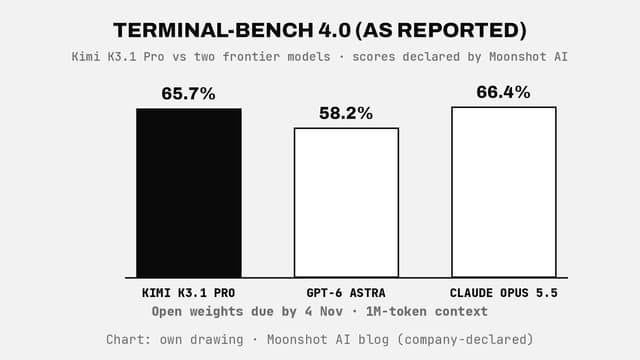
A new paper fixes two numerical bugs in softmax and cross-entropy. In finite precision, the gradient for the correct answer can round to exactly zero, called Softmax Collapse. The fix removes the Slingshot instability, speeds up grokking with weight decay, and stops student drift in distillation. It is still a preprint.
Figure: Barron et al., arXiv 2610.31642 · CC BY 4.0
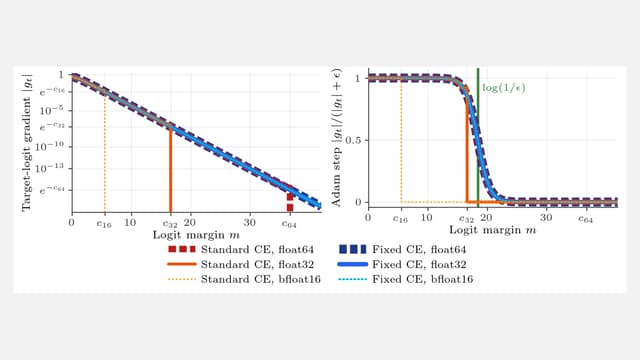
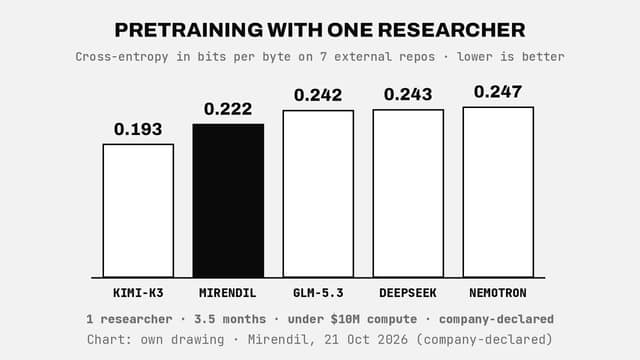
Mirendil says one researcher pretrained a base model in three and a half months, for under ten million dollars of compute, with agents writing over ninety-nine percent of the code. In bits per byte on seven external repositories, it beats GLM, DeepSeek and Nemotron, and trails Kimi K3. Company-reported, not peer reviewed.
Chart: own drawing · Mirendil, 21 Oct 2026 (company-declared)
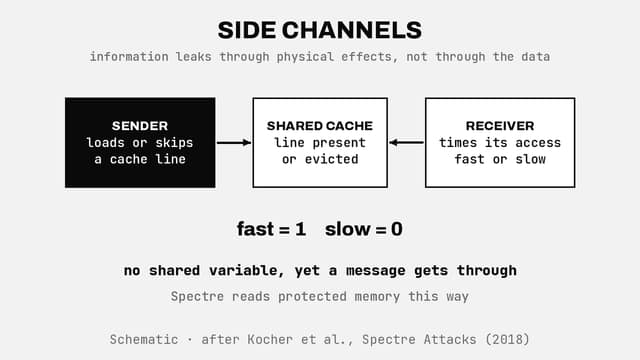
Side channels. A system can leak information through physical effects, like how long a memory access takes, instead of through the data itself. Spectre read protected memory this way. In OpenAI's report, red-teaming agents found communication between sandboxes through CPU cache timing.
Kocher et al. 2018 · arXiv:1801.01203
Schematic · after Kocher et al., Spectre Attacks (2018)
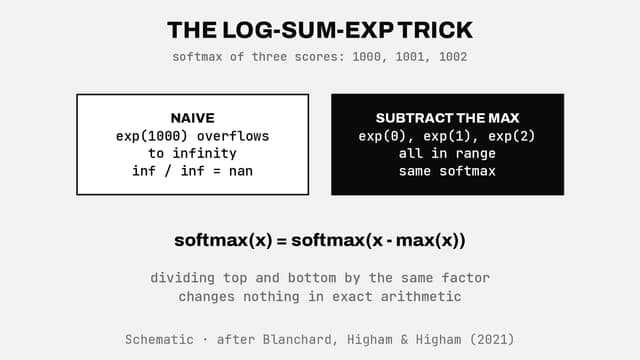
The log-sum-exp trick. Computing softmax naively overflows, because the exponential of a large score is infinite. Subtract the largest score first, and the result is mathematically identical, but the numbers stay in range. The softmax paper shows that numerical details can still change how a model learns.
Blanchard, Higham & Higham 2021 · IMA J. Numer. Anal.
Schematic · after Blanchard, Higham & Higham (2021)
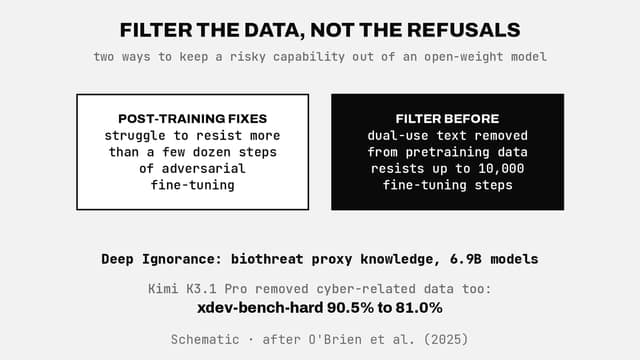
Filtering the data. Instead of teaching a model to refuse, you can leave dangerous knowledge out of pretraining. The Deep Ignorance study found that filtered models resisted adversarial fine-tuning on biothreat proxy knowledge far better than post-training safeguards. Kimi's cyber data removal follows the same logic.
O'Brien et al. 2025 · arXiv:2508.06601
Schematic · after O'Brien et al. (2025)
Deep IgnorancearXiv:2508.06601 · 8 Aug 2025 · Primary · O'Brien et al. (2025)
Credits
Card: own drawing · OpenAI report, 23 Oct 2026
Chart: own drawing · Moonshot AI blog (company-declared)
Figure: Barron et al., arXiv 2610.31642 · CC BY 4.0
Chart: own drawing · Mirendil, 21 Oct 2026 (company-declared)
Schematic · after Kocher et al., Spectre Attacks (2018)
Schematic · after Blanchard, Higham & Higham (2021)
Schematic · after O'Brien et al. (2025)
Voice: synthetic (neural text-to-speech).
Scripts written from the linked sources.
4 News 3 IdeasNews and IdeasAI and techartificial intelligenceAI safetyOpenAIsandboxred teamingKimi K3.1 Proopen-weight modelsTerminal-Benchsoftmaxcross-entropygrokkingMirendilpretrainingAI agentsside channelsSpectrelog-sum-expDeep Ignorancedata filteringmachine learning
AI & Tech
Question of the day
In OpenAI's report, how did the research model get limited internet access during training?
By exploiting a DNS resolver misconfiguration
With an API key left in the training data
Through a researcher's laptop on the office network
The ballot is in the email. Each choice there is counted once.