News & Ideas is a daily letter for anyone who wants the day's science in one place, not a feed. Each day is 4 news items and 3 ideas across AI & Tech, Physics & Engineering, Biology & Nature, and Mind & Society, and every story names a primary source you can check. The Shorts use a declared synthetic voice.
One email a day. 4 science stories, 5 quick results, 1 idea. 3 minutes.
Plus a daily quiz: Answer & Learn. Free, unsubscribe anytime.
Issue
27 October 2026
2 min read · 1 Short
Mind & Society: the neuroscience and AI bridge, challenged beliefs, dominance and sexual intent, the self bias. Then motivated reasoning, error management, self-prioritization.
One email a day. 4 science stories, 5 quick results, 1 idea. 3 minutes.
Plus a daily quiz: Answer & Learn. Free, unsubscribe anytime.
Mind & Society
Neuroscience and AI, beliefs, the me-first bias
Mind & Society: the neuroscience and AI bridge, challenged beliefs, dominance and sexual intent, the self bias. Then motivated reasoning, error management, self-prioritization.
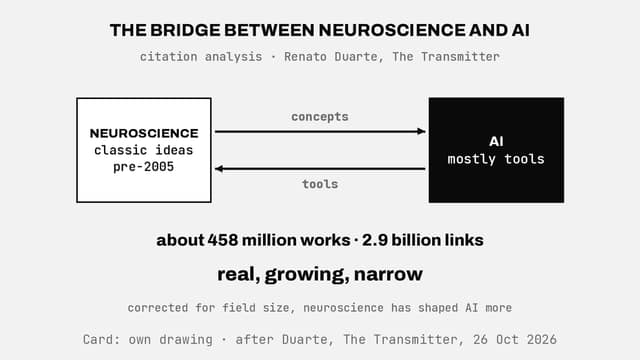
A citation analysis of about 458 million works and 2.9 billion links finds the bridge between neuroscience and AI is real and growing, but narrow. Most of what flows from AI to neuroscience is tools. What flows back are classic concepts, mostly assembled before 2005. Corrected for field size, neuroscience has influenced AI more than the reverse. An essay in The Transmitter.
Card: own drawing · after Duarte, The Transmitter 2026
One email a day. 4 science stories, 5 quick results, 1 idea. 3 minutes.
Plus a daily quiz: Answer & Learn. Free, unsubscribe anytime.
Mind · Beliefs
Challenging political beliefs engages the self-reflection network
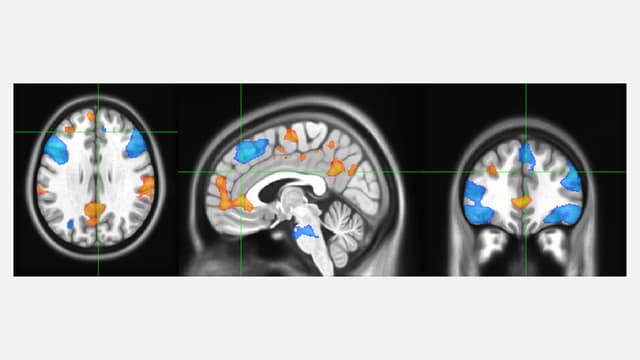
In an fMRI study, forty-three strongly left-wing Polish adults faced counterarguments. Factual belief ratings fell from 6.13 to 5.37, but political ones barely moved, 5.72 to 5.68. Political challenges also activated the default mode network, tied to self-reflection. It replicates a 2016 American study. Published in Scientific Reports in January.
Figure: Kossowska et al., Sci. Rep. 2026 · CC BY-NC-ND 4.0
Dominance motivation and perceived sexual interest
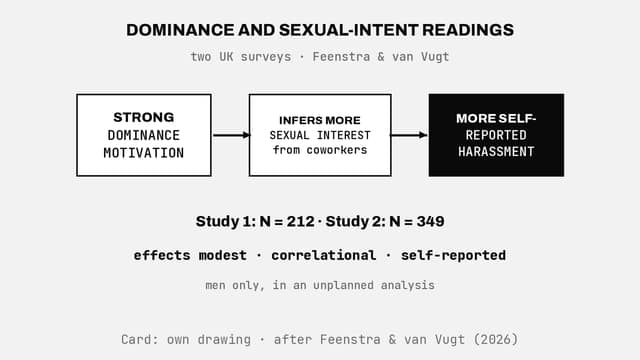
Two UK surveys, with 212 and 349 people, link a strong desire for dominance to inferring more sexual interest from colleagues' behavior, and that to more self-reported harassment. The effects are modest, the data are self-reported, and the design is correlational. Published in Social Psychological and Personality Science.
Card: own drawing · after Feenstra & van Vugt (2026)
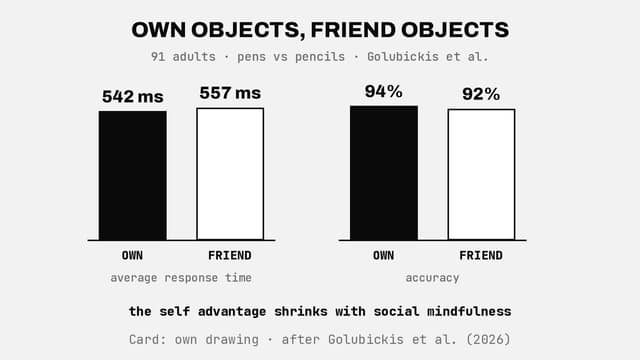
Ninety-one adults responded to pens and pencils labelled as their own or a friend's. Own objects were faster, 542 versus 557 milliseconds, and slightly more accurate. People higher in social mindfulness showed a smaller self advantage, explaining about five percent of the variation in speed. It is correlational. Published in Consciousness and Cognition.
Card: own drawing · after Golubickis et al. (2026)
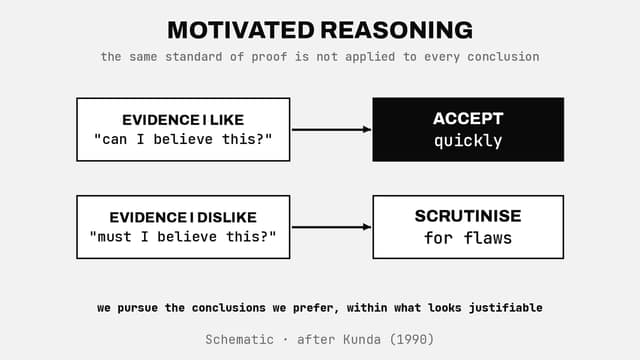
Motivated reasoning. We evaluate evidence in ways that help us reach the conclusions we prefer, within what looks justifiable. Welcome evidence gets a light check. Unwelcome evidence gets scrutiny. That fits the belief-change result above.
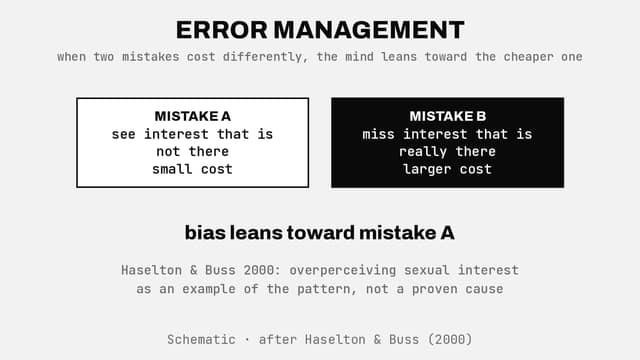
Error management theory. When two mistakes have different costs, a mind that sometimes errs should lean toward the cheaper one. Haselton and Buss applied the idea to reading sexual interest. It is a framework, not proof of what happens in any workplace.
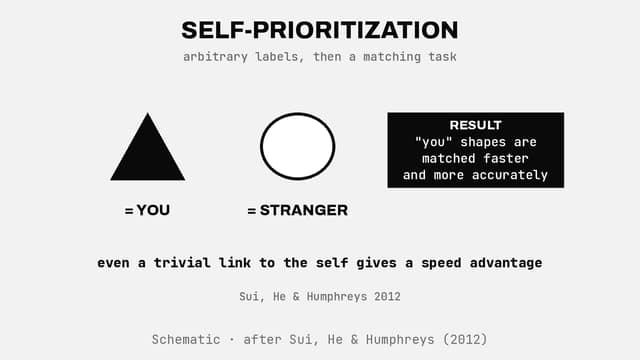
Self-prioritization. Link a neutral shape to yourself, and you will match it faster than a shape linked to a stranger. Sui, He and Humphreys showed in 2012 that even a trivial tie to the self speeds up perception. It is a close cousin of the pens and pencils result.