News & Ideas is a daily letter for anyone who wants the day's science in one place, not a feed. Each day is 4 news items and 3 ideas across AI & Tech, Physics & Engineering, Biology & Nature, and Mind & Society, and every story names a primary source you can check. The Shorts use a declared synthetic voice.
One email a day. 4 science stories, 5 quick results, 1 idea. 3 minutes.
Plus a daily quiz: Answer & Learn. Free, unsubscribe anytime.
Issue
8 November 2026
2 min read · 1 Short
Mind & Society: Silk Traces Cover Sanxingdui Ritual Objects, Las Minillas Supplied Bronze Age Copper, Maya Lakes Record Toxic Mercury, Rotated Practice Improves Upright Handwriting. Then Corrosion Can Preserve a Textile, Isotopes Indicate Compatibility, Not Routes, Learn the Shape of a Movement.
One email a day. 4 science stories, 5 quick results, 1 idea. 3 minutes.
Plus a daily quiz: Answer & Learn. Free, unsubscribe anytime.
Mind & Society
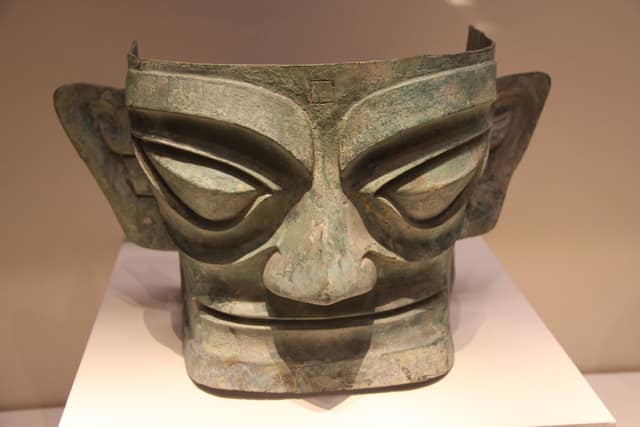
Silk Found on Sanxingdui Bronze Masks
Mind & Society: Silk Traces Cover Sanxingdui Ritual Objects, Las Minillas Supplied Bronze Age Copper, Maya Lakes Record Toxic Mercury, Rotated Practice Improves Upright Handwriting. Then Corrosion Can Preserve a Textile, Isotopes Indicate Compatibility, Not Routes, Learn the Shape of a Movement.
Guo and colleagues analysed a sample of textile residues recorded on 101 artefacts at Sanxingdui, including bronze, gold, jade and ivory. Microscopy and infrared spectra support mulberry silk; one bronze mask carried three distinct textile patches near its right eye and eyebrow. Silk likely wrapped, covered or accompanied ritual objects. Local silk production is suggested, not demonstrated.
Image: Gary Todd, Wikimedia Commons (CC0) · illustrative, not K3QW:21
One email a day. 4 science stories, 5 quick results, 1 idea. 3 minutes.
Plus a daily quiz: Answer & Learn. Free, unsubscribe anytime.
Mind & Society
A Mine Offers Bronze Age Copper Clues
Excavation and radiocarbon dates place mining at Las Minillas in southern Spain in the Late Bronze Age. Eleven Scandinavian bronzes are isotopically and chemically consistent with its copper. This is compatibility, not proof of specific shipments; two bronzes postdate the dated mine activity. The chronology of local smelting remains open.
Sediment cores from Lago Cobá and Cenote Xcach on the Yucatán Peninsula exceeded modern mercury toxicity guidelines during ancient Maya occupation, coinciding with aquatic food-web collapse. Imported mercury or cinnabar is the authors’ proposed source. Methylmercury was not measured; chronic human exposure is possible, not demonstrated in these populations.
Sun, Xie and McDougle trained people to copy rotated unfamiliar characters. Across 11 experiments, later copying of upright forms improved comparably to direct practice. Effects did not require mental imagery and transferred between hands. This is a specific motor-learning paradigm, not a universal training prescription.
Copper ions and corrosion products can inhibit microbes and replace organic material while retaining fibre shapes. Most Sanxingdui textile residues are mineralized. Preservation is context dependent: copper can also accelerate degradation, and the surviving traces are not intact cloth.
Guo et al., Antiquity, 26 Oct 2026
Antiquity, 26 Oct 2026doi.org · 26 Oct 2026 · Primary · Corrosion Can Preserve a Textile — Guo et al.
Idea · Mind & Society
Isotopes Indicate Compatibility, Not Routes
Lead-isotope ratios and trace elements can test whether an artefact is compatible with a mining district. Different sources overlap and metal can be recycled. Eleven bronzes compatible with Las Minillas are evidence to investigate, not a reconstructed shipping manifest.
A motor abstraction retains the structure of a gesture while changing details such as orientation or the hand used. Rotated-character practice tests this idea: different low-level movements still improve the canonical pattern. It supports abstraction in this task, not every form of skill learning.
Sun, Xie & McDougle, Nature Human Behaviour, 19 Oct 2026