News & Ideas is a daily letter for anyone who wants the day's science in one place, not a feed. Each day is 4 news items and 3 ideas across AI & Tech, Physics & Engineering, Biology & Nature, and Mind & Society, and every story names a primary source you can check. The Shorts use a declared synthetic voice.
One email a day. 4 science stories, 5 quick results, 1 idea. 3 minutes.
Plus a daily quiz: Answer & Learn. Free, unsubscribe anytime.
Issue
26 October 2026
2 min read · 1 Short
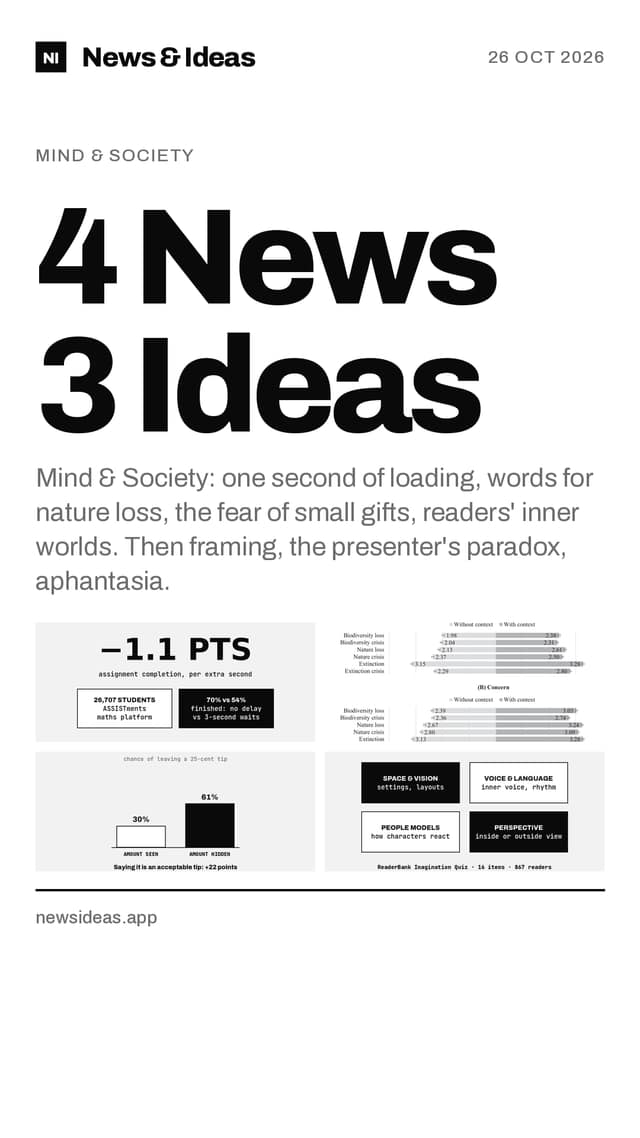
Mind & Society: one second of loading, words for nature loss, the fear of small gifts, readers' inner worlds. Then framing, the presenter's paradox, aphantasia.
One email a day. 4 science stories, 5 quick results, 1 idea. 3 minutes.
Plus a daily quiz: Answer & Learn. Free, unsubscribe anytime.
Mind & Society
One second of loading, extinction, tips
Mind & Society: one second of loading, words for nature loss, the fear of small gifts, readers' inner worlds. Then framing, the presenter's paradox, aphantasia.
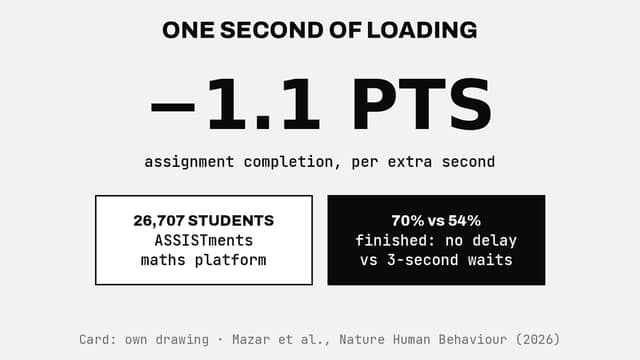
A second of loading can cost a lesson. In data from 26,707 students on a maths platform, each extra second meant 1.1 points less assignment completion. In a randomized test, 70 percent of adults finished a reading task without delays, and 54 percent with three-second waits. Published in Nature Human Behaviour.
Card: own drawing · Mazar et al., Nature Human Behaviour 2026
One email a day. 4 science stories, 5 quick results, 1 idea. 3 minutes.
Plus a daily quiz: Answer & Learn. Free, unsubscribe anytime.
Society · Communication
'Extinction' moves people more than 'biodiversity loss'
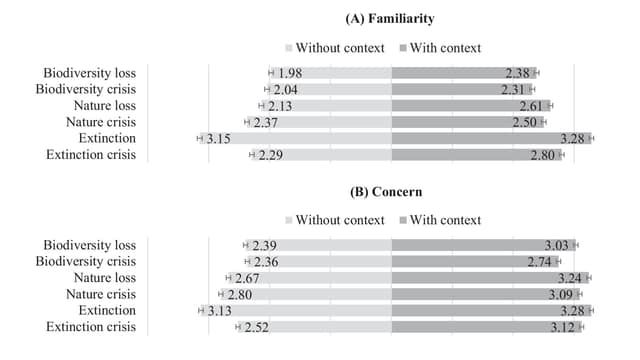
Which words make people care about nature? In a survey of 7,338 US adults, 'biodiversity loss' was among the least familiar and least worrying phrases. 'Extinction of plants and animals' worried people most, with similar results across political groups. Published in npj Biodiversity.
Figure: Bruine de Bruin et al., npj Biodiversity 2026 · CC BY-NC-ND 4.0
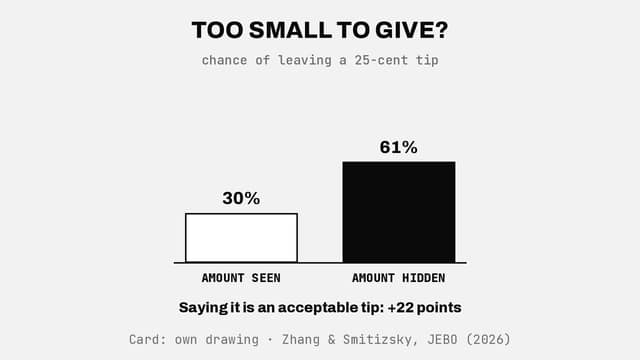
Why do we skip giving when we have little? In four studies with nearly 2,000 people, hiding the amount more than doubled the chance of leaving a 25-cent tip, from 30 to 61 percent. Saying the amount was acceptable added 22 points. Published in the Journal of Economic Behavior and Organization.
Give enough or not at allJournal of Economic Behavior & Organization · 2026 · Primary · Zhang & Smitizsky (2026); Journal of Economic Behavior & Organization
Mind · Reading
The same novel, different inner worlds
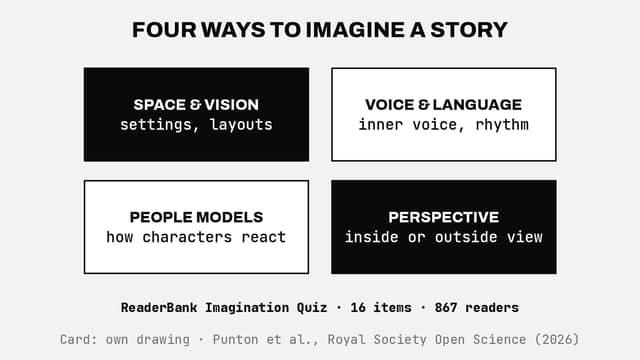
Do you see a novel, or hear it? Researchers at Durham University asked 867 readers sixteen questions and found four dimensions of reading imagination: space and vision, voice and language, people models, and perspective. Getting lost in a book was unrelated to poor attention. Published in Royal Society Open Science.
Card: own drawing · Punton et al., Royal Society Open Science 2026
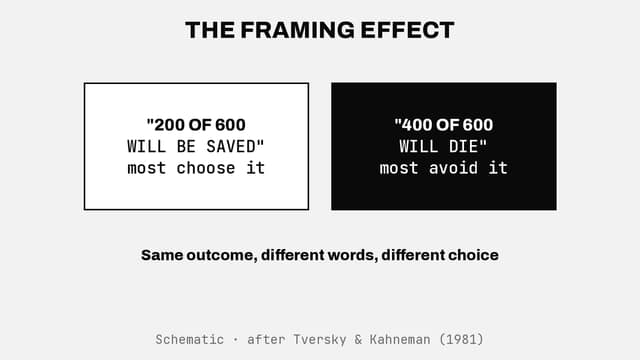
The framing effect. In a classic study, the same choice described as lives saved or lives lost flipped people's preferences. The words around a fact shape what we feel about it, which is why 'extinction' moves people more than 'biodiversity loss'.
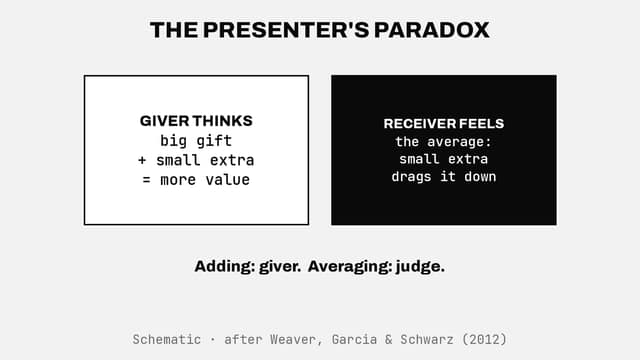
The presenter's paradox. Givers think adding a small extra adds value. Receivers tend to average, so the small extra drags the impression down. It helps explain why people would rather give nothing than a tip that looks too small.
Weaver, Garcia & Schwarz 2012 · Journal of Consumer Research
Diagram: own drawing · Weaver, Garcia & Schwarz 2012
The Presenter's ParadoxJournal of Consumer Research · 2012 · Primary · Weaver, Garcia & Schwarz (2012)
Idea · Imagery
Aphantasia
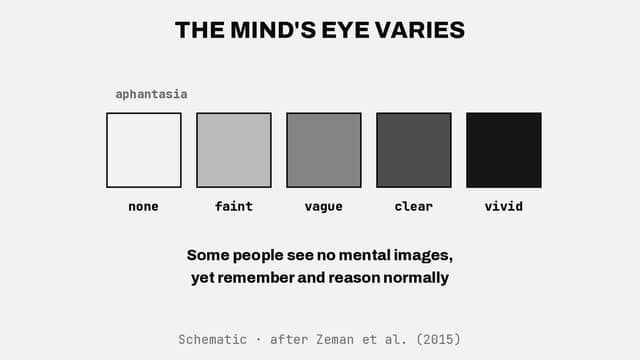
Aphantasia. Some people have no visual mental images at all, yet remember and reason normally. Imagination varies far more between people than we assume, which is why the same novel can feel like a film to one reader and a voice to another.