News & Ideas is a daily letter for anyone who wants the day's science in one place, not a feed. Each day is 4 news items and 3 ideas across AI & Tech, Physics & Engineering, Biology & Nature, and Mind & Society, and every story names a primary source you can check. The Shorts use a declared synthetic voice.
One email a day. 4 science stories, 5 quick results, 1 idea. 3 minutes.
Plus a daily quiz: Answer & Learn. Free, unsubscribe anytime.
Issue
26 October 2026
2 min read · 1 Short
Biology & Nature: a virus in the chimp brain, deep-sea plastics, Europe's first megaraptoran, ant antennae. Then two-level evolution, allometry, vicariance.
One email a day. 4 science stories, 5 quick results, 1 idea. 3 minutes.
Plus a daily quiz: Answer & Learn. Free, unsubscribe anytime.
Biology & Nature
A virus in chimp brains, megaraptoran, ants
Biology & Nature: a virus in the chimp brain, deep-sea plastics, Europe's first megaraptoran, ant antennae. Then two-level evolution, allometry, vicariance.
An ancient virus switches off a gene in chimp brains
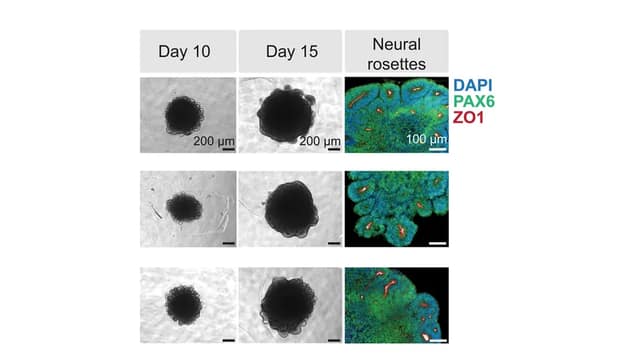
Humans and chimpanzees share almost all their genes, yet their brains develop differently. Lund University researchers found that remnants of an ancient virus, PTERV1, silence a gene called LINC00662 in chimpanzee brain organoids. Removing the viral DNA switched the gene back on. This is basic research, published in Science Advances.
Figure: Gerdes et al., Science Advances 2026 · CC BY 4.0
One email a day. 4 science stories, 5 quick results, 1 idea. 3 minutes.
Plus a daily quiz: Answer & Learn. Free, unsubscribe anytime.
Nature · Ocean
Plastics with built-in enzymes degrade in the deep sea
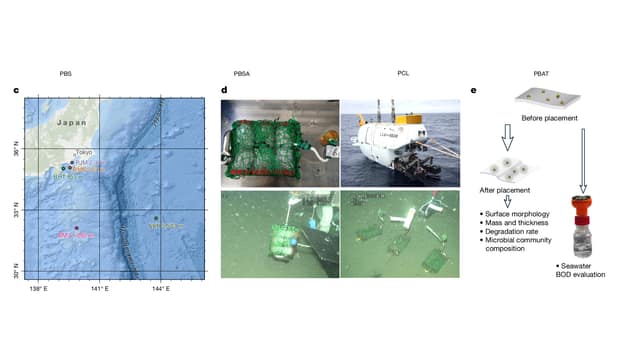
Biodegradable plastics often fail in the cold deep sea. Researchers embedded enzymes inside four polyesters and tested them down to 5,503 meters. At 757 meters, the plastic almost completely degraded in five months; at the deepest site, degradation was moderate. Published in Nature.
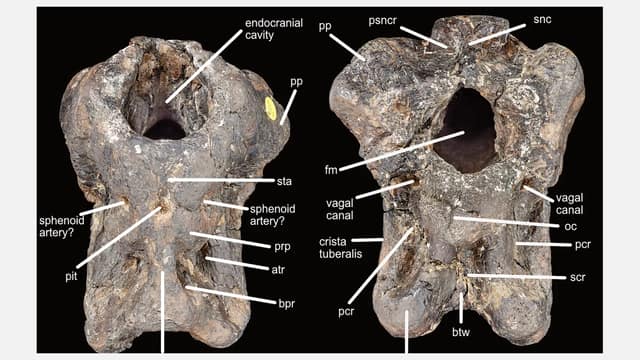
A braincase from the Isle of Wight sat at London's Natural History Museum from 1924, until it was recognized in 2020. Now it has a name: Invictibellatrix, the first megaraptoran known from Europe. About five meters long and 120 million years old, it is the smallest known. Published in Royal Society Open Science.
Figure: Morrison et al., Royal Society Open Science 2026 · CC BY 4.0
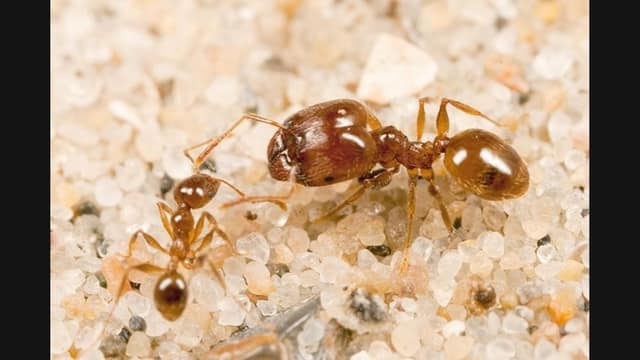
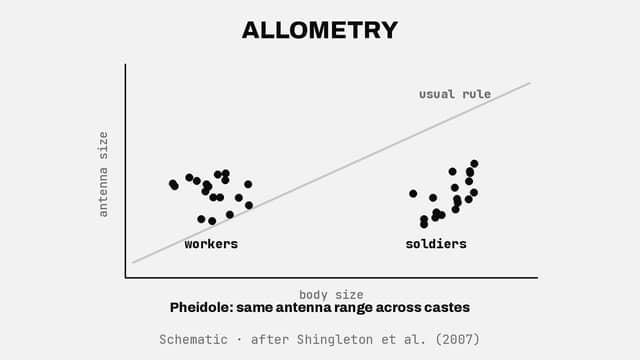
In Pheidole ants, soldiers have much bigger heads and bodies than workers, yet their antennae are the same size. Measured across 565 species, this breaks the usual scaling rule. Colony signals and juvenile hormone regulate it, and by changing a soldier pheromone, researchers even produced nanosoldiers. Published in PNAS.
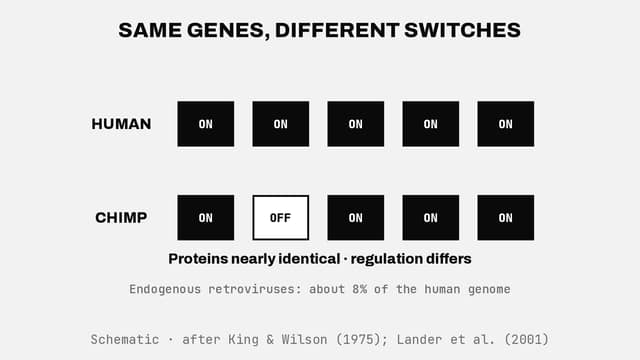
Evolution at two levels. Human and chimp proteins are almost identical, so many differences lie in when and how strongly genes switch on. Viral remnants like PTERV1 are part of that story: endogenous retroviruses make up about eight percent of the human genome.
King & Wilson 1975 · Science; Lander et al. 2001 · Nature
Allometry. Body parts usually scale with body size in a fixed way: a bigger head comes with longer antennae. Biologists use these scaling rules to spot when evolution has decoupled one organ from the rest, which is exactly what Pheidole soldiers did.
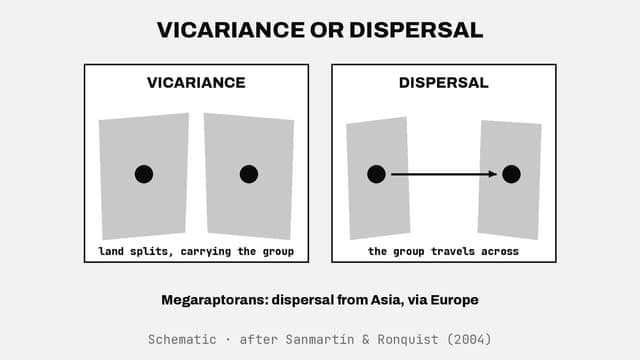
Vicariance or dispersal. A group spread across continents may be there because the land split and carried it, or because it travelled. For megaraptorans, the new fossil supports travel: from Asia, through Europe and Africa, to the southern continents.
Figure: Gerdes et al., Science Advances 2026 · CC BY 4.0
Figure: Huang et al., Nature 2026 · CC BY 4.0
Figure: Morrison et al., Royal Society Open Science 2026 · CC BY 4.0
Image: Hugo Darras
Diagram: own drawing · King & Wilson 1975
Diagram: own drawing · Shingleton et al. 2007
Diagram: own drawing · Sanmartín & Ronquist 2004
Voice: synthetic (neural text-to-speech).
Scripts written from the linked sources.
4 News 3 IdeasNews and Ideasbiology and naturebiologyevolutionchimpanzeebrain organoidsendogenous retrovirusgene regulationCRISPRbiodegradable plasticsdeep seaenzymesocean pollutiondinosaursmegaraptoranIsle of WightNatural History MuseumpalaeontologyantsPheidoleallometrybiogeographyvicariance
Biology & Nature
Question of the day
What happened when Lund researchers removed the PTERV1 viral insertion from chimpanzee cells?
The cells stopped dividing
The LINC00662 gene was expressed again
Nothing changed
The ballot is in the email. Each choice there is counted once.