News & Ideas is a daily letter for anyone who wants the day's science in one place, not a feed. Each day is 4 news items and 3 ideas across AI & Tech, Physics & Engineering, Biology & Nature, and Mind & Society, and every story names a primary source you can check. The Shorts use a declared synthetic voice.
One email a day. 4 science stories, 5 quick results, 1 idea. 3 minutes.
Plus a daily quiz: Answer & Learn. Free, unsubscribe anytime.
Issue
19 November 2026
3 min read · 1 Short
Biology & Nature: bogong moths with a magnetic compass, Homo erectus lingered in southern China, young emperor penguins meet krill fishing, bumblebees with a taste for salt. Then radical pairs, ancient proteins, salt limitation.
One email a day. 4 science stories, 5 quick results, 1 idea. 3 minutes.
Plus a daily quiz: Answer & Learn. Free, unsubscribe anytime.
Biology & Nature
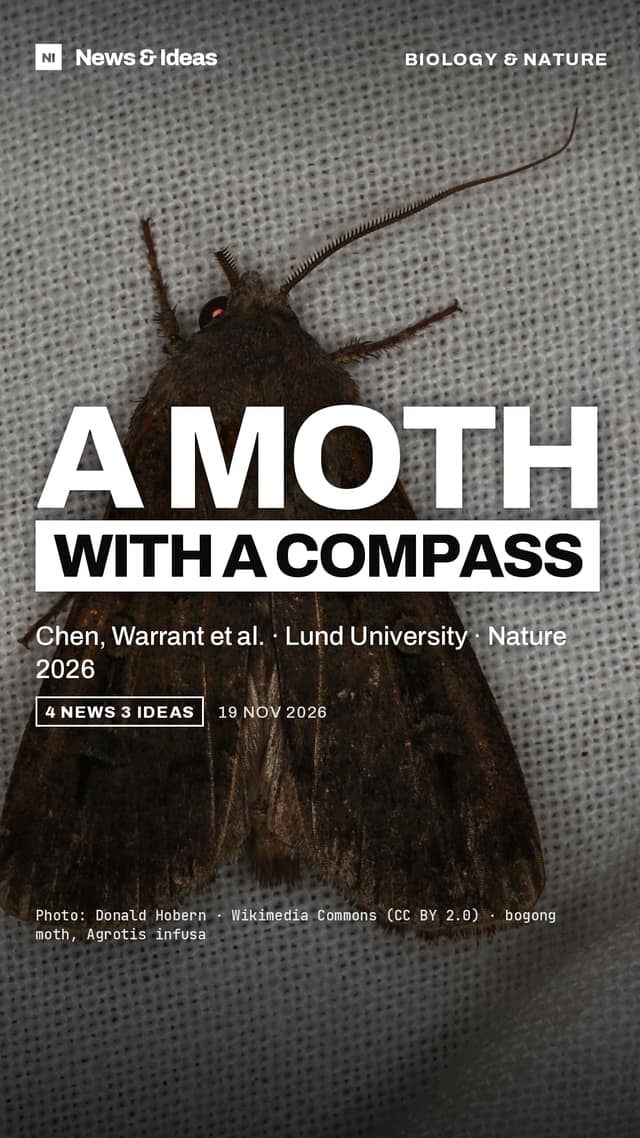
Bogong Moths Carry a Magnetic Compass
Biology & Nature: bogong moths with a magnetic compass, Homo erectus lingered in southern China, young emperor penguins meet krill fishing, bumblebees with a taste for salt. Then radical pairs, ancient proteins, salt limitation.
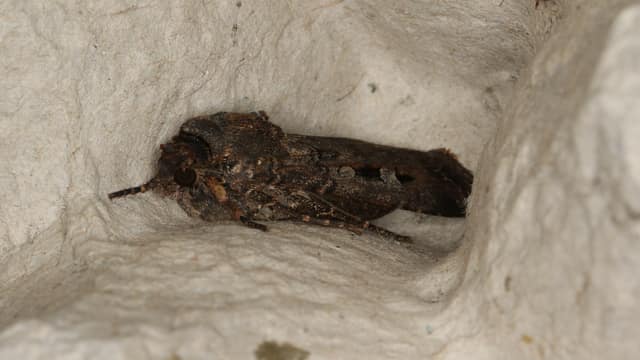
Hui Chen, Eric Warrant and colleagues (Lund University, Carl von Ossietzky University Oldenburg, Australian National University, University of South Australia) tested migrating bogong moths (Agrotis infusa) in a non-magnetic laboratory near Adaminaby in the Snowy Mountains. Tethered moths flew in an arena inside magnetic coils while their heading was recorded; when the field was reversed, they turned correspondingly. The moths use a light-dependent inclination compass, reading the angle between the field lines and the ground, like nocturnally migrating birds, in addition to the star compass shown in 2025. Every summer the moths travel more than 1,000 km at night to caves in the Snowy Mountains, with a brain about a tenth the size of a rice grain.
Photo: Donald Hobern · Wikimedia Commons (CC BY 2.0) · bogong moth, Agrotis infusa
One email a day. 4 science stories, 5 quick results, 1 idea. 3 minutes.
Plus a daily quiz: Answer & Learn. Free, unsubscribe anytime.
Evolution · Human origins
Homo erectus Lingered in Southern China
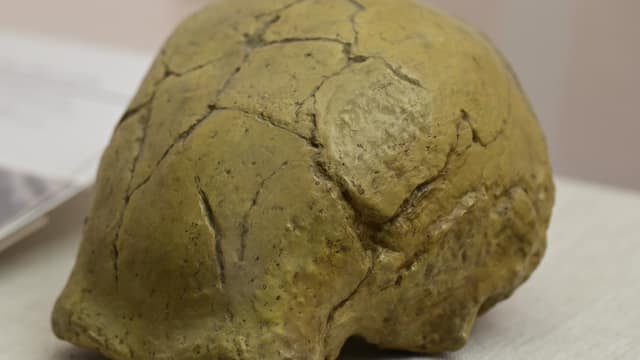
Wei Liao, Clément Zanolli, Frido Welker and colleagues analysed nine human teeth from Naxian and Baxian Caves in Guangxi, southern China, dated to between 324,000 and 184,000 years ago. Eight were confidently identified as Homo erectus, supported by enamel protein sequences, extending the species' known timeline on the Asian mainland, where it was thought to have largely disappeared around 400,000 years ago, by about 200,000 years. One tooth matches neither Homo erectus nor the protein profile of any known human species, suggesting at least two human groups lived in the region at the same time. Chemical traces and animal fossils indicate a tropical rainforest habitat.
Photo: Jonathan Chen · Wikimedia Commons (CC BY 4.0) · Hexian Homo erectus skull cast, illustrative
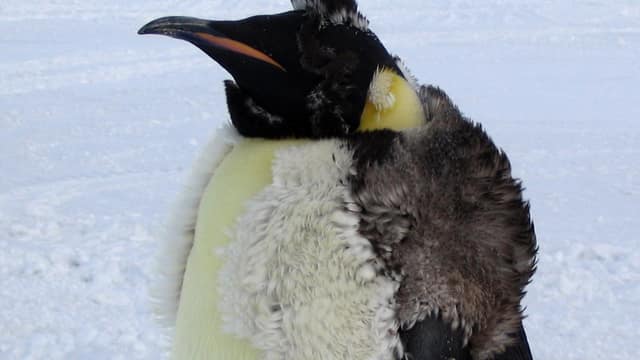
Émile Brisson-Curadeau, Daniel Zitterbart, Céline Le Bohec and colleagues (CNRS, Centre Scientifique de Monaco, Woods Hole Oceanographic Institution) tracked 48 juvenile emperor penguins from Snow Hill Island, Jason Peninsula and Atka Bay, the first tracking of juveniles from the two western colonies. Over more than 1,500 km and a year at sea, birds from different colonies and years followed very similar routes. Juveniles from Atka Bay spent 32% of their time in proposed marine protected areas, versus 21% (Snow Hill) and 15% (Jason Peninsula). Western-colony birds met more fishing, mostly for Antarctic krill; Jason Peninsula juveniles spent over 60% of February and March in recently fished zones.
Tegan Gaetano, Lesley Lancaster and colleagues (University of Aberdeen) tested how buff-tailed bumblebees (Bombus terrestris audax) responded to calcium, potassium, magnesium and sodium at a range of concentrations in artificial nectar. The bees avoided high concentrations of all four minerals but showed a clear preference for an intermediate level of sodium, higher than typically reported in floral nectar. It is the first study to show a clearly preferred salt level in bumblebee food, which may help explain why pollinators seek salt from puddles, bricks and even sweat.
Photo: Charles J. Sharp · Wikimedia Commons (CC BY-SA 4.0) · buff-tailed bumblebee
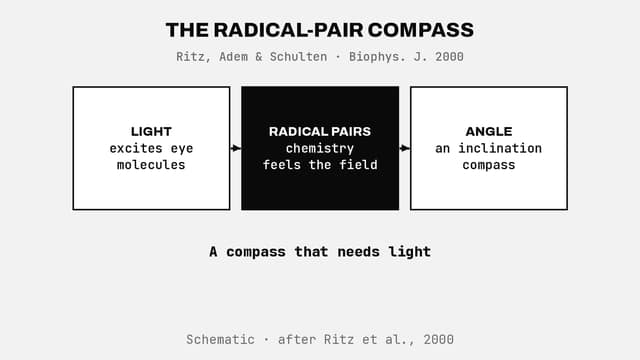
Ritz, Adem and Schulten (Biophysical Journal, 2000) proposed that magnetoreception in birds relies on light-induced radical pairs in photoreceptor molecules, whose spin chemistry depends on their orientation relative to the geomagnetic field. Such a mechanism is light-dependent and senses the axis of the field rather than its polarity, i.e. an inclination compass, the type now described in bogong moths; whether moths use radical pairs is still open.
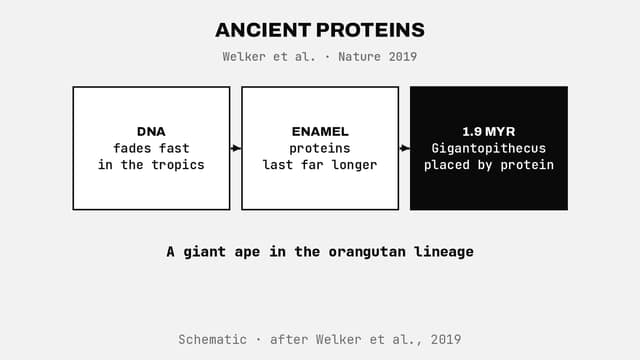
Welker et al. (Nature, 2019) recovered enamel proteome sequences from a roughly 1.9-million-year-old Gigantopithecus blacki molar from Chuifeng Cave, China, and showed that Gigantopithecus was an early-diverging pongine, a sister lineage to orangutans. Enamel palaeoproteomics now also confirms the identity of the Homo erectus teeth from Guangxi.
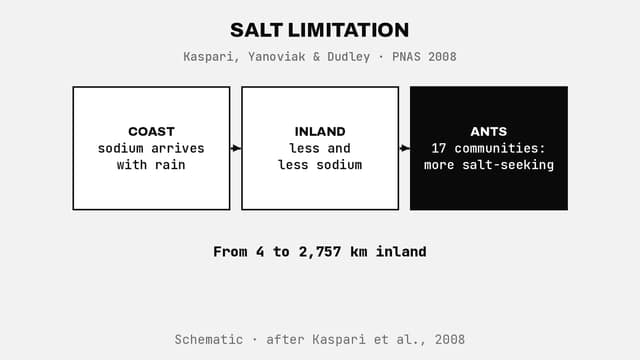
Kaspari, Yanoviak and Dudley (PNAS, 2008) noted that sodium deposition in rainfall decreases with distance inland, and tested sucrose and NaCl baits in 17 New World ant communities 4–2,757 km from the coast. Sodium use, and preference for the saltiest baits, increased further inland, consistent with sodium limitation for plant-eating and omnivorous animals. Bumblebees preferring more sodium than nectar offers fits the same picture.