News & Ideas is a daily letter for anyone who wants the day's science in one place, not a feed. Each day is 4 news items and 3 ideas across AI & Tech, Physics & Engineering, Biology & Nature, and Mind & Society, and every story names a primary source you can check. The Shorts use a declared synthetic voice.
One email a day. 4 science stories, 5 quick results, 1 idea. 3 minutes.
Plus a daily quiz: Answer & Learn. Free, unsubscribe anytime.
Issue
30 October 2026
2 min read · 1 Short
Biology & Nature: neurons with broken genomes purged at birth, our closest archaeal relatives grown in the lab, a whole-body fish atlas, flying insects younger than thought. Then mosaicism, complex cells, molecular clocks.
One email a day. 4 science stories, 5 quick results, 1 idea. 3 minutes.
Plus a daily quiz: Answer & Learn. Free, unsubscribe anytime.
Biology & Nature
Broken neurons purged, our archaeal kin
Biology & Nature: neurons with broken genomes purged at birth, our closest archaeal relatives grown in the lab, a whole-body fish atlas, flying insects younger than thought. Then mosaicism, complex cells, molecular clocks.
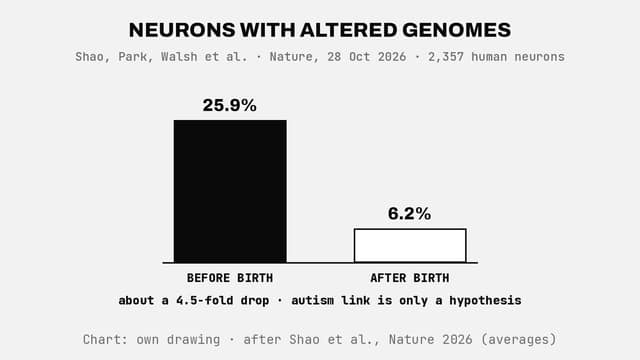
A team at Boston Children's Hospital and Harvard sequenced 2,357 single neurons from human brains, before and after birth. Neurons with widespread chromosome changes dropped about four and a half times after birth. The authors suggest a genome quality check; any link to autism is still a hypothesis. Published in Nature.
Chart: own drawing · after Shao et al., Nature 2026
One email a day. 4 science stories, 5 quick results, 1 idea. 3 minutes.
Plus a daily quiz: Answer & Learn. Free, unsubscribe anytime.
Biology · Evolution
Our closest archaeal relatives, grown in the lab
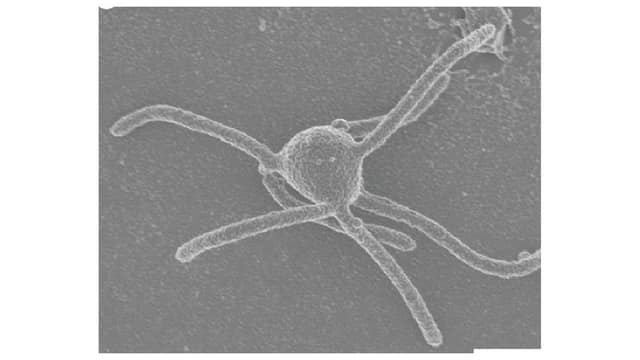
Researchers at JAMSTEC in Japan grew two strains of Heimdallarchaeia, the archaea closest to complex cells like ours. They grow only with methane-producing partners. Inside they are simple, with no nucleus; outside, long branching protrusions hook onto those partners. Published in Nature.
Image: Imachi, Nobu et al., Nature 2026 (CC BY 4.0) · Fig. 2c
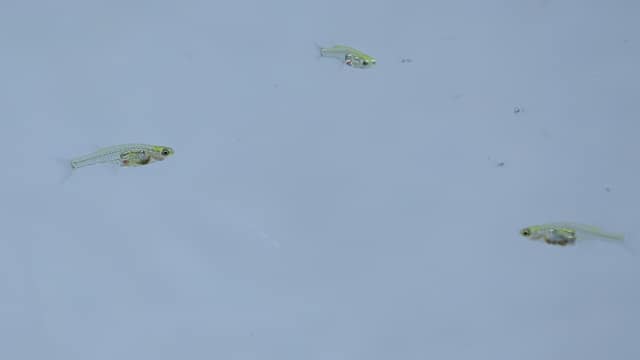
The Whitehead Institute and colleagues profiled more than 600,000 cells across the whole body of Danionella cerebrum, a transparent fish about one centimetre long. It is the first whole-body cell atlas of an adult vertebrate, and it follows neurons regrowing after brain injury. Published in Science.
Photo: AngryBurmese · Wikimedia Commons (CC BY 4.0)
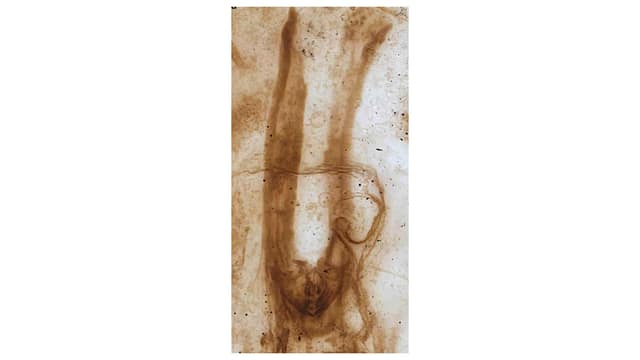
A head fragment under a millimetre long, found in Scottish chert in 1926, was seen as the oldest winged insect. New microscopy at London's Natural History Museum shows its jaws match neither winged insects nor centipedes. Without it, winged insects may have appeared up to 80 million years later. Published in Scientific Reports.
Image: Long et al., Sci. Rep. 2026 (CC BY 4.0) · Fig. 1a
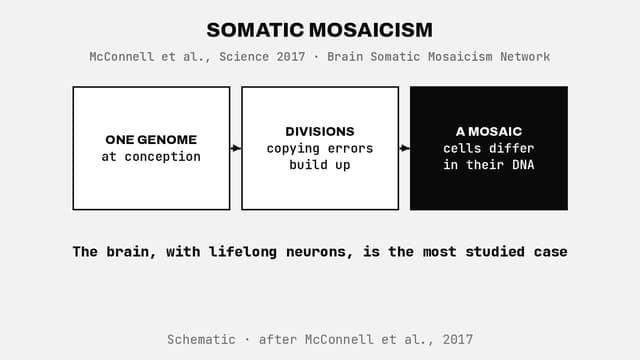
Somatic mosaicism. Not every cell in your body carries the same DNA. Copying errors during cell division build a mosaic, and the brain, whose neurons last a lifetime, is the most studied case.
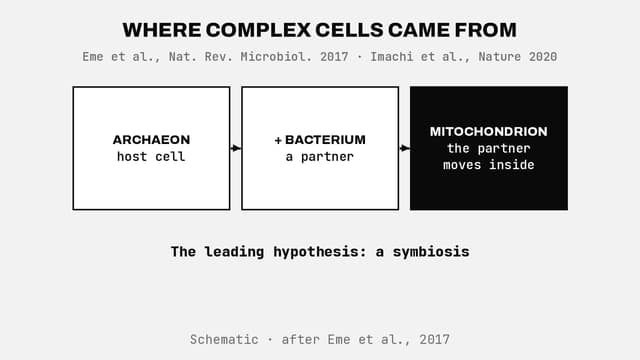
Where complex cells came from. The leading idea is that an archaeon teamed up with a bacterium, which became the mitochondrion. Relatives like today's archaea give a look at how that ancestor may have lived.
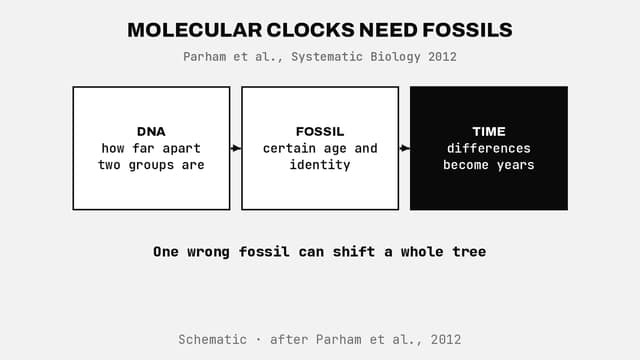
Molecular clocks need fossils. DNA differences show how far apart two groups are, but turning them into years needs fossils of certain age and identity. One wrong fossil can shift a whole tree, as today's insect shows.