News & Ideas is a daily letter for anyone who wants the day's science in one place, not a feed. Each day is 4 news items and 3 ideas across AI & Tech, Physics & Engineering, Biology & Nature, and Mind & Society, and every story names a primary source you can check. The Shorts use a declared synthetic voice.
One email a day. 4 science stories, 5 quick results, 1 idea. 3 minutes.
Plus a daily quiz: Answer & Learn. Free, unsubscribe anytime.
Issue
5 November 2026
3 min read · 1 Short
Biology & Nature: pet dogs trained to sniff out invasive plants, leaf nitrogen and phosphorus predict autumn colour, glioblastoma cells switch states by rules, a fruit fly that only courts near food. Then detection dogs, nutrient recycling, Waddington's landscape.
One email a day. 4 science stories, 5 quick results, 1 idea. 3 minutes.
Plus a daily quiz: Answer & Learn. Free, unsubscribe anytime.
Biology & Nature
Pet Dogs Trained to Sniff Out Invasive Plants
Biology & Nature: pet dogs trained to sniff out invasive plants, leaf nitrogen and phosphorus predict autumn colour, glioblastoma cells switch states by rules, a fruit fly that only courts near food. Then detection dogs, nutrient recycling, Waddington's landscape.
Researchers at the Helmholtz Centre for Environmental Research (UFZ) trained 31 volunteer teams of pet dogs and owners, in two cohorts, to find three invasive plants: Japanese knotweed, Himalayan balsam and common ragweed. 87.1% of teams finished the online course and 77.4% the practical workshop. Twelve teams reached the final field test and eleven passed, with an average detection rate of 74.7% and no false alarms. The authors cite costs of up to 7.4 billion euros a year in Europe for ragweed alone, and see volunteer teams as a way to find invasive plants early. Peer-reviewed, open access.
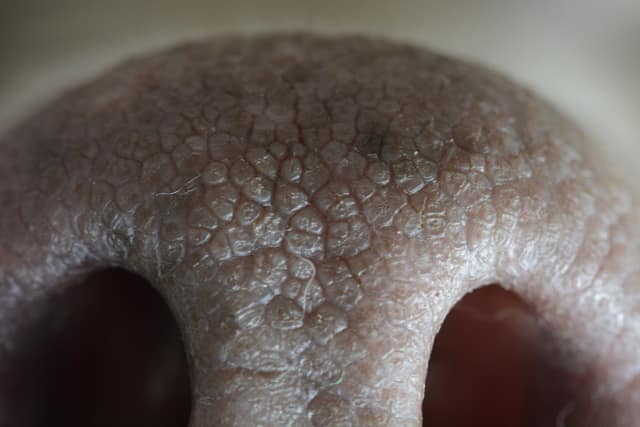
Photo: Clint Budd · Wikimedia Commons (CC BY 2.0) · a pet dog, not from the study
One email a day. 4 science stories, 5 quick results, 1 idea. 3 minutes.
Plus a daily quiz: Answer & Learn. Free, unsubscribe anytime.
Biology · Forests
Leaf nitrogen and phosphorus predict autumn colour
A Duke-led team used airborne data from the US NEON network across 25 forests. Where leaves held more nitrogen relative to phosphorus, autumn senescence started earlier, in 20 of the forests, regardless of climate and species; a high nitrogen-to-potassium ratio delayed it. Earlier leaf fall means less carbon dioxide taken up, so the result helps forecast the forest carbon cycle. Peer-reviewed.
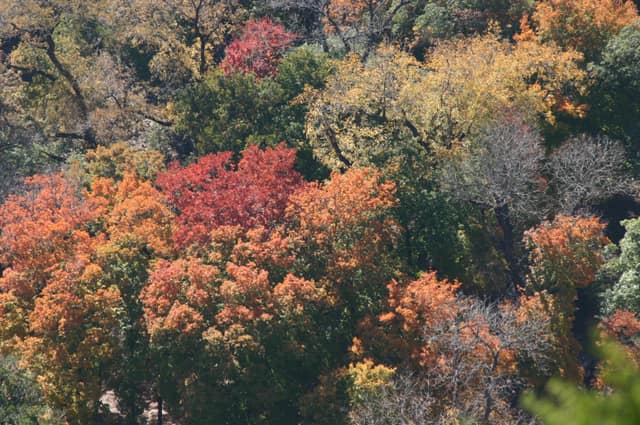
Photo: Wing-Chi Poon · Wikimedia Commons (CC BY-SA 2.5) · an autumn forest, not a study site
Glioblastoma cells switch states by predictable rules
Researchers at DKFZ, EMBL and the Wellcome Sanger Institute built a molecular atlas from 12 patients and more than a million cells of glioblastoma, an aggressive brain tumour. Cells moved between states along stereotyped paths, not at random. The regulator MYT1L reduced this plasticity, and in mice, tumours with that change led to better survival. An AI method, scDORI, helped map the rules. This is basic research, not a treatment. Peer-reviewed, open access.
Rockefeller University researchers found that males of the fruit fly Drosophila erecta barely court without the smell of food; with apple cider vinegar odour, over 90% of matings happen on the food source. Courtship neurons, P1 and LC10a, switch on only when the food smell is present. The same brain circuit is retuned by the environment rather than rewired. Peer-reviewed, open access.
Trained dogs can find rare or invasive species faster and more reliably than human surveyors, from scats to plants. The catch: results depend on standard training and on checking the dogs' accuracy. Today's study adds volunteer pet dogs, with an average detection rate of 74.7% in the field test.
Beebe et al., Frontiers in Veterinary Science (2016)
Before a leaf drops, the tree dismantles chlorophyll and pulls nitrogen and phosphorus back into its branches and trunk; the autumn colours are a side effect. Climate change shifts the timing. Today's Duke study links the start of this process to the leaf's nitrogen-to-phosphorus balance.
Waddington's landscape: cells rolling down valleys
Biologist Conrad Waddington pictured a cell's state as a ball rolling down a landscape of valleys: transitions follow preferred paths. The image is now used to model how cells change identity. Today's glioblastoma atlas finds tumour cells moving between states along stereotyped paths.