News & Ideas is a daily letter for anyone who wants the day's science in one place, not a feed. Each day is 4 news items and 3 ideas across AI & Tech, Physics & Engineering, Biology & Nature, and Mind & Society, and every story names a primary source you can check. The Shorts use a declared synthetic voice.
One email a day. 4 science stories, 5 quick results, 1 idea. 3 minutes.
Plus a daily quiz: Answer & Learn. Free, unsubscribe anytime.
Issue
14 November 2026
3 min read · 1 Short
Biology & Nature: Kelp That Can Reproduce Without a Partner, Hamster Cells Carrying Algal DNA, Cats Meow for Their Owners, A Genetic Atlas of 10,000 Years of Sheep Breeding. Then The Twofold Cost of Sex, Expression QTLs and the GTEx Atlas, Cats Meow Mostly at Humans.
One email a day. 4 science stories, 5 quick results, 1 idea. 3 minutes.
Plus a daily quiz: Answer & Learn. Free, unsubscribe anytime.
Biology & Nature
Male Kelp Made Egg-Like Cells and Reproduced Alone
Biology & Nature: Kelp That Can Reproduce Without a Partner, Hamster Cells Carrying Algal DNA, Cats Meow for Their Owners, A Genetic Atlas of 10,000 Years of Sheep Breeding. Then The Twofold Cost of Sex, Expression QTLs and the GTEx Atlas, Cats Meow Mostly at Humans.
Male Kelp Made Egg-Like Cells and Reproduced Alone
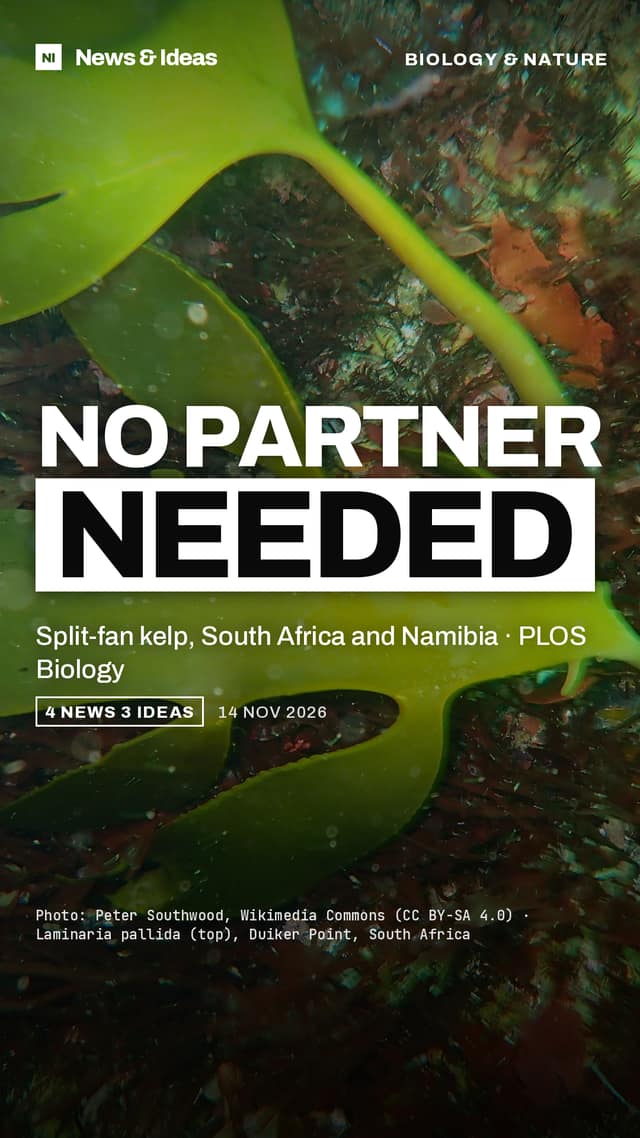
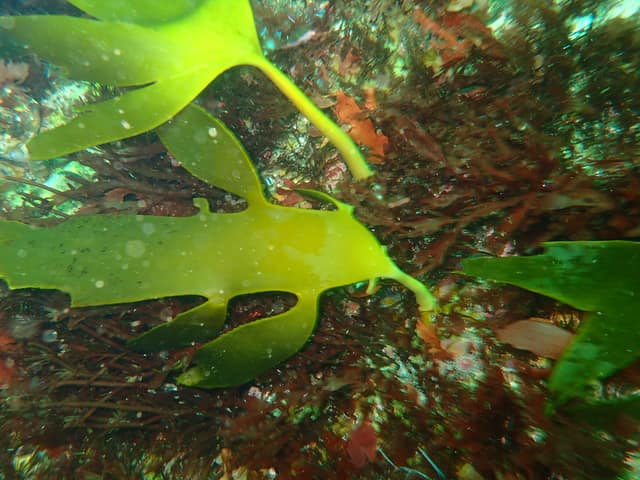
Split-fan kelp (Laminaria pallida) from South Africa and Namibia normally needs separate males and females. In the lab, researchers led from the Max Planck Institute for Biology found that both sexes can reproduce without fertilization: 92% of single-sex cultures did so. Male gametophytes even produced egg-like cells, which the authors call completely unexpected, and their gene expression became more female-like. Asexual offspring were fewer, grew more slowly and showed abnormalities, and 523 wild samples showed no sign of clonality, so it looks like a backup plan. Keeping the opposite sex nearby behind a mesh suppressed asexual reproduction, pointing to a chemical cue. Open access (CC BY).
Photo: Peter Southwood, Wikimedia Commons (CC BY-SA 4.0) · Laminaria pallida (top), Duiker Point, South Africa
One email a day. 4 science stories, 5 quick results, 1 idea. 3 minutes.
Plus a daily quiz: Answer & Learn. Free, unsubscribe anytime.
Biology & Nature
Hamster Cells Carrying Algal DNA
At the University of Tokyo, Aoki, Matsunaga and colleagues fused hamster cells with the red alga Cyanidioschyzon merolae to make planimal hybrid cells. About 16.3 million base pairs of algal DNA, with sequences from all 20 algal chromosomes, persisted in the animal cells, detectable through 155 generations (95 without selection). About 96% of the transferred genes were silenced by methylation involving DNMT3A. No photosynthetic animal cells were produced. Open access in Nature Communications.
Fukimoto and colleagues tested 38 cats at home with favourite food locked in a closed box for one minute. The odds of meowing were about 16 times higher when the owner was present than when the cat was alone, and about 56% of meows came while the cat was looking at the owner, suggesting meows are aimed at people. The sample was small and included cats that meow often. Published in Animal Behaviour.
An international team including Aarhus University built SheepGTEx, a map of how genetic variants control gene activity in 51 sheep tissues and cell types, from 6,761 RNA samples from 2,816 sheep. Combined with DNA from 52 ancient sheep spanning about 10,000 years, it suggests breeding favoured variants that act in only one or a few tissues, such as skin and cervix, consistent with selection for wool, pigmentation and reproduction. A skin variant linked to the THNSL2 gene became more common in Europe from the Neolithic to the Middle Ages; a direct effect on wool is not established. Published in Nature Genetics.
An asexual female can have twice as many reproducing offspring as a sexual one, because she makes no males. So why is sex so common? Sarah Otto reviews the answers, from shuffling genes to escaping parasites. The kelp keeps asexuality only as a backup.
Many genetic variants do not change a protein; they change how much of a gene is made, and in which tissue. The human GTEx atlas mapped these effects across dozens of tissues. SheepGTEx applies the same approach to sheep.
The meow is thought to be largely a signal aimed at people rather than other cats. Nicolas Nicastro found that domestic cat meows sound shorter and more pleasant to humans than those of African wildcats, their wild relatives.