News & Ideas is a daily letter for anyone who wants the day's science in one place, not a feed. Each day is 4 news items and 3 ideas across AI & Tech, Physics & Engineering, Biology & Nature, and Mind & Society, and every story names a primary source you can check. The Shorts use a declared synthetic voice.
One email a day. 4 science stories, 5 quick results, 1 idea. 3 minutes.
Plus a daily quiz: Answer & Learn. Free, unsubscribe anytime.
Issue
22 November 2026
2 min read · 1 Short
Biology & Nature: thin air beats bee mites, important genes mutate too, 2,100 species indoors, a fossil woodcock that was a snipe. Then a virus riding a mite, mutation bias, flightless on islands.
One email a day. 4 science stories, 5 quick results, 1 idea. 3 minutes.
Plus a daily quiz: Answer & Learn. Free, unsubscribe anytime.
Biology & Nature
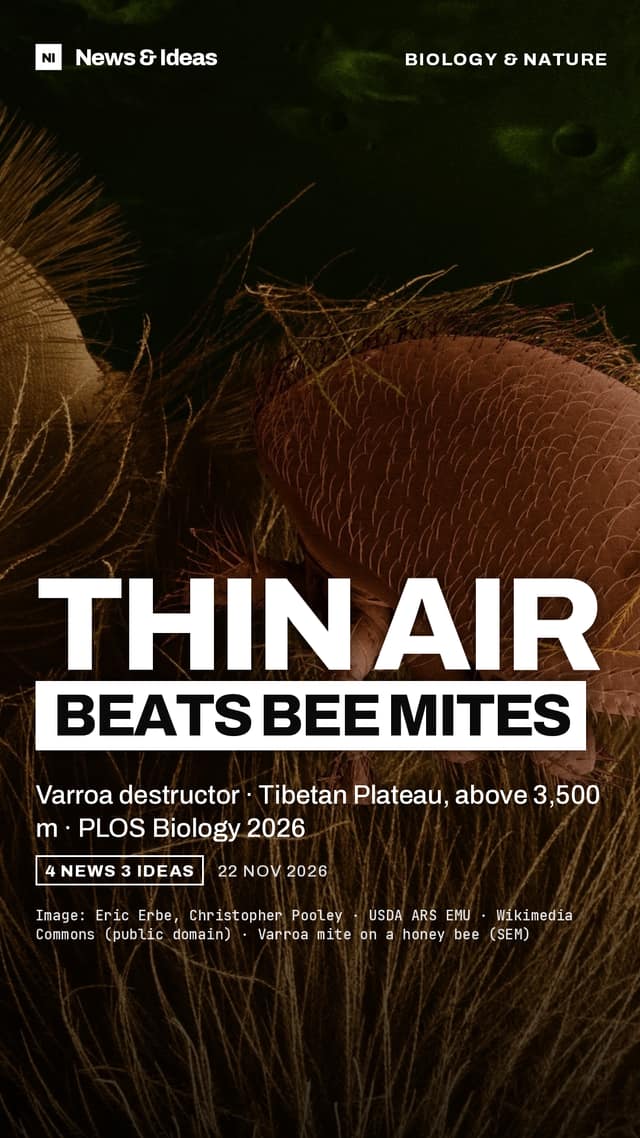
Thin Air Beats Deadly Bee Mites
Biology & Nature: thin air beats bee mites, important genes mutate too, 2,100 species indoors, a fossil woodcock that was a snipe. Then a virus riding a mite, mutation bias, flightless on islands.
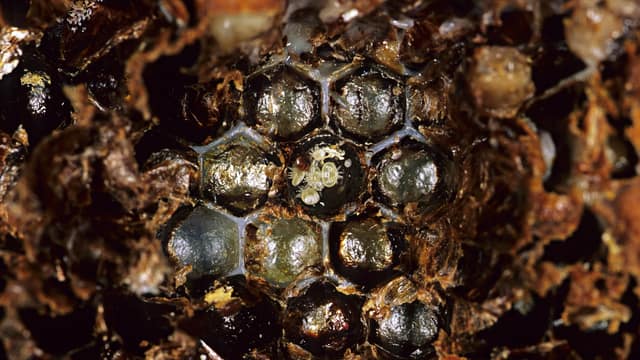
Zhejiang University researchers moved 60 mite-infested honey bee colonies to four altitudes in China. Above 3,500 meters, 13 of 15 colonies survived two years; elsewhere, none lasted beyond one. The Varroa mites bred less, and low oxygen alone did the same at low altitude. PLOS Biology.
Photo: Denis Anderson, CSIRO · Wikimedia Commons (CC BY 3.0) · a Varroa mite with offspring
One email a day. 4 science stories, 5 quick results, 1 idea. 3 minutes.
Plus a daily quiz: Answer & Learn. Free, unsubscribe anytime.
Biology · Evolution
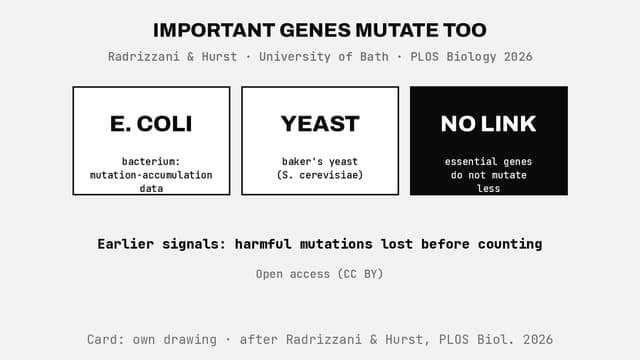
Important Genes Mutate Too
Do cells shield their most important genes from mutation? A University of Bath team pooled mutation data from E. coli and baker's yeast. Genes for essential or abundant proteins did not mutate less. Earlier signals, they argue, may come from harmful mutations vanishing before anyone counted them. Published in PLOS Biology.
Card: own drawing · after Radrizzani & Hurst, PLOS Biol. 2026
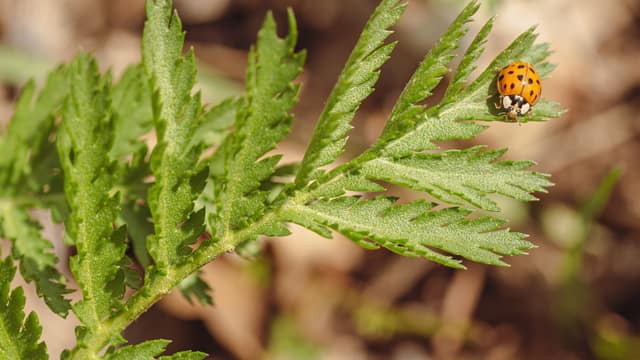
Using iNaturalist photos, ecologists compiled about 24,000 observations of wild life inside homes and buildings in the US and Canada, nearly 2,100 species. Most were insects and spiders; the most common was the Asian lady beetle. One record: an alligator in a garage. Published in Ecology.
Photo: Flocci Nivis · Wikimedia Commons (CC BY 4.0) · an Asian lady beetle, illustrative
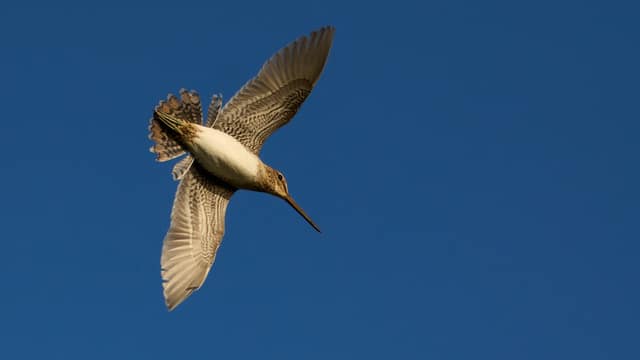
Florida Museum researchers read ancient DNA from fossils of an extinct bird from Hispaniola, long called a woodcock. It's a snipe. Their family tree of snipes and woodcocks reveals ocean crossings, including from South America to the southwest Pacific, and island species wiped out after humans arrived. Published in PNAS.
Photo: Hobbyfotowiki · Wikimedia Commons (CC0) · a common snipe in flight, illustrative
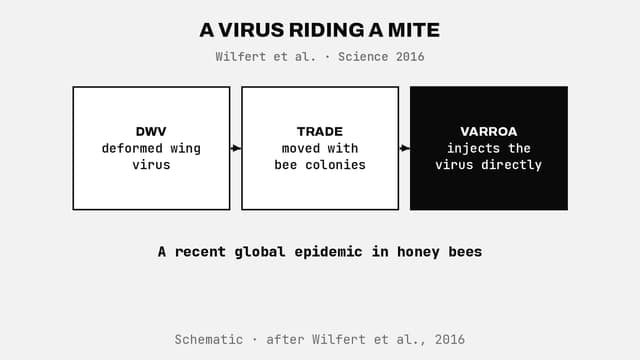
A virus riding a mite. In 2016, Lena Wilfert and colleagues traced deformed wing virus worldwide. It spread recently from European honey bees, moved by the trade in colonies, and Varroa fuels it by injecting the virus directly.
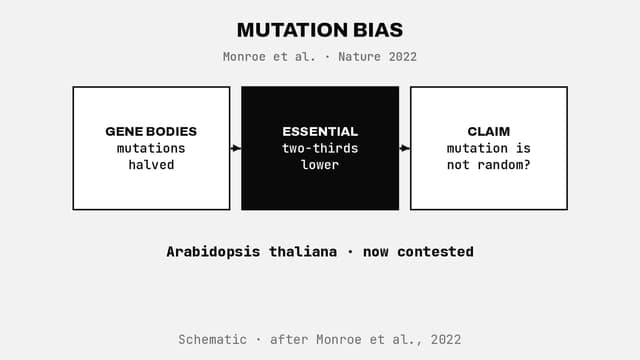
Mutation bias. In 2022, Grey Monroe's team reported that in the plant Arabidopsis, mutations were half as common inside genes, and two-thirds lower in essential ones. The Bath study finds no such shield in bacteria or yeast.
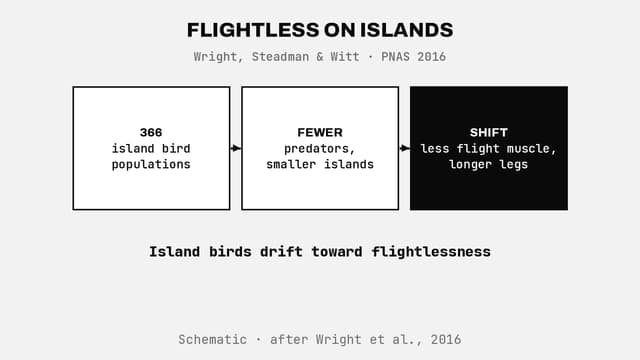
Flightless on islands. In 2016, Wright, Steadman and Witt measured 366 island bird populations. Where predators were scarce, birds evolved smaller flight muscles and longer legs. The extinct Hispaniolan snipe had short wings and big legs.