News & Ideas is a daily letter for anyone who wants the day's science in one place, not a feed. Each day is 4 news items and 3 ideas across AI & Tech, Physics & Engineering, Biology & Nature, and Mind & Society, and every story names a primary source you can check. The Shorts use a declared synthetic voice.
One email a day. 4 science stories, 5 quick results, 1 idea. 3 minutes.
Plus a daily quiz: Answer & Learn. Free, unsubscribe anytime.
Issue
22 November 2026
2 min read · 1 Short
Mind & Society: weaned early and nursed long in a Greek colony, who lay in a Roman coffin, degrees dropped and pay up, scientists disagree on science. Then reading milk in bones, job market signaling, the demarcation problem.
One email a day. 4 science stories, 5 quick results, 1 idea. 3 minutes.
Plus a daily quiz: Answer & Learn. Free, unsubscribe anytime.
Mind & Society
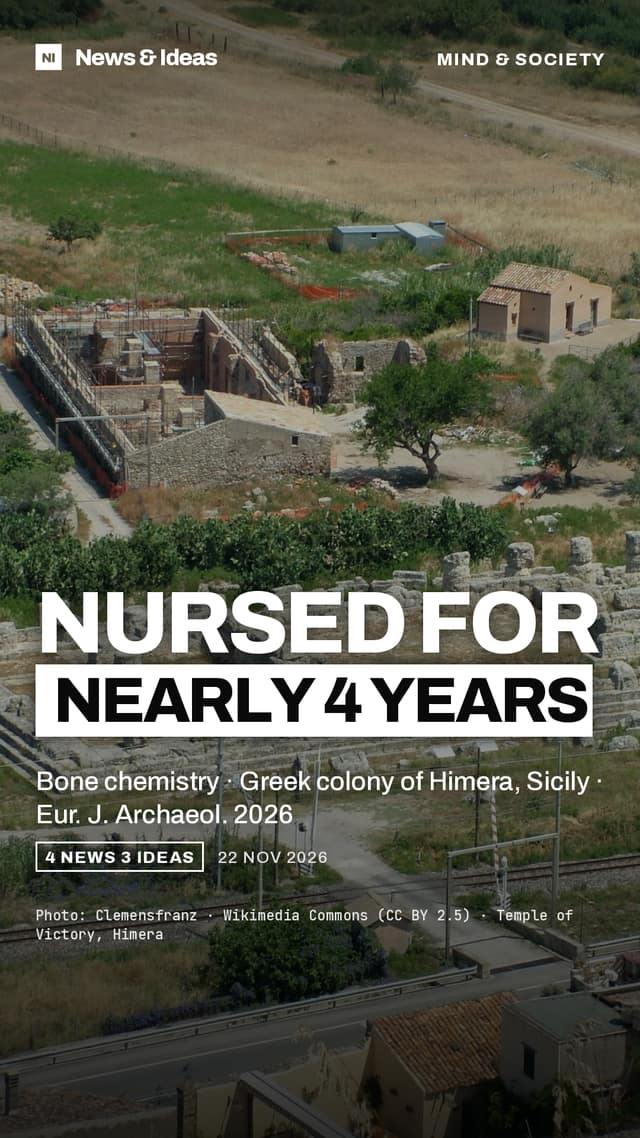
Ancient Greek Babies Nursed Nearly 4 Years
Mind & Society: weaned early and nursed long in a Greek colony, who lay in a Roman coffin, degrees dropped and pay up, scientists disagree on science. Then reading milk in bones, job market signaling, the demarcation problem.
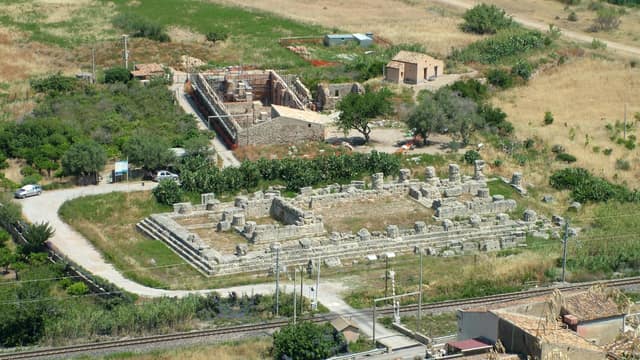
University of Georgia researchers measured carbon and nitrogen isotopes in the bones of 58 children and 27 women from Himera, a Greek colony in Sicily. Solid food typically began at three to four months, but weaning wasn't complete until three and a half to four years, later than ancient physicians advised. European Journal of Archaeology.
Photo: Clemensfranz · Wikimedia Commons (CC BY 2.5) · Temple of Victory, Himera
One email a day. 4 science stories, 5 quick results, 1 idea. 3 minutes.
Plus a daily quiz: Answer & Learn. Free, unsubscribe anytime.
Society · History
Who Lay in the Roman Coffin
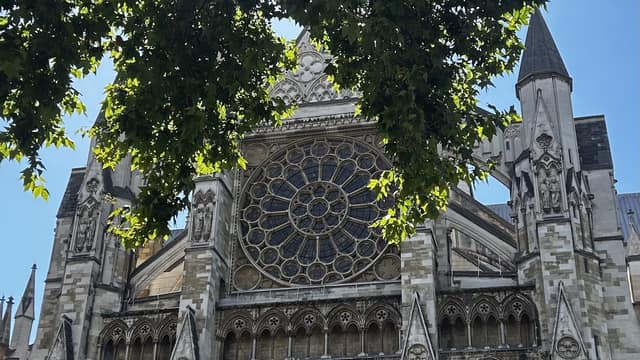
A Roman stone coffin at Westminster Abbey names a wealthy Briton, Valerius Amandinus. But inside lies a man in his late forties, radiocarbon dated to around the year 1000. Archaeologist Warwick Rodwell argues it's Abbot Aelfwig, who died around 1020. Journal of the British Archaeological Association.
Photo: MarineKardumyan · Wikimedia Commons (CC0) · Westminster Abbey, London
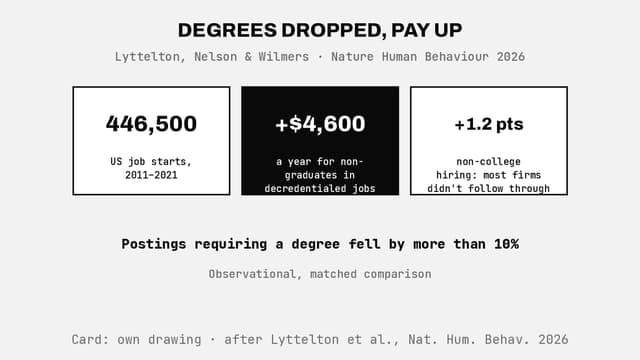
Matching 446,500 US job starts, researchers found employers cut the share of postings requiring a degree by more than ten percent. Non-graduates hired into those jobs earned about 4,600 dollars a year more than similar workers, for at least five years. Yet most such employers still hired graduates. Nature Human Behaviour.
Card: own drawing · after Lyttelton et al., Nat. Hum. Behav. 2026
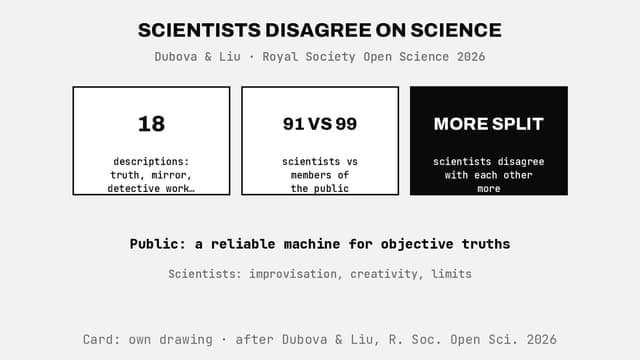
Is science a search for truth, a mirror of nature, or detective work? Marina Dubova and Qiawen Liu asked 91 scientists and 99 members of the public to rate 18 such descriptions. Scientists disagreed with each other more than the public did, stressing improvisation and creativity. Royal Society Open Science.
Card: own drawing · after Dubova & Liu, R. Soc. Open Sci. 2026
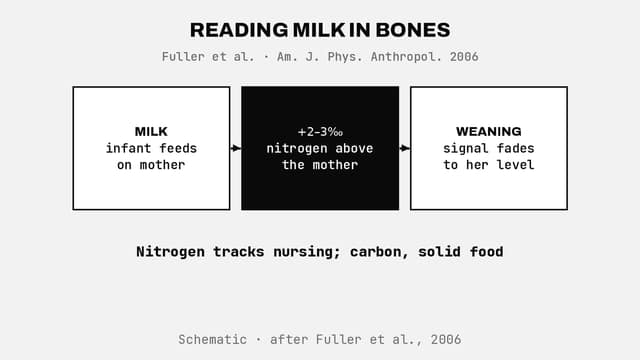
Reading milk in bones. In 2006, Benjamin Fuller's team tracked mothers and babies through hair and nails. Breastfed infants' nitrogen sat two to three parts per thousand above their mothers'. Nitrogen tracks nursing; carbon, solid food.
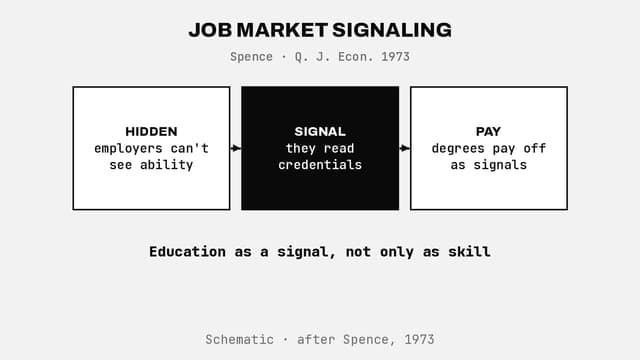
Job market signaling. In 1973, Michael Spence modeled education as a signal: employers can't see ability, so they read credentials, and degrees can pay off even without making anyone more productive.
Spence · Q. J. Econ. 1973
Schematic · after Spence, 1973
Job Market SignalingThe Quarterly Journal of Economics · Aug 1973 · Primary · Spence, Q. J. Econ. 87, 355 (1973)
Idea · Philosophy of science
The Demarcation Problem
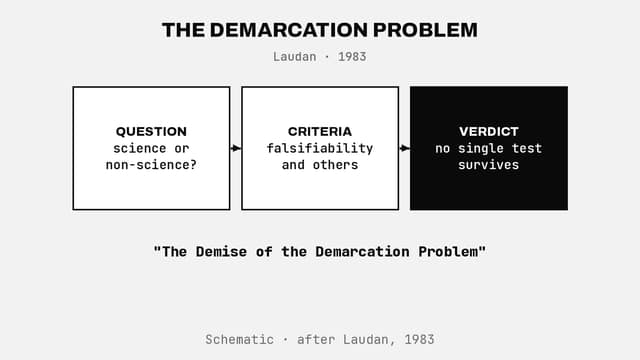
The demarcation problem. What separates science from non-science? Karl Popper proposed falsifiability, but in 1983 philosopher Larry Laudan argued that no single criterion survives scrutiny, and called it a pseudo-problem.
Laudan · 1983
Schematic · after Laudan, 1983
The Demise of the Demarcation ProblemBoston Studies in the Philosophy of Science (Physics, Philosophy and Psychoanalysis) · 1983 · Primary · Laudan, in Physics, Philosophy and Psychoanalysis (1983)
Credits
Photo: Clemensfranz · Wikimedia Commons (CC BY 2.5) · Temple of Victory, Himera
Photo: MarineKardumyan · Wikimedia Commons (CC0) · Westminster Abbey, London
Card: own drawing · after Lyttelton et al., Nat. Hum. Behav. 2026
Card: own drawing · after Dubova & Liu, R. Soc. Open Sci. 2026
Schematic · after Fuller et al., 2006
Schematic · after Spence, 1973
Schematic · after Laudan, 1983
Voice: synthetic (neural text-to-speech).
Scripts written from the linked sources.
News and Ideas4 News 3 IdeasscienceresearchMind & Societyarchaeologyancient GreeceHimeraSicilybreastfeedingweaningstable isotopesWestminster AbbeyRoman sarcophagusskills-based hiringcollege degreessignalingphilosophy of sciencedemarcation problem
Mind & Society
Question of the day
Who does Warwick Rodwell argue lay in Westminster Abbey's Roman coffin?
Valerius Amandinus, a Roman Briton
Abbot Aelfwig, who died around 1020
King Henry III
The ballot is in the email. Each choice there is counted once.