News & Ideas is a daily letter for anyone who wants the day's science in one place, not a feed. Each day is 4 news items and 3 ideas across AI & Tech, Physics & Engineering, Biology & Nature, and Mind & Society, and every story names a primary source you can check. The Shorts use a declared synthetic voice.
One email a day. 4 science stories, 5 quick results, 1 idea. 3 minutes.
Plus a daily quiz: Answer & Learn. Free, unsubscribe anytime.
Issue
17 November 2026
3 min read · 1 Short
Mind & Society: tree rings and an Alaskan volcano date Babylon's fall, 7,000 years of human height, songs that trigger shared memories, a nudge that curbs flu. Then height as a standard of living, the reminiscence bump, spillover effects.
One email a day. 4 science stories, 5 quick results, 1 idea. 3 minutes.
Plus a daily quiz: Answer & Learn. Free, unsubscribe anytime.
Mind & Society
Tree Rings and a Volcano Help Date Babylon's Fall
Mind & Society: tree rings and an Alaskan volcano date Babylon's fall, 7,000 years of human height, songs that trigger shared memories, a nudge that curbs flu. Then height as a standard of living, the reminiscence bump, spillover effects.
Charlotte Pearson and colleagues measured radiocarbon in single tree rings from timbers at Anatolian archaeological sites, anchoring a combined tree-ring chronology to calendar years from 2072 to 744 BCE. Combining tree-ring dates (some from palaces with records in the Old Assyrian calendar) with ice-core evidence, including the large Aniakchak II eruption in Alaska around 1628–1627 BCE matched to Babylonian Venus observations, they tested competing chronologies for Mesopotamia between 2000 and 1500 BCE and found strong support for the 'middle–low' chronology, which places the fall of Babylon around 1587 BCE (as reported by Phys.org). The rings also record a severe drought in 1194–1192 BCE, shortly before the Hittite capital Hattusa was sacked. PNAS, open access (CC BY-NC-ND 4.0).
Photo: Katmai National Park and Preserve (NPS) · Wikimedia Commons (public domain) · Aniakchak caldera, Alaska
One email a day. 4 science stories, 5 quick results, 1 idea. 3 minutes.
Plus a daily quiz: Answer & Learn. Free, unsubscribe anytime.
Economics · History
7,000 Years of Human Height
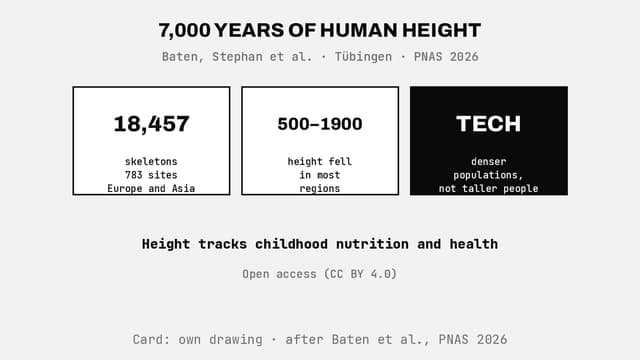
Jörg Baten, Manon Stephan, Mark Hudson and colleagues assembled 18,457 stature estimates from long bones at 783 sites across Europe and Asia, covering roughly the 7,000 years before the 20th century. Stature declined markedly in most regions between 500 and 1900 CE. Higher technology levels were associated with higher population density but not with greater stature before the modern era, even after controls such as latitude and transport access. Examples from the release: men in Southeast Asia averaged about 1.78 m 7,000 years ago and just over 1.60 m in the 19th century; in China, 11th-century high-yield rice did not bring taller people. PNAS, open access (CC BY 4.0).
Researchers including Elizabeth Margulis (Princeton) collected free descriptions of memories evoked by short clips of familiar hit songs from 233 undergraduates; the songs spanned pop, country and hip-hop, from the listeners' own teenage years or their parents'. Natural language processing showed that songs from the same category (genre and release period) cued strikingly similar memories across listeners. Control groups given key words from the lyrics (n = 121) or narrative summaries (n = 129) did not show this, so lyrics do not explain it. The authors argue that private-feeling memories follow shared, culturally learned scripts. PNAS, open access (CC BY 4.0).
Card: own drawing · after Turnbull, Margulis et al., PNAS 2026
Brian Richardson, Allison Aiello and Michael Hudgens re-analysed the eX-FLU cluster-randomised trial, which followed 579 students on a US college campus for ten weeks of flu season; students in the intervention arm were encouraged to isolate in their dorm room for three days when they had influenza-like illness. Because students interact and effects can spill over, the authors propose a randomisation-based test that controls the type I error rate in the presence of dependence and spillover. Applied to eX-FLU, it gives moderate evidence that the intervention reduced influenza-like illness. Research, not medical advice. PNAS, open access (CC BY-NC-ND 4.0).
Card: own drawing · after Richardson et al., PNAS 2026
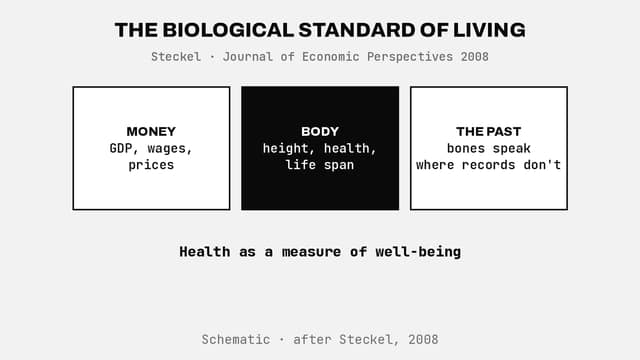
Economists traditionally measure living standards with money, such as GDP. Richard Steckel (2008) examines four biological measures, life expectancy, morbidity, stature and features of skeletal remains, which capture health and nutrition, a 'biological standard of living'. They are especially useful for historical periods where monetary data are thin or missing, as in the 7,000-year stature study.
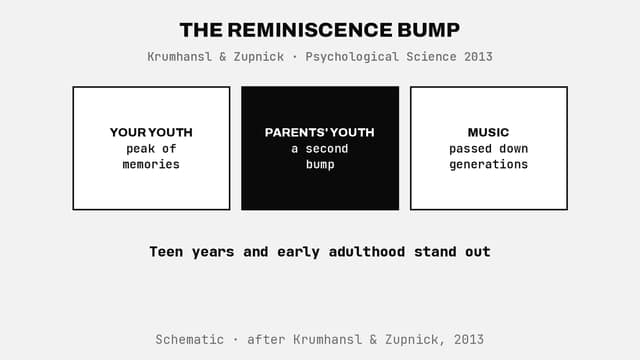
The reminiscence bump is the tendency to recall disproportionately many memories from adolescence and early adulthood. Krumhansl and Zupnick (2013) probed young adults' memories and reactions to top hits spanning five and a half decades: besides the expected bump for music of their own youth, they found 'cascading' bumps for music popular when their parents were young, suggesting music and its memories are transmitted across generations.
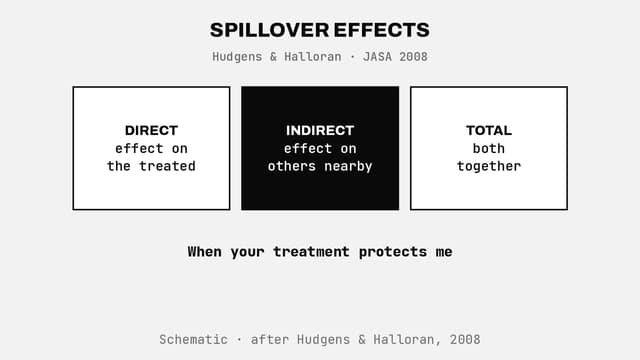
Standard causal inference assumes no interference: one person's treatment does not affect another's outcome. With infectious disease this fails. Hudgens and Halloran (2008) defined direct, indirect (spillover), total and overall causal effects for populations of groups, using two-stage randomisation. Hudgens is also a co-author of the eX-FLU analysis.