News & Ideas is a daily letter for anyone who wants the day's science in one place, not a feed. Each day is 4 news items and 3 ideas across AI & Tech, Physics & Engineering, Biology & Nature, and Mind & Society, and every story names a primary source you can check. The Shorts use a declared synthetic voice.
One email a day. 4 science stories, 5 quick results, 1 idea. 3 minutes.
Plus a daily quiz: Answer & Learn. Free, unsubscribe anytime.
Issue
4 November 2026
4 min read · 1 Short
Mind & Society: coca and alcohol traces in the hair of Inca mountain sacrifices, expert Counter-Strike players decide faster but don't multitask better, a 92-country well-being survey, 3,000 forgotten flints from Heliopolis. Then hair as a diary, drift-diffusion, flourishing.
One email a day. 4 science stories, 5 quick results, 1 idea. 3 minutes.
Plus a daily quiz: Answer & Learn. Free, unsubscribe anytime.
Mind & Society
Coca Traces Found in All Hair Samples From Inca Mummies
Mind & Society: coca and alcohol traces in the hair of Inca mountain sacrifices, expert Counter-Strike players decide faster but don't multitask better, a 92-country well-being survey, 3,000 forgotten flints from Heliopolis. Then hair as a diary, drift-diffusion, flourishing.
Coca Traces Found in All Hair Samples From Inca Mummies
Coca, alcohol and an Amazon vine: new tests on eight Inca mountain sacrifices
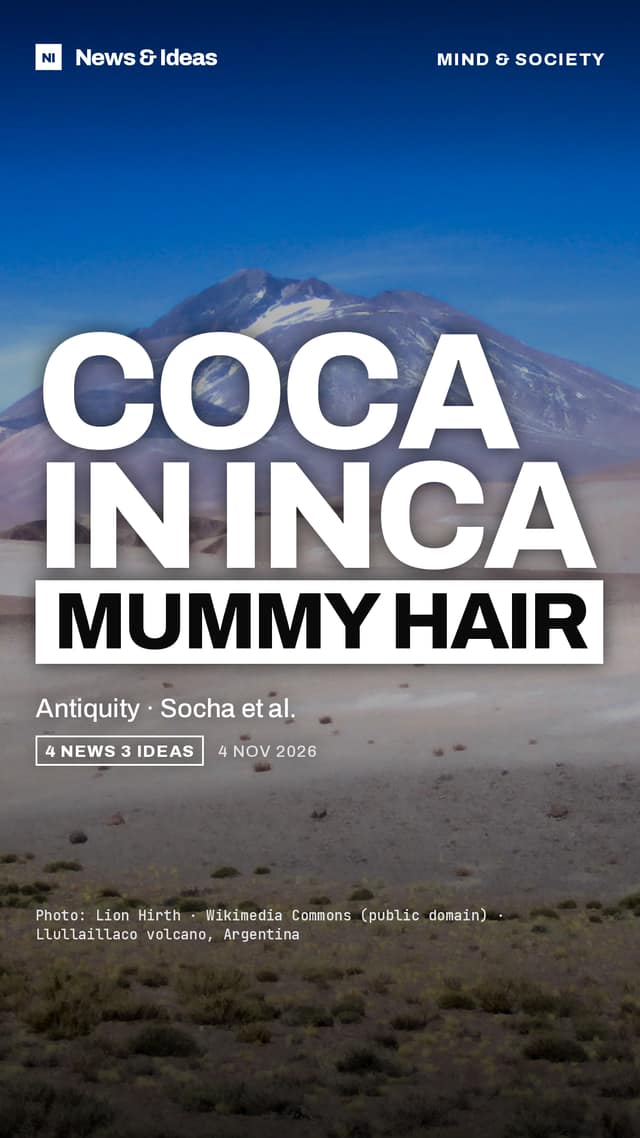
Researchers analysed hair from six and nails from two of eight Inca human sacrifices buried near volcanic peaks in Peru and Argentina, testing for ten substances with liquid chromatography and mass spectrometry. Cocaine and its metabolite benzoylecgonine, the signature of coca, were in all hair samples, but not in the two nail samples. Chuscha and Sara Sara, negative in earlier tests, are now positive. Cocaethylene, formed by the liver when cocaine and alcohol are both present, appeared only at Chuscha and Llullaillaco; in Chuscha's hair, cut into six monthly segments, only in the final month. Harmine, likely from an Amazonian vine traded over long distances, was in the nails of a girl from Ampato. The authors find no clear pattern across rituals. Small sample; peer-reviewed, open access.
One email a day. 4 science stories, 5 quick results, 1 idea. 3 minutes.
Plus a daily quiz: Answer & Learn. Free, unsubscribe anytime.
Psychology · Decisions
Expert Counter-Strike players decide faster, but they don't multitask better
Psychologists at Sheffield and Bochum recruited 310 Counter-Strike players online in 2021; 230 remained in the final sample, and cluster analysis identified 34 experts. In a decision task with one or several rules, experts responded in 863.97 milliseconds on average against 952.40 for novices, about 88 ms faster, and 523.90 against 608.77 ms with a single rule. There was no specific multitasking advantage. A drift-diffusion model put the difference down to faster uptake of information and shorter non-decision time, 339 against 393 ms. The study is correlational, so it cannot say whether gaming makes people faster or faster people become experts, and it measured behaviour, not the brain. Peer-reviewed.
Photo: European Parliament · Wikimedia Commons (CC BY 2.0) · Illustrative: a Counter-Strike 2 tournament stage, not the study participants
Young adults score lowest on well-being in a 92-country survey
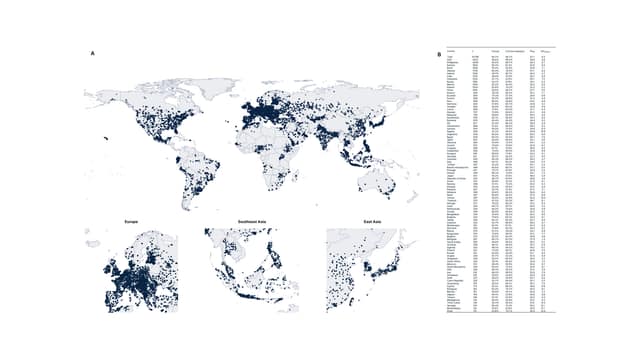
A Columbia-led consortium surveyed 53,799 people in 92 countries in mid-2025, measuring ten dimensions of well-being plus the PHQ-4 screening questionnaire. People scored highest on relationships, meaning and competence and lowest on vitality, resilience and emotional stability. Only 6.5% met an exploratory definition of flourishing. Well-being was lowest among young adults, with no U-shape across age. On the PHQ-4, 20.82% passed the threshold for depression and 22.27% for anxiety. The sample was mostly online and not representative, and the authors advise against ranking countries. Research, not clinical advice; the PHQ-4 is a screening, not a diagnosis. Peer-reviewed, open access.
Figure: Ruggeri et al., Social Indicators Research 2026 (CC BY 4.0)
3,000 forgotten flints in museum boxes reveal a Predynastic workshop at Heliopolis
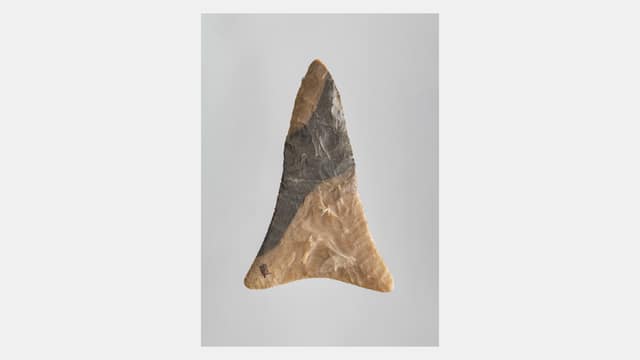
Nearly 3,000 flints excavated by Ernesto Schiaparelli at Heliopolis in 1905 and 1906 spent more than a century in 40 wooden crates at the Museo Egizio in Turin. Researchers from Italy's CNR and the museum studied them and compared them with recent finds. Many cores and few blades point to a specialised workshop where skilled knappers made blade blanks in quantities beyond household needs, while users retouched and maintained their own tools. Standardised Hammamiya knives found across the region suggest long-distance exchange. The authors argue that the village economy laid groundwork for the pharaonic state. The early-1900s excavation is less well documented than a modern dig. Peer-reviewed, open access.
Photo: Museo Egizio · Wikimedia Commons (CC0) · Illustrative: a Predynastic flint knife in the Museo Egizio, not from Heliopolis
Hair grows about one centimetre a month and takes in substances and isotopes present in the blood as it forms. Cut into segments from the root, it gives a timeline of the last months of life, something nails cannot do. Wilson and colleagues used it on the Llullaillaco mummies in 2013 and found escalating coca and alcohol use in the lead-up to death. In today's study, the six 10-millimetre segments of Chuscha's hair show cocaethylene only in the final month.
Wilson et al., PNAS 110(33), 2013 · Wikipedia, Hair analysis
The drift-diffusion model: taking a decision apart
A choice between two options can be modelled as a noisy accumulation of evidence towards one of two thresholds. The drift rate measures how fast and well information is extracted; the distance between thresholds measures caution; non-decision time covers encoding and the motor response. From the same reaction times, the model tells you why someone is faster. The expert Counter-Strike players had a higher drift rate and shorter non-decision times, 339 against 393 ms, not lower thresholds or better multitasking.
Flourishing and languishing: health is more than no illness
The sociologist Corey Keyes proposed in 2002 a continuum of mental health. At one end is flourishing, positive emotions plus good psychological and social functioning; at the other, languishing, an empty life that can exist without any diagnosable disorder. Well-being and illness are therefore two separate axes. The 92-country survey measures both, ten dimensions of well-being plus the PHQ-4 screening, and estimates flourishing at 6.5% of respondents.