News & Ideas is a daily letter for anyone who wants the day's science in one place, not a feed. Each day is 4 news items and 3 ideas across AI & Tech, Physics & Engineering, Biology & Nature, and Mind & Society, and every story names a primary source you can check. The Shorts use a declared synthetic voice.
One email a day. 4 science stories, 5 quick results, 1 idea. 3 minutes.
Plus a daily quiz: Answer & Learn. Free, unsubscribe anytime.
Issue
5 November 2026
2 min read · 1 Short
Mind & Society: many Viking ancestors came from northern Germany, Celtic languages spread from central Europe, mice that watch fights turn aggressive, DNA from 7,000-year-old goat leather. Then steppe migrations, the Bobo doll, radiocarbon calibration.
One email a day. 4 science stories, 5 quick results, 1 idea. 3 minutes.
Plus a daily quiz: Answer & Learn. Free, unsubscribe anytime.
Mind & Society
Viking Ancestors Came From Northern Germany
Mind & Society: many Viking ancestors came from northern Germany, Celtic languages spread from central Europe, mice that watch fights turn aggressive, DNA from 7,000-year-old goat leather. Then steppe migrations, the Bobo doll, radiocarbon calibration.
A study of 712 new ancient genomes, compared with 4,009 published ones, traces the spread of Germanic languages. About 1,600 years ago, people from northern Germany largely replaced the local population of Denmark and southern Sweden, a shift that coincides with the arrival of Old Norse. Many Danish and Swedish Vikings therefore shared roots with the Anglo-Saxons; Norway's population stayed largely unchanged. The authors stress that DNA does not tell us directly which language people spoke. Peer-reviewed, open access.
Photo: Jorchr · Wikimedia Commons (CC BY-SA 3.0) · Ales Stenar, southern Sweden
One email a day. 4 science stories, 5 quick results, 1 idea. 3 minutes.
Plus a daily quiz: Answer & Learn. Free, unsubscribe anytime.
History · Languages
Celtic languages spread from central Europe about 3,000 years ago
A companion study finds an expansion of ancestry from central Europe, linked to the Urnfield culture, into France, Britain, Ireland and Iberia around 3,000 years ago. It supports a central-European origin of the Celtic languages over the rival 'Atlantic' model. Peer-reviewed, open access.
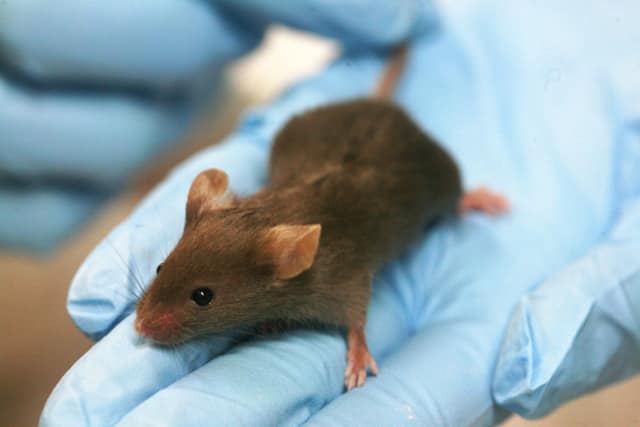
Princeton researchers found that male mice that only watched fights for eight days later attacked sooner and more often, like mice that had fought themselves. Watching reduced inhibition in a subcortical social network; reactivating the inhibitory areas returned the observers to baseline. Watching non-aggressive mice had no such effect. Peer-reviewed, in mice.
Photo: Rama · Wikimedia Commons (CC BY-SA 2.0 FR) · a lab mouse, not from the study
Tanned leather from the Cueva de los Murciélagos in Albuñol, southern Spain, dated to 7,246–7,008 calibrated years before present, yielded genomic data: it came from a female domestic goat related to the Bermeya breed of northern Spain. The authors say these are the oldest nuclear genomic data from dried skin outside frozen contexts. Peer-reviewed, open access.
Ancient DNA showed in 2015 that a large migration from the steppe north of the Black Sea reached central Europe about 4,500 years ago, a likely route for Indo-European languages. Today's Germanic and Celtic studies apply the same method to later branches of that family.
In 1961 Albert Bandura showed that children who watched an adult hit an inflatable doll imitated the aggression, without any reward. Learning by observation became a core idea of social learning theory. Today's Princeton study finds a brain mechanism for something similar in mice.
Bandura, Ross & Ross (1961) · Wikipedia, Bobo doll experiment
The amount of carbon-14 in the air has changed over time, so raw radiocarbon ages must be corrected with a calibration curve built from tree rings and other records. That is why dates come as 'cal BP' ranges, like the 7,246–7,008 years of today's goat leather.