News & Ideas is a daily letter for anyone who wants the day's science in one place, not a feed. Each day is 4 news items and 3 ideas across AI & Tech, Physics & Engineering, Biology & Nature, and Mind & Society, and every story names a primary source you can check. The Shorts use a declared synthetic voice.
One email a day. 4 science stories, 5 quick results, 1 idea. 3 minutes.
Plus a daily quiz: Answer & Learn. Free, unsubscribe anytime.
Issue
30 October 2026
2 min read · 1 Short
Mind & Society: the phantom lighthouse, moral surgery on our memories, unreliable sources that still sway us, fake local news ads. Then the Bayesian brain, reconstructive memory, the continued influence effect.
One email a day. 4 science stories, 5 quick results, 1 idea. 3 minutes.
Plus a daily quiz: Answer & Learn. Free, unsubscribe anytime.
Mind & Society
A phantom lighthouse, moral memory, fake local news
Mind & Society: the phantom lighthouse, moral surgery on our memories, unreliable sources that still sway us, fake local news ads. Then the Bayesian brain, reconstructive memory, the continued influence effect.
A phantom lighthouse, moral memory, fake local news
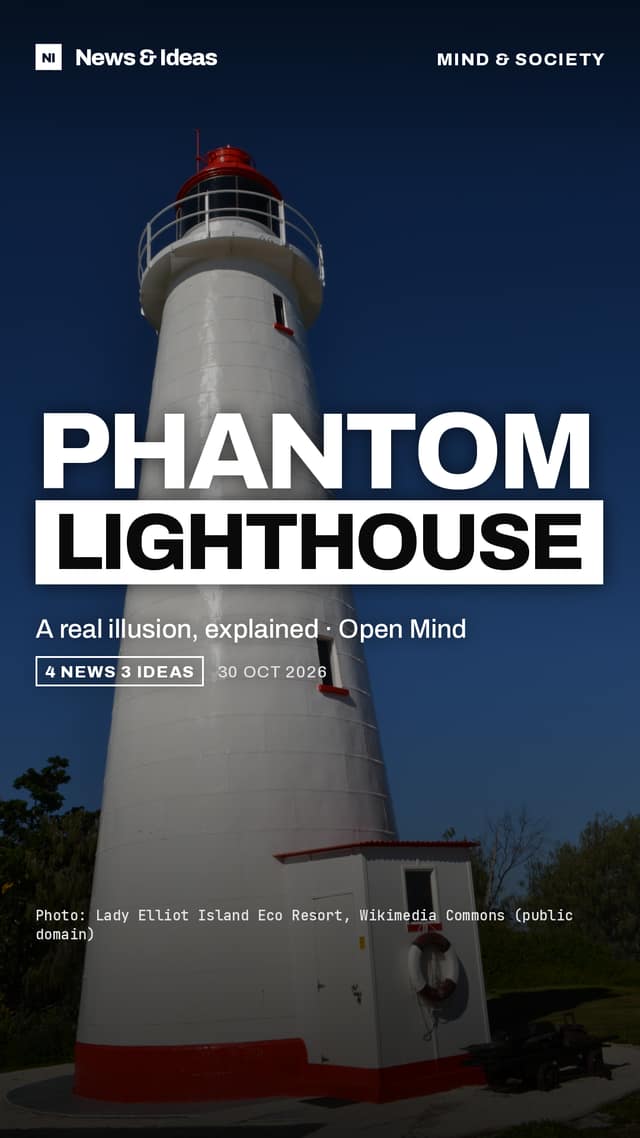
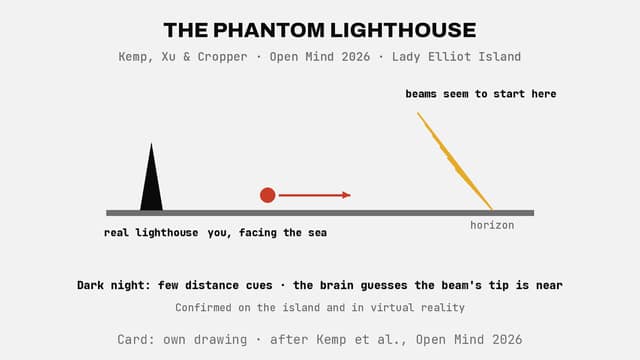
On Lady Elliot Island, in Australia, visitors at night see beams of a phantom lighthouse on the horizon. Researchers explain it with a Bayesian model: in the dark, the brain assumes the beam's tip is near and slow. They confirmed it on the island and in virtual reality. Published in Open Mind.
Card: own drawing · after Kemp, Xu & Cropper, Open Mind 2026
One email a day. 4 science stories, 5 quick results, 1 idea. 3 minutes.
Plus a daily quiz: Answer & Learn. Free, unsubscribe anytime.
Society · Memory
After a scandal, we rewrite the artist
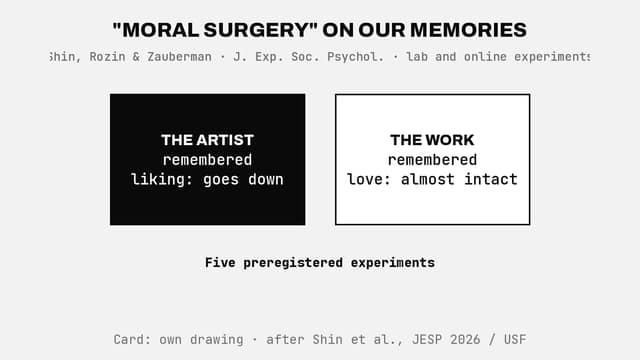
In five preregistered lab and online experiments, researchers at South Florida, Penn and Yale found after learning of a creator's wrongdoing, people remembered liking the artist less, while their memory of loving the work stayed almost intact. Published in the Journal of Experimental Social Psychology.
Card: own drawing · after Shin, Rozin & Zauberman, JESP 2026
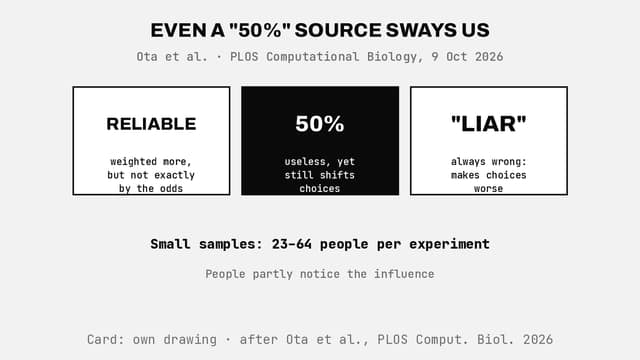
A team from Tsukuba and Queen Mary University of London gave people advice from sources labelled with how often they are right. Even sources labelled fifty percent, which are useless, still shifted choices. Samples were small, a few dozen people each. Published in PLOS Computational Biology.
Card: own drawing · after Ota et al., PLOS Comput. Biol. 2026
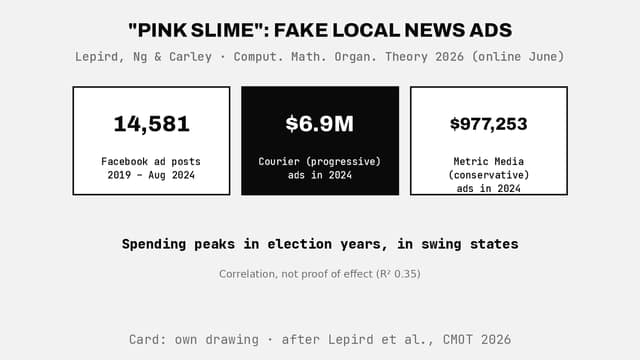
Carnegie Mellon researchers studied pink slime sites, partisan outlets that look like local papers. Facebook ad spending rose in election years, mostly in swing states. In 2024 the progressive Courier spent 6.9 million dollars on ads; the conservative Metric Media, about 977,000. The link to online conversation is a correlation.
Card: own drawing · after Lepird, Ng & Carley, CMOT 2026
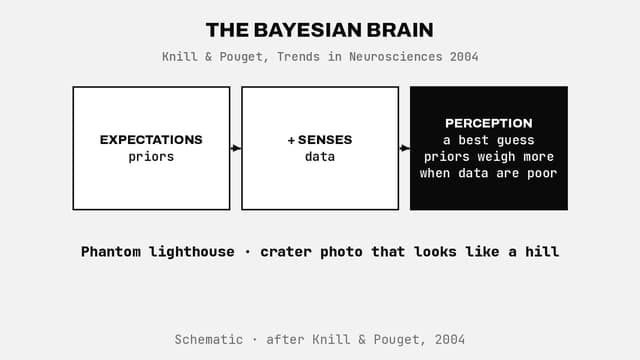
The Bayesian brain. Perception is inference: the brain combines expectations with sensory data, and leans on expectations when the data are poor. Think of the phantom lighthouse, or a crater photo that looks like a hill upside down.
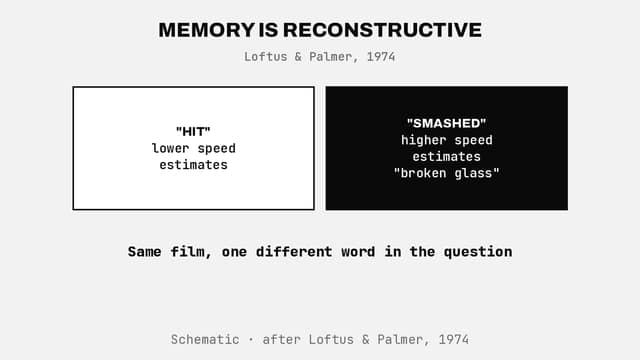
Memory is reconstructive. Remembering rebuilds the past, and later information can change it. In Loftus and Palmer's classic study, people asked how fast cars smashed, not hit, gave higher speeds, and some recalled broken glass that was not there.
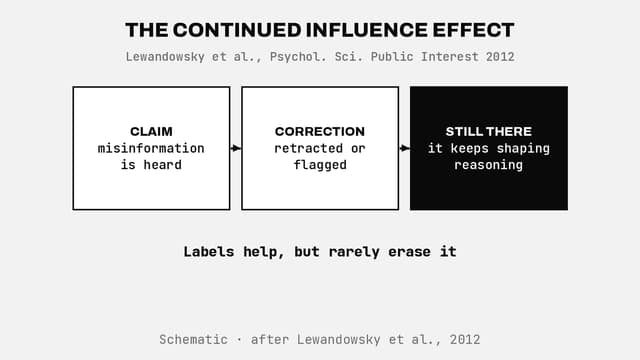
The continued influence effect. Misinformation keeps shaping our reasoning even after it is corrected or flagged as doubtful. That is why labels help, but rarely erase a weak source's pull.