News & Ideas is a daily letter for anyone who wants the day's science in one place, not a feed. Each day is 4 news items and 3 ideas across AI & Tech, Physics & Engineering, Biology & Nature, and Mind & Society, and every story names a primary source you can check. The Shorts use a declared synthetic voice.
One email a day. 4 science stories, 5 quick results, 1 idea. 3 minutes.
Plus a daily quiz: Answer & Learn. Free, unsubscribe anytime.
Issue
15 November 2026
3 min read · 1 Short
Mind & Society: a Roman 'frog feast' that was owls, love and loneliness with chatbots, why climate worry freezes some teens, funny job ads. Then taphonomy, parasocial bonds, fear appeals.
One email a day. 4 science stories, 5 quick results, 1 idea. 3 minutes.
Plus a daily quiz: Answer & Learn. Free, unsubscribe anytime.
Mind & Society
A Roman 'Frog Feast' That Was Really Owls
Mind & Society: a Roman 'frog feast' that was owls, love and loneliness with chatbots, why climate worry freezes some teens, funny job ads. Then taphonomy, parasocial bonds, fear appeals.
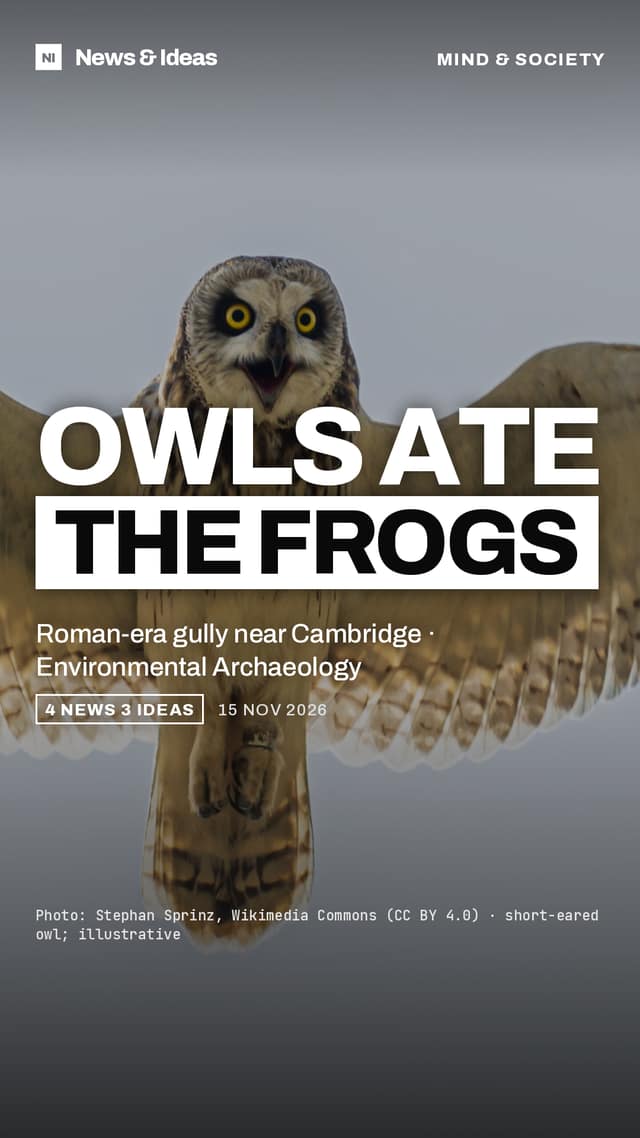
During roadworks near Cambridge, excavators found an Iron Age/Roman gully with 9,135 tiny bones, mostly common frogs, plus voles, shrews and snakes. Paul Clarkson (Bournemouth University) and colleagues examined over 1,700 of them: no burning, butchery or chewing, and digestion marks on nearly 86% of the frogs. The damage pattern rules out barn owls, otters, snakes and herons and points to short-eared owls, probably roosting with hen harriers, feasting on a single year's glut of young frogs. Because these shy birds avoid people, the authors suggest the area was rarely visited that winter. Environmental Archaeology, open access (CC BY 4.0).
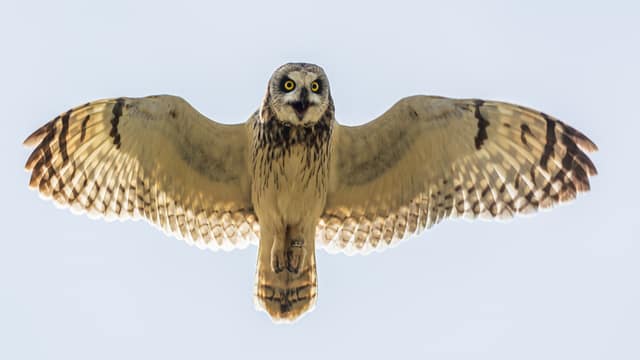
Photo: Stephan Sprinz · Wikimedia Commons (CC BY 4.0) · short-eared owl; illustrative
One email a day. 4 science stories, 5 quick results, 1 idea. 3 minutes.
Plus a daily quiz: Answer & Learn. Free, unsubscribe anytime.
Psychology · AI
Love With a Chatbot, and Loneliness
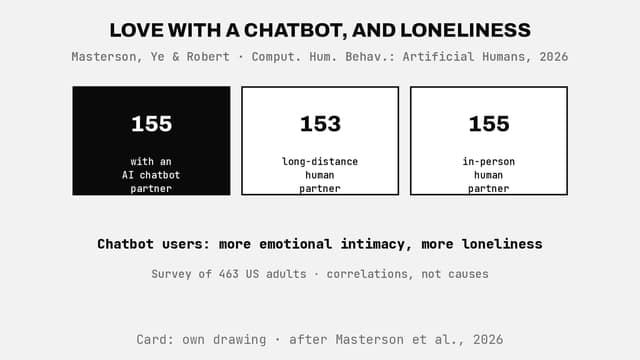
Researchers including Lionel Robert (University of Michigan) surveyed 463 US adults: 155 in intimate relationships with AI chatbots, 153 in long-distance and 155 in in-person human relationships. Intimacy levels were comparable across groups. In chatbot relationships, emotional intimacy correlated with higher loneliness while also raising satisfaction, the opposite of human relationships; the link disappeared once social support was accounted for. Intellectual intimacy predicted well-being and satisfaction more strongly in chatbot and long-distance relationships. Cross-sectional survey: correlations, not causes. Computers in Human Behavior: Artificial Humans, open access.
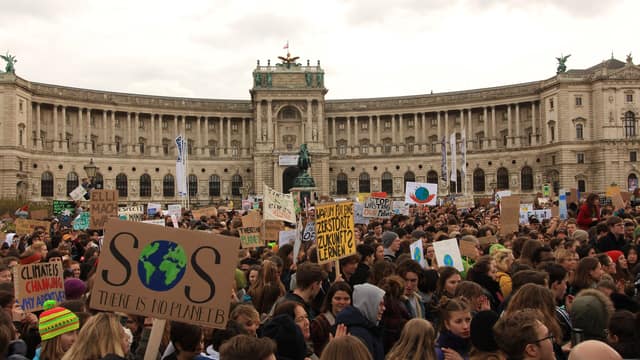
Brianne Suldovsky (Portland State University) and colleagues surveyed a diverse sample of 1,603 US teens and young adults aged 13 to 22. Climate distress positively predicted willingness to take individual and collective climate action, but also eco-paralysis. Climate contempt, being annoyed by the panic about climate change, tested alongside distress, predicted more eco-paralysis and less willingness to act. Learning about climate on social media did not reliably predict action; news and conversations did more for collective action (release). Cross-sectional survey. Climate (MDPI), open access (CC BY 4.0).
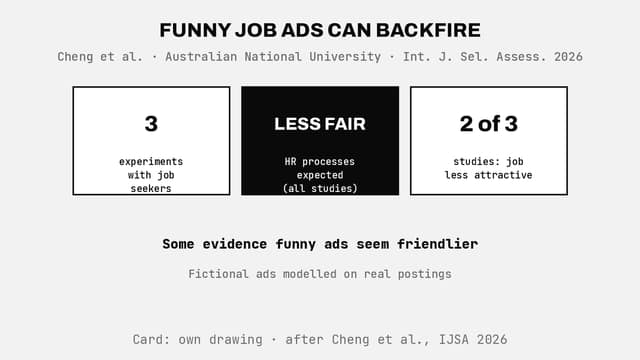
David Cheng (Australian National University) and colleagues ran three experiments with over 750 job seekers, using postings modelled on real ads. Across studies, humorous postings led people to expect lower procedural justice, that is, less fair HR processes. Studies 1 and 2 found a negative effect of humour on job attractiveness; Study 3, using many stimuli, found no significant effect. There was some evidence that humour made the organisation seem friendlier. International Journal of Selection and Assessment, open access (CC BY-NC-ND 4.0).
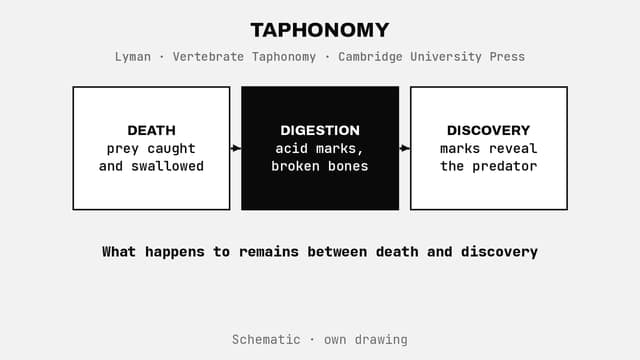
Taphonomy studies what happens to remains between death and excavation: predators, digestion, trampling, roots, soil chemistry. Lyman's textbook sets out how these processes are read from bones. Owls swallow small prey whole and regurgitate pellets, and the degree of digestion and breakage differs by predator, which is how Clarkson and colleagues identified short-eared owls behind the Roman-era frog bones.
Lyman · Vertebrate Taphonomy (Cambridge)
Schematic · own drawing
Vertebrate TaphonomyCambridge University Press · 1994 · Primary · Lyman, Vertebrate Taphonomy (Cambridge University Press, 1994)
Idea · Media psychology
Parasocial Relationships
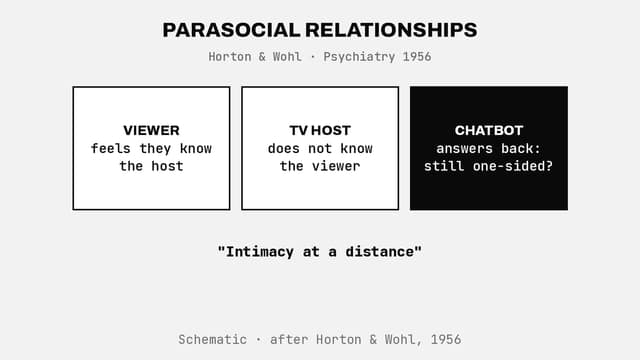
In 1956 Donald Horton and Richard Wohl described para-social interaction: the illusion of a face-to-face relationship with a media performer, an 'intimacy at a distance' that is one-sided because the performer does not know the viewer. AI companions complicate the idea because they respond, which is part of what today's chatbot-intimacy survey explores.
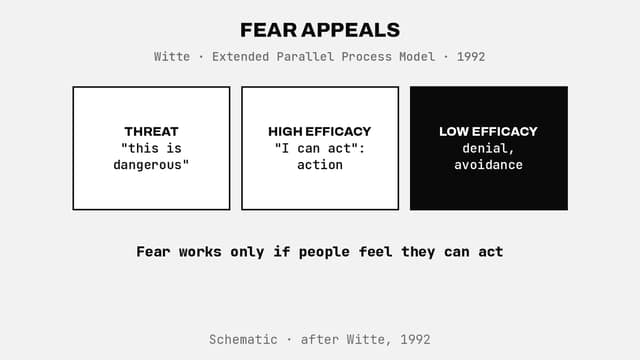
Kim Witte's Extended Parallel Process Model (1992) says fear appeals lead to protective action only when perceived efficacy is high: people must believe the recommended action works and that they can do it. With high threat and low efficacy, people switch to controlling the fear, through denial, avoidance or reactance. It offers one lens on why climate distress paralyses some young people.