News & Ideas is a daily letter for anyone who wants the day's science in one place, not a feed. Each day is 4 news items and 3 ideas across AI & Tech, Physics & Engineering, Biology & Nature, and Mind & Society, and every story names a primary source you can check. The Shorts use a declared synthetic voice.
One email a day. 4 science stories, 5 quick results, 1 idea. 3 minutes.
Plus a daily quiz: Answer & Learn. Free, unsubscribe anytime.
Issue
13 November 2026
2 min read · 1 Short
Mind & Society: Preschoolers Keep a Wrong Belief to Stay in the Group, Possibly Poisoned Weapons at a 125,000-Year-Old Arabian Lake, Useful Shapes Improve Down Generations; Pretty Ones Drift, Who Uses AI, and Who Pays for It. Then The Blicket Detector, Identity-Protective Cognition, Transmission-Chain Experiments.
One email a day. 4 science stories, 5 quick results, 1 idea. 3 minutes.
Plus a daily quiz: Answer & Learn. Free, unsubscribe anytime.
Mind & Society
Preschoolers Keep a Wrong Belief to Fit In
Mind & Society: Preschoolers Keep a Wrong Belief to Stay in the Group, Possibly Poisoned Weapons at a 125,000-Year-Old Arabian Lake, Useful Shapes Improve Down Generations; Pretty Ones Drift, Who Uses AI, and Who Pays for It. Then The Blicket Detector, Identity-Protective Cognition, Transmission-Chain Experiments.
Preschoolers Keep a Wrong Belief to Stay in the Group
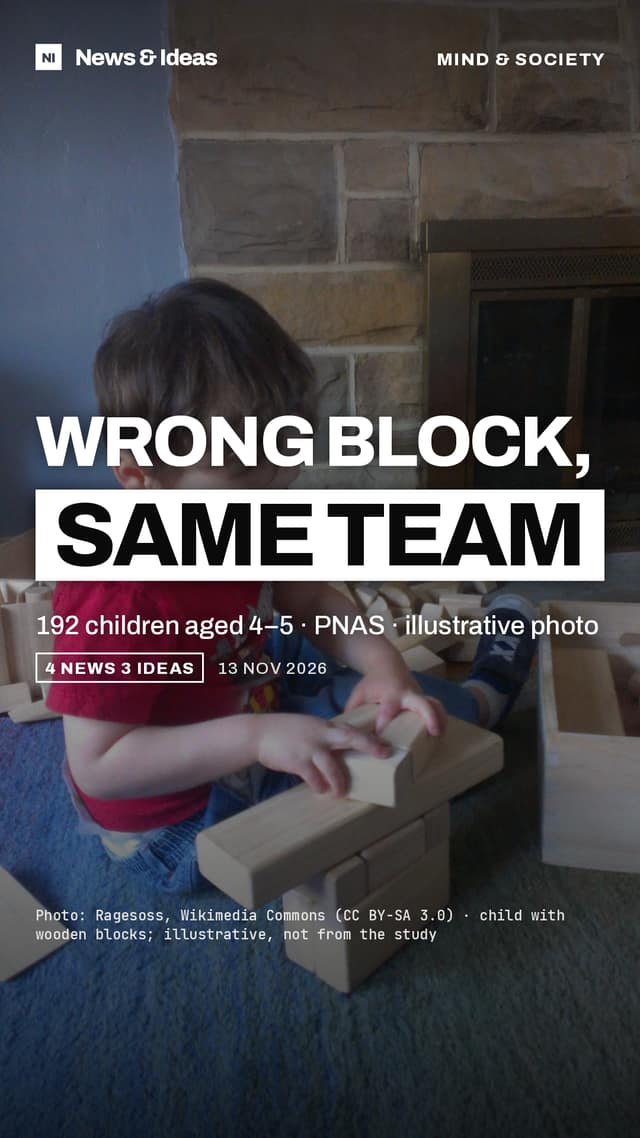
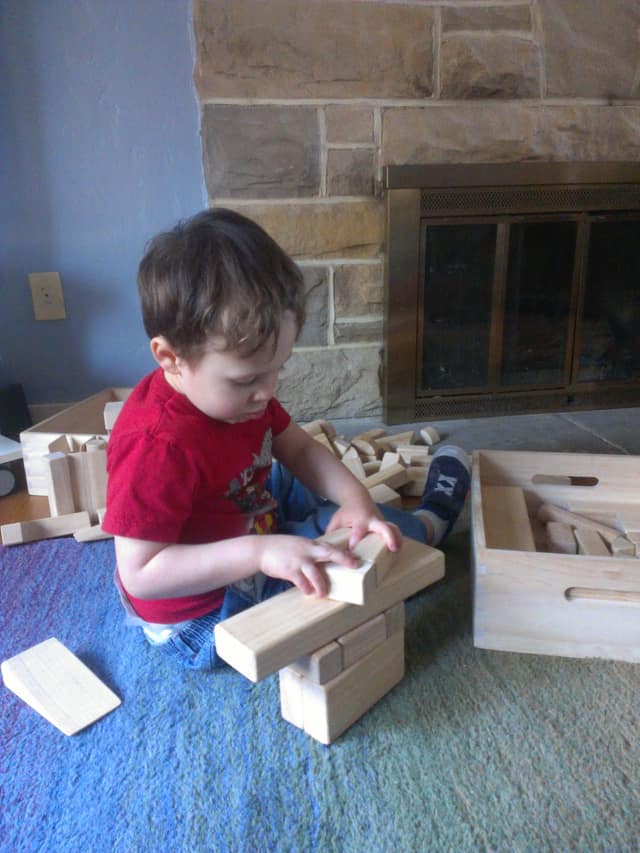
In three studies with 192 children aged four and five, Duke psychologists let each child pick an orange or a purple block to light up a machine, then introduced a puppet team that shared the choice. When membership depended on holding that belief, children kept choosing their block even after it failed twice and the other block worked twice; when the team was simply friendly, they revised. Calling the belief a 'guess' removed the resistance, and the effect held even with the puppets absent. The study does not show how this develops into adult polarization. Peer-reviewed, PNAS.
Photo: Ragesoss, Wikimedia Commons (CC BY-SA 3.0) · child with wooden blocks; illustrative, not from the study
One email a day. 4 science stories, 5 quick results, 1 idea. 3 minutes.
Plus a daily quiz: Answer & Learn. Free, unsubscribe anytime.
Mind & Society
Possibly Poisoned Weapons at a 125,000-Year-Old Arabian Lake
At 'Uruq Aljelibah in the Rub' al-Khali desert, a team led by Griffith University recovered more than 5,000 stone artifacts from a paleolake shore of the humid period about 125,000 years ago. Hafted points carry impact damage, animal residues at the tips, resin and fibres at the base, and biomarkers linked to Acokanthera schimperi, a tree used for arrow poison, which the authors read as possible evidence of poisoned weapons. Bones show hippos, buffalo, camels, gazelles and oryx. Peer-reviewed, Science.
Useful Shapes Improve Down Generations; Pretty Ones Drift
Six hundred participants in Czechia and Cameroon designed 3D-printed objects in transmission chains, each copying the previous design. Objects meant to roll down a ramp improved generation after generation even without selection, a sign of guided variation, while objects judged on looks did not. Peer-reviewed, Evolution and Human Behavior (CC BY-NC).
Dupree and Liang argue that differences in who adopts AI tools, and how, could widen existing social inequalities, and set out a research agenda on unequal causes and consequences of AI use. A Comment piece without new data. Open access, Communications Psychology.
Developmental psychologists study causal learning with a box that lights up when certain objects, 'blickets', are placed on it. Even preschoolers use the evidence to work out which objects have the hidden power. The Duke study uses a similar machine to see when children ignore that evidence.
When a fact threatens a group identity, people often reason to protect the identity rather than the fact. In Kahan's experiments, numerate adults solved the same data problem correctly when it was about skin cream but less accurately when the answer clashed with their politics on gun control.
Like the telephone game, one person learns something and passes it to the next, and researchers watch what changes. Such chains reveal biases in what we remember and copy. The 3D-printed shapes study is a modern version with physical objects.