News & Ideas is a daily letter for anyone who wants the day's science in one place, not a feed. Each day is 4 news items and 3 ideas across AI & Tech, Physics & Engineering, Biology & Nature, and Mind & Society, and every story names a primary source you can check. The Shorts use a declared synthetic voice.
One email a day. 4 science stories, 5 quick results, 1 idea. 3 minutes.
Plus a daily quiz: Answer & Learn. Free, unsubscribe anytime.
Issue
27 November 2026
2 min read · 1 Short
Mind & Society: Stone Age road signs, rings for traveling merchants, whether the few must always rule, interest versus money. Then the iron law of oligarchy, the overjustification effect, cognitive maps.
One email a day. 4 science stories, 5 quick results, 1 idea. 3 minutes.
Plus a daily quiz: Answer & Learn. Free, unsubscribe anytime.
Mind & Society
Were Stone Age Elk Carvings Road Signs?
Mind & Society: Stone Age road signs, rings for traveling merchants, whether the few must always rule, interest versus money. Then the iron law of oligarchy, the overjustification effect, cognitive maps.
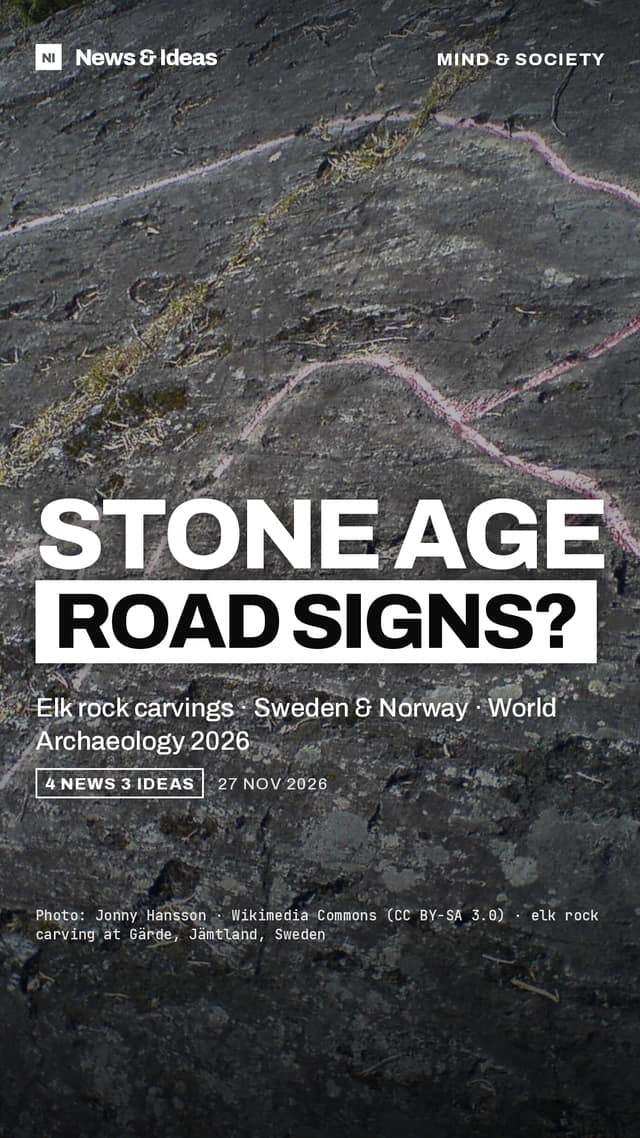
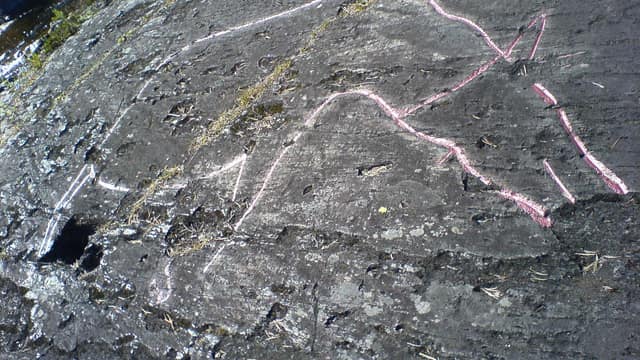
Between about 9,000 and 4,000 BC, people in Scandinavia carved huge, sometimes life-size elk and reindeer on rock faces by water. A Lund-led team studied four sites in Sweden and Norway. The animals stand at river crossings and near dangerous rapids, so the carvings may have marked hunting grounds.
Photo: Jonny Hansson · Wikimedia Commons (CC BY-SA 3.0) · elk rock carving at Gärde, Jämtland, Sweden
One email a day. 4 science stories, 5 quick results, 1 idea. 3 minutes.
Plus a daily quiz: Answer & Learn. Free, unsubscribe anytime.
Archaeology · Trade
Rings for Traveling Merchants?
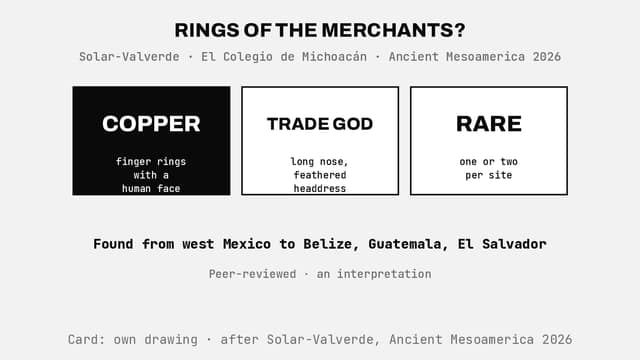
Copper rings with the same face, a long nose and a feathered headdress, turn up from west Mexico to Belize and El Salvador. An archaeologist argues the face is a god of trade, and these rare rings, one or two per site, marked long-distance merchants around 900 to 1350 AD.
Card: own drawing · after Solar-Valverde, Ancient Mesoamerica 2026
Sociologist Robert Michels claimed every organization ends up ruled by a few. UC Merced researchers simulated competing groups of 500 virtual members. When fast agreement paid off, a few leaders took over. When careful deliberation paid off, groups evolved flatter structures. It's a model, not field data.
Card: own drawing · after Aswamenakul et al., R. Soc. Open Sci. 2026
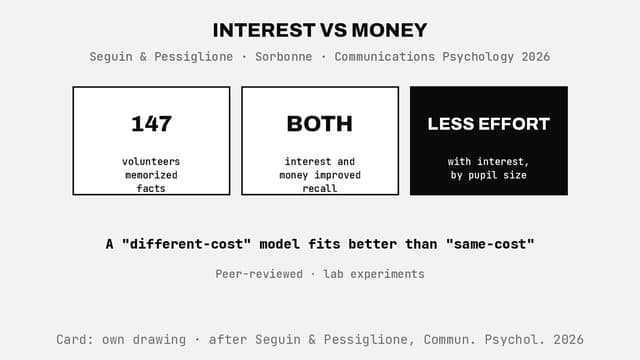
Does learning for fun feel easier than learning for money? Sorbonne University researchers had 147 volunteers memorize facts, rating their interest and earning cash for correct recall. Both interest and money improved memory. But pupil measurements showed that interest did it with less mental effort.
Card: own drawing · after Seguin & Pessiglione, Commun. Psychol. 2026
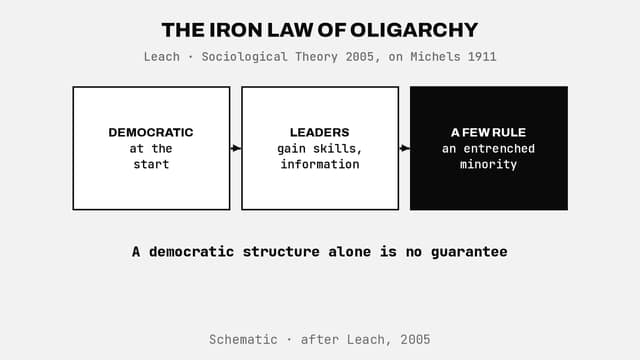
The iron law of oligarchy. In 1911, Robert Michels argued that organizations, however democratic, hand power to an elite. In 2005, Darcy Leach defined oligarchy as illegitimate power held by an entrenched minority, and showed democratic rules alone don't prevent it.
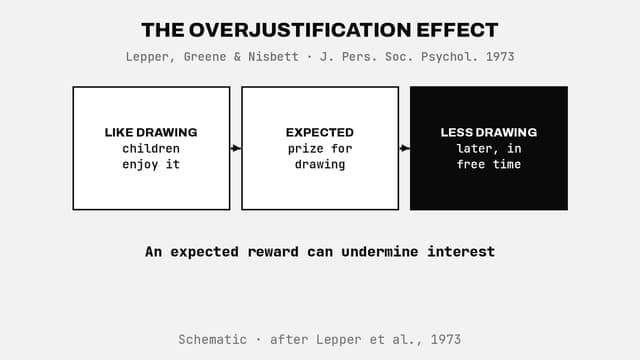
The overjustification effect. In 1973, Mark Lepper, David Greene and Richard Nisbett let preschoolers who liked drawing earn an expected award for it. Later, in free play, they drew less than kids who got no award or a surprise one. Paying for fun can backfire.
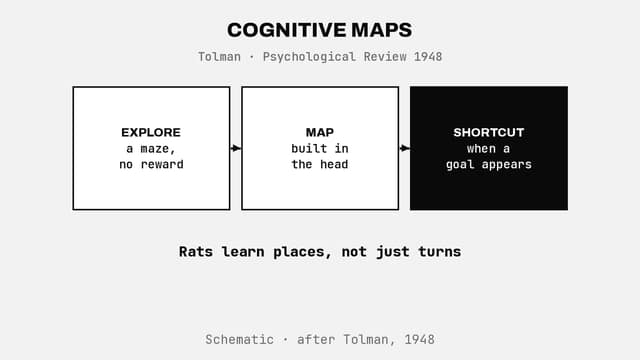
Cognitive maps. In 1948, Edward Tolman argued that rats in mazes learn a map of the space, not just a chain of turns. Rats that explored with no reward still learned the maze, and showed it once food appeared. Landmarks are what such maps are made of.