News & Ideas is a daily letter for anyone who wants the day's science in one place, not a feed. Each day is 4 news items and 3 ideas across AI & Tech, Physics & Engineering, Biology & Nature, and Mind & Society, and every story names a primary source you can check. The Shorts use a declared synthetic voice.
One email a day. 4 science stories, 5 quick results, 1 idea. 3 minutes.
Plus a daily quiz: Answer & Learn. Free, unsubscribe anytime.
Issue
28 November 2026
2 min read · 1 Short
Mind & Society: stories that build grit, who reads your face best, the pandemic’s lasting effect on city travel, inequality that converges. Then universal facial expressions, habit discontinuity, sound symbolism.
One email a day. 4 science stories, 5 quick results, 1 idea. 3 minutes.
Plus a daily quiz: Answer & Learn. Free, unsubscribe anytime.
Mind & Society
Stories That Build Grit in Kids
Mind & Society: stories that build grit, who reads your face best, the pandemic’s lasting effect on city travel, inequality that converges. Then universal facial expressions, habit discontinuity, sound symbolism.
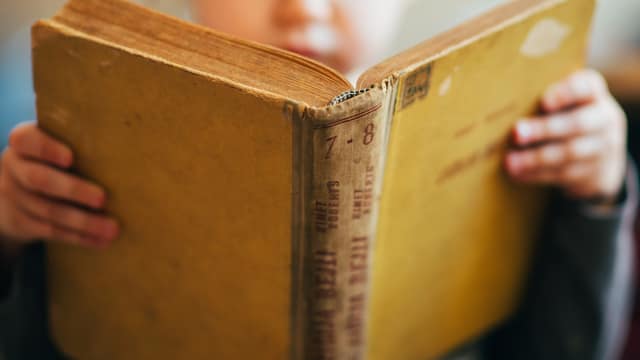
Can a story make kids try harder? Concordia University researchers read storybooks to 154 children aged seven and eight: tales of characters who struggle and persist, or wordplay stories. A day later, the struggle group spent longer on hard mazes and puzzles, made more attempts, and succeeded more often.
Photo: Shixart1985 · Wikimedia Commons (CC BY 2.0) · a child reading, illustrative
One email a day. 4 science stories, 5 quick results, 1 idea. 3 minutes.
Plus a daily quiz: Answer & Learn. Free, unsubscribe anytime.
Psychology · Emotions
Who Reads Your Face Best?
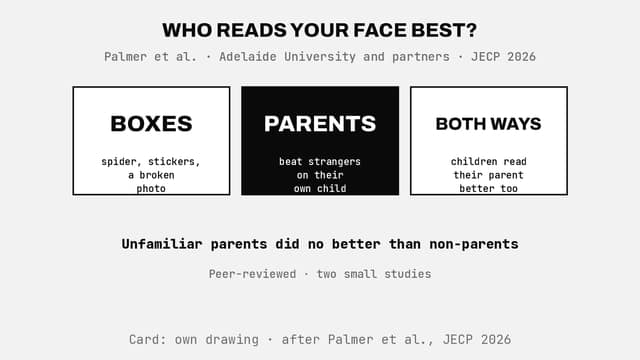
Picture a child opening a box with a toy spider inside, while a parent guesses what's in it from the child's face. Adelaide University researchers and partners found parents read their own child better than strangers did, and children read their own parent better. Other parents had no edge.
Card: own drawing · after Palmer et al., JECP 2026
University of Liverpool researchers analyzed over 170 million anonymized Facebook location records from Argentina, Chile and Colombia. Two years after the pandemic began, movement in dense city areas was still below pre-pandemic levels, by 25 to 50 percent in Colombia. The most affluent third of communities still hadn't returned to baseline.
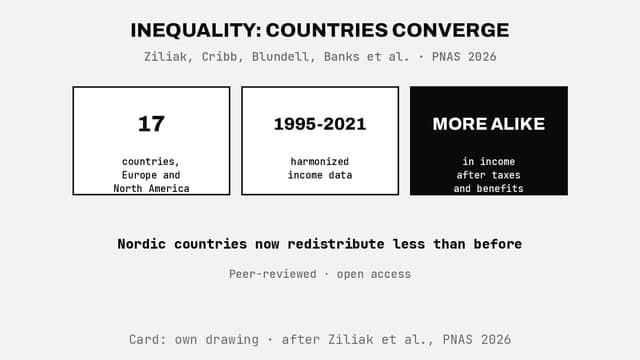
Fifty-eight researchers compared income data from 17 countries in Europe and North America, from 1995 to 2021. Earnings inequality grew more different between countries. But after taxes and benefits, countries became more alike, as Nordic countries redistributed less and others more. Average inequality rose.
Card: own drawing · after Ziliak et al., PNAS 2026
Unpacking transatlantic income inequalityProceedings of the National Academy of Sciences · 3 Nov 2026 · Primary · Ziliak, Cribb, Blundell, Banks et al., PNAS (2026)
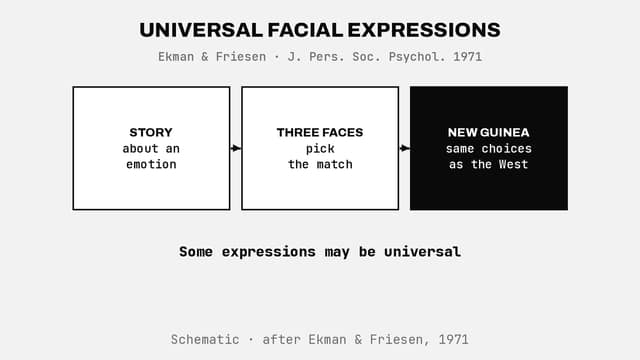
Universal facial expressions. In 1971, Paul Ekman and Wallace Friesen told people in New Guinea, with little exposure to Western media, short stories, then showed three faces. Their choices matched other cultures'. Some expressions may be universal, yet a familiar face is easier to read.
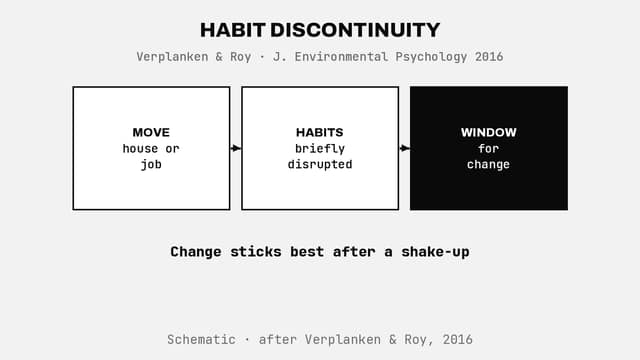
Habit discontinuity. In 2016, Bas Verplanken and a colleague tested an intervention promoting greener habits with 800 people. It worked better for those who had just moved house, with a window of about three months. Big disruptions can reset routines, for better or for worse.
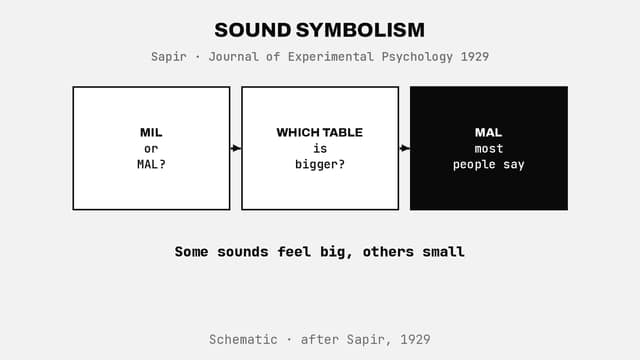
Sound symbolism. In 1929, linguist Edward Sapir asked people which made-up word, mil or mal, named a bigger table. Most chose mal. Vowels made further back in the mouth tend to sound bigger, a pattern linguists still find across languages. Think of teeny versus huge.
Sapir · J. Exp. Psychol. 1929
Schematic · after Sapir, 1929
A study in phonetic symbolismJournal of Experimental Psychology · Jun 1929 · Primary · Sapir, J. Exp. Psychol. 12, 225 (1929)
Credits
Photo: Shixart1985 · Wikimedia Commons (CC BY 2.0) · a child reading, illustrative
Card: own drawing · after Palmer et al., JECP 2026