News & Ideas is a daily letter for anyone who wants the day's science in one place, not a feed. Each day is 4 news items and 3 ideas across AI & Tech, Physics & Engineering, Biology & Nature, and Mind & Society, and every story names a primary source you can check. The Shorts use a declared synthetic voice.
One email a day. 4 science stories, 5 quick results, 1 idea. 3 minutes.
Plus a daily quiz: Answer & Learn. Free, unsubscribe anytime.
Issue
28 November 2026
2 min read · 1 Short
AI & Tech: a battery that works at minus 50, silent speech from a tooth, hair that records the brain, AI that follows hopping electrons. Then neural-network potentials, CTC, organic electrochemical transistors.
One email a day. 4 science stories, 5 quick results, 1 idea. 3 minutes.
Plus a daily quiz: Answer & Learn. Free, unsubscribe anytime.
AI & Tech
A Battery That Works at −50°C
AI & Tech: a battery that works at minus 50, silent speech from a tooth, hair that records the brain, AI that follows hopping electrons. Then neural-network potentials, CTC, organic electrochemical transistors.
Water-based batteries usually freeze in deep cold. A team in China made the electrolyte from filtered salt-lake water plus antifreeze, and coated the zinc electrode with an alloy. Their pouch battery kept 80 percent of its capacity after 900 cycles at minus 50 degrees Celsius.
Photo: ZhengZhou · Wikimedia Commons (CC BY-SA 3.0) · Chaqia Salt Lake, Qinghai, China, illustrative
One email a day. 4 science stories, 5 quick results, 1 idea. 3 minutes.
Plus a daily quiz: Answer & Learn. Free, unsubscribe anytime.
AI · Interfaces
Talk to AI Without a Sound
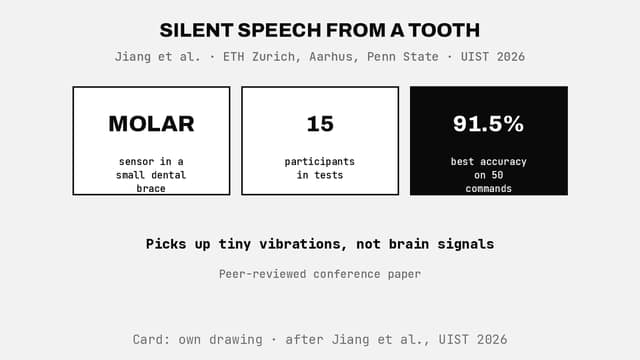
Imagine talking to an AI without a sound. ETH Zurich researchers built InvisiSpeech, a tiny sensor in a dental brace around a back molar. It picks up faint vibrations as you silently form words with your tongue. With 15 people, it recognized up to 91.5 percent of 50 commands.
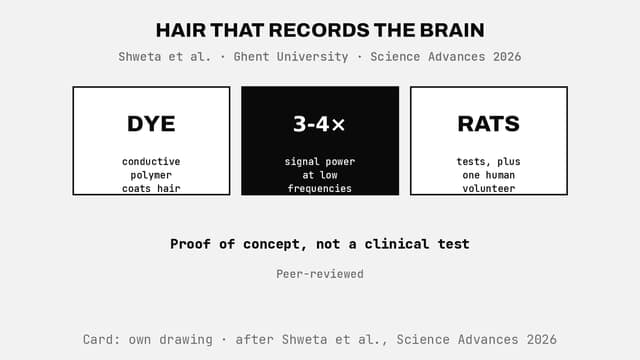
Hair gets in the way of brain electrodes. So a team including Ghent University researchers turned hair into electrodes, with conductive polymer dyes. In rats, dyed hair picked up three to four times more low-frequency signal power than a standard electrode, though placement may explain part of that.
Card: own drawing · after Shweta et al., Science Advances 2026
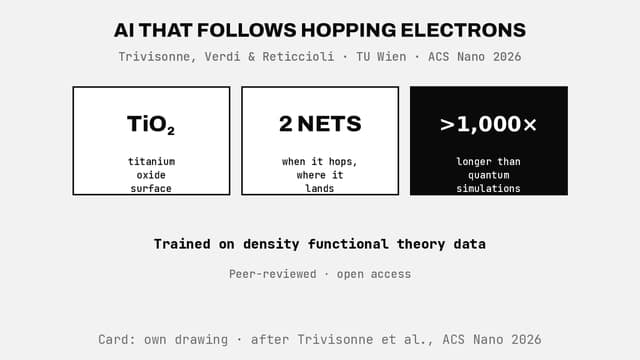
In some materials, extra electrons hop between atoms, and simulating that is slow. A TU Wien team trained two neural networks on quantum calculations: one predicts when an electron leaves, the other where it lands. On titanium oxide, simulations ran over a thousand times longer without significant loss of accuracy.
Card: own drawing · after Trivisonne et al., ACS Nano 2026
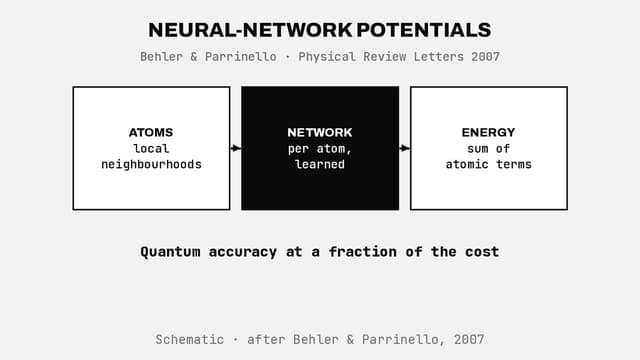
Neural-network potentials. In 2007, Jörg Behler and Michele Parrinello split a material's energy into contributions from each atom, each predicted by a neural network from its neighborhood. Trained on quantum calculations, such networks stand in for them at a fraction of the cost.
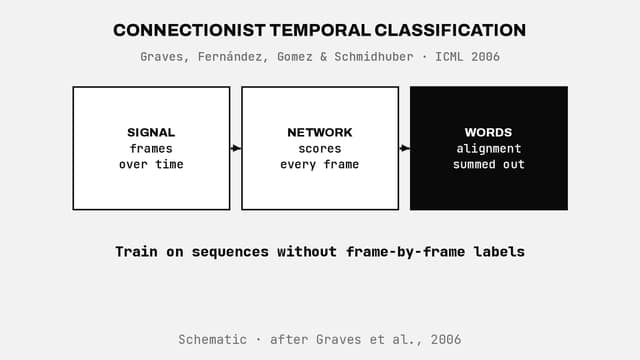
Connectionist temporal classification. In 2006, Alex Graves and colleagues showed how to train a network on speech without marking where each sound begins. It scores every time step, then sums over all the ways those steps could line up with the transcript. Many speech recognizers learned this way.
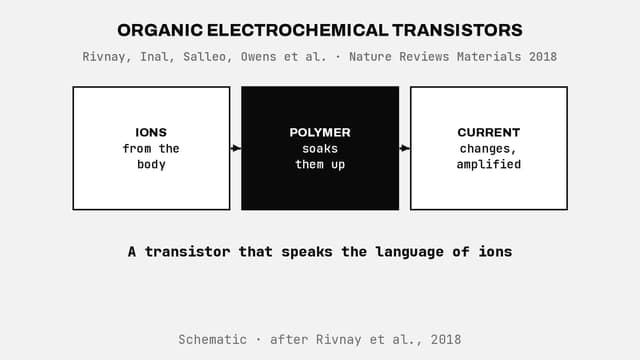
Organic electrochemical transistors. As Jonathan Rivnay and colleagues reviewed in 2018, they use a polymer channel that soaks up ions from body fluids or other liquids. Small ionic signals change a much larger current, so the device amplifies them. Dyed hair became one of these amplifiers.