News & Ideas is a daily letter for anyone who wants the day's science in one place, not a feed. Each day is 4 news items and 3 ideas across AI & Tech, Physics & Engineering, Biology & Nature, and Mind & Society, and every story names a primary source you can check. The Shorts use a declared synthetic voice.
One email a day. 4 science stories, 5 quick results, 1 idea. 3 minutes.
Plus a daily quiz: Answer & Learn. Free, unsubscribe anytime.
Issue
17 November 2026
3 min read · 1 Short
AI & Tech: the carbon cost of America's biggest data centres, a bank-transfer loophole, GitHub stars that flag risky bugs, AI that counts mosquito eggs. Then data-centre energy estimates, exploit prediction, YOLO.
One email a day. 4 science stories, 5 quick results, 1 idea. 3 minutes.
Plus a daily quiz: Answer & Learn. Free, unsubscribe anytime.
AI & Tech
US Data Centres Emitted About 26 Million Tonnes of CO2
AI & Tech: the carbon cost of America's biggest data centres, a bank-transfer loophole, GitHub stars that flag risky bugs, AI that counts mosquito eggs. Then data-centre energy estimates, exploit prediction, YOLO.
US Data Centres Emitted About 26 Million Tonnes of CO2
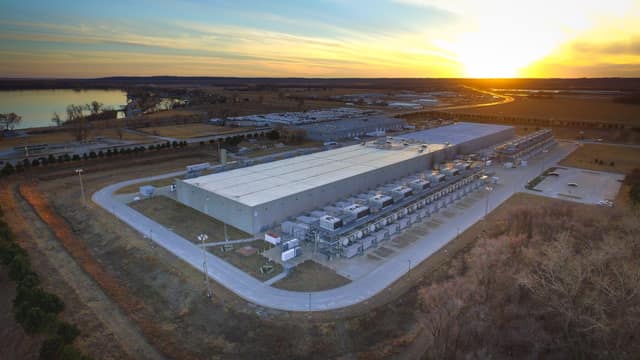
Researchers led by Francesca Dominici at Harvard compiled facility-level information on 403 US hyperscale data centres operating between May 2024 and April 2025 and estimated their electricity use, electricity sources and attributable CO2 emissions. Across load scenarios they consumed about 68–99 TWh and were associated with about 21–31 million tonnes of CO2 (location-based attribution). In the central scenario, demand was about 82 TWh, about 1.8% of total US electricity consumption, with about 25.7 Mt of CO2; roughly 54% of the attributed generation came from fossil fuels. Their electricity-weighted carbon intensity (about 314 gCO2/kWh) was slightly below the US average (about 348). The senior author told AP the estimate is two to three times what previous studies had shown. Model-based estimate, because operators disclose little. Nature Sustainability (2026).
Photo: Chad Davis · Wikimedia Commons (CC BY 2.0) · Google data centre, Council Bluffs; illustrative
One email a day. 4 science stories, 5 quick results, 1 idea. 3 minutes.
Plus a daily quiz: Answer & Learn. Free, unsubscribe anytime.
Tech · Security
Money Credited, Never Debited
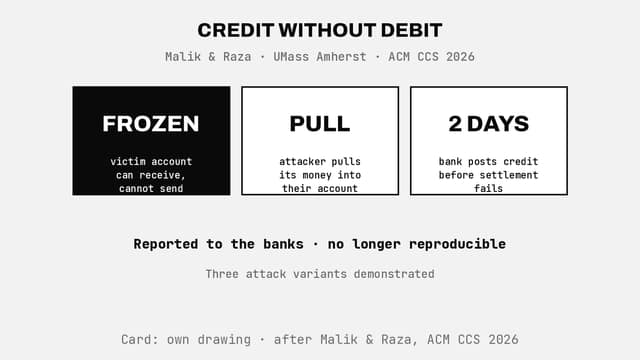
Ali Hamza Malik and Taqi Raza at the University of Massachusetts Amherst describe 'credit without debit' (CWD), a class of attacks on ACH bank-to-bank transfers. Because settlement takes about two days, some banks provisionally post incoming funds. An attacker links a victim's frozen account (able to receive but not send money), pulls funds from it, and withdraws the provisional credit before the transfer is rejected, leaving the bank with the loss. They demonstrated three variants, including microdeposit verification and a credit-card bill paid from a frozen account; the root cause, they say, is that banks treated distinct security checkpoints as interchangeable. The issues were disclosed to the affected banks and are no longer reproducible. Presented at ACM CCS 2026 (open access, CC BY 4.0).
Card: own drawing · after Malik & Raza, ACM CCS 2026
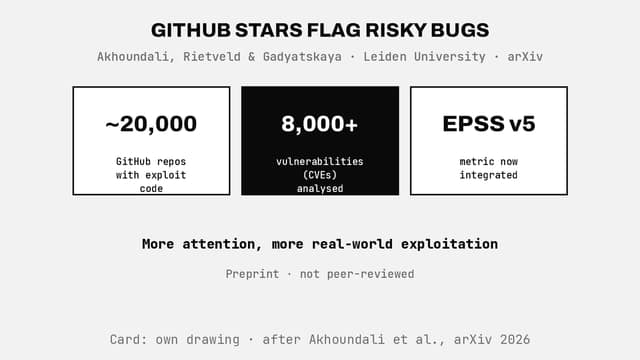
Jafar Akhoundali, Kristian Rietveld and Olga Gadyatskaya (Leiden University) propose the GitHub Popularity Metric (GPM), an open, publicly computable way to prioritise software vulnerabilities from the popularity of proof-of-concept exploit code on GitHub (stars, forks, unique users). Analysing nearly 20,000 repositories linked to more than 8,000 vulnerabilities, they found that CVEs drawing more attention were more often associated with known real-world exploitation, and the metric flagged some CVEs that other lists ranked low. GPM has been integrated into version 5 of EPSS. arXiv preprint; a demo was accepted at ACM CCS 2026.
Card: own drawing · after Akhoundali et al., arXiv 2026
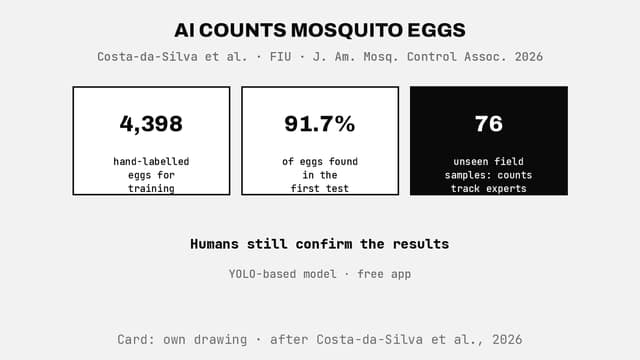
A team led by Andre Costa-da-Silva at Florida International University built AeEggCounter, a YOLO-based computer-vision tool that detects and counts Aedes mosquito eggs on ovitrap paper strips from smartphone photos taken with different phone models. It was trained on 4,398 manually labelled eggs in 168 images. In a first test it correctly identified 88.3% of the eggs it flagged and found 91.7% of the eggs present; on 76 unseen field samples performance declined, but its overall counts correlated strongly with those of trained specialists. The researchers say humans should still confirm results. Available in the free ACTT-Study app. Journal of the American Mosquito Control Association (2026).
Card: own drawing · after Costa-da-Silva et al., 2026
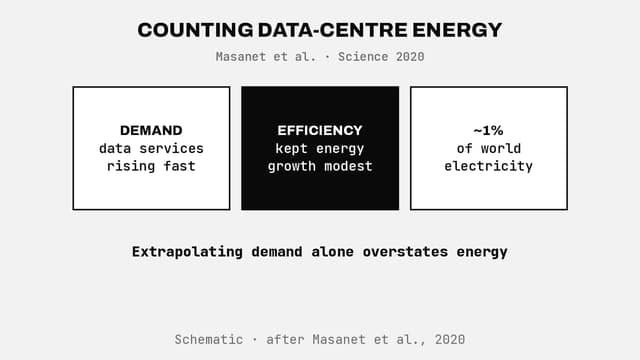
Data centres were estimated to use around 1% of worldwide electricity. Masanet and colleagues (Science, 2020) argued that oft-cited extrapolations, claiming energy use had doubled and would triple or quadruple, overlooked strong efficiency trends, and integrated new data suggesting more modest growth. The Harvard study takes a facility-resolved approach, linking each hyperscale data centre to plant-level generation and emissions data.
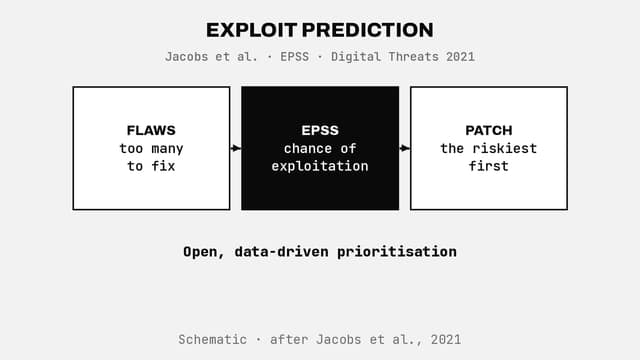
The Exploit Prediction Scoring System (EPSS), described by Jacobs and colleagues in 2021, is an open, data-driven framework that estimates the probability that a vulnerability will be exploited in the wild, to help prioritise remediation instead of trying to fix everything. The Leiden GitHub Popularity Metric was integrated into EPSS version 5.
Jacobs et al. · Digital Threats 2021
Schematic · after Jacobs et al., 2021
Exploit Prediction Scoring System (EPSS)Digital Threats: Research and Practice · 9 Jul 2021 · Primary · Jacobs et al., Digital Threats: Research and Practice 2(3) (2021)
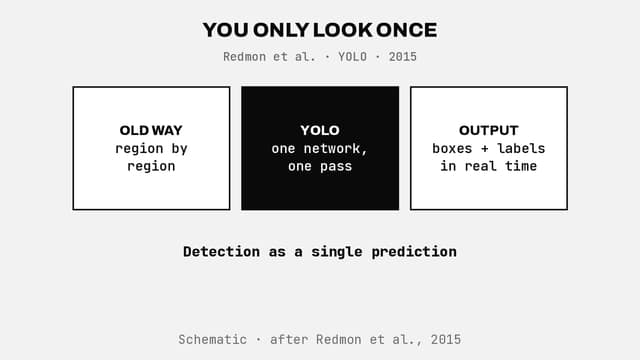
Redmon and colleagues' YOLO (2015) reframed object detection as a single regression problem: one neural network looks at the whole image once and predicts bounding boxes and class probabilities directly, making real-time detection possible. Earlier pipelines repurposed classifiers over many proposed regions. FIU's AeEggCounter uses a YOLO model to find eggs in phone photos.