News & Ideas is a daily letter for anyone who wants the day's science in one place, not a feed. Each day is 4 news items and 3 ideas across AI & Tech, Physics & Engineering, Biology & Nature, and Mind & Society, and every story names a primary source you can check. The Shorts use a declared synthetic voice.
One email a day. 4 science stories, 5 quick results, 1 idea. 3 minutes.
Plus a daily quiz: Answer & Learn. Free, unsubscribe anytime.
Issue
25 November 2026
2 min read · 1 Short
AI & Tech: a chatbot instead of the web, a chatbot against fresh conspiracies, AI agents that unmask interviews, AR glasses for daylight. Then the digital provide, k-anonymity, AI dialogues that last.
One email a day. 4 science stories, 5 quick results, 1 idea. 3 minutes.
Plus a daily quiz: Answer & Learn. Free, unsubscribe anytime.
AI & Tech
A Chatbot Cheaper Than the Web
AI & Tech: a chatbot instead of the web, a chatbot against fresh conspiracies, AI agents that unmask interviews, AR glasses for daylight. Then the digital provide, k-anonymity, AI dialogues that last.
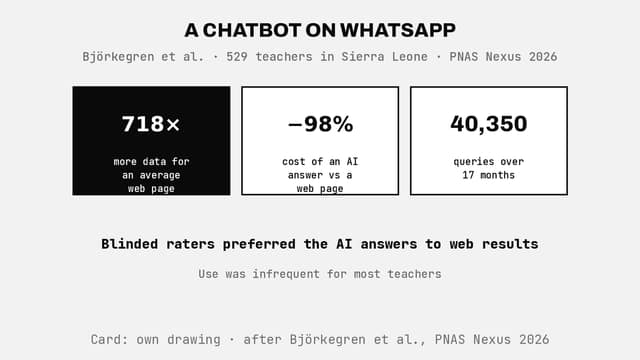
Only 37 percent of sub-Saharan Africans use the internet. Researchers studied 529 teachers in Sierra Leone using an AI chatbot on WhatsApp. Its answers cost 98 percent less than loading a web page, and blinded teachers rated them more helpful. But most used it only occasionally.
Card: own drawing · after Björkegren et al., PNAS Nexus 2026
One email a day. 4 science stories, 5 quick results, 1 idea. 3 minutes.
Plus a daily quiz: Answer & Learn. Free, unsubscribe anytime.
AI · Misinformation
A Chatbot vs Fresh Conspiracies
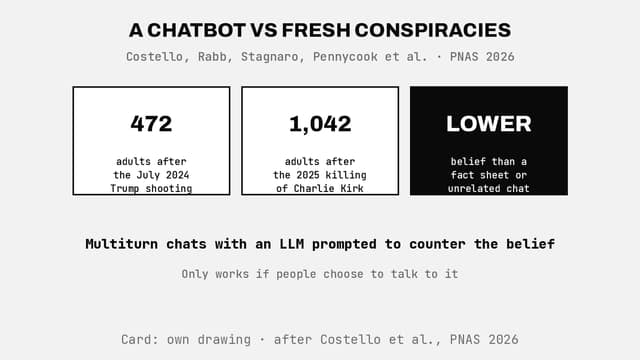
Can a chatbot cool a brand-new conspiracy theory? Days after the July 2024 attempt on Donald Trump's life, and again after Charlie Kirk's killing in 2025, about 1,500 US adults chatted with an AI prompted to counter their beliefs. Belief dropped more than with a fact sheet.
Card: own drawing · after Costello et al., PNAS 2026
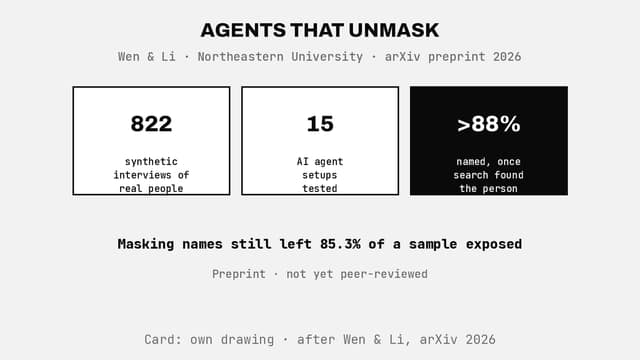
Can AI agents unmask anonymous interviews? Northeastern researchers wrote 822 fake interviews based on real people's public lives, then tested 15 AI setups. Once web search surfaced the person, agents named them in over 88 percent of cases. Privacy instructions stopped the naming, not the searching. A preprint.
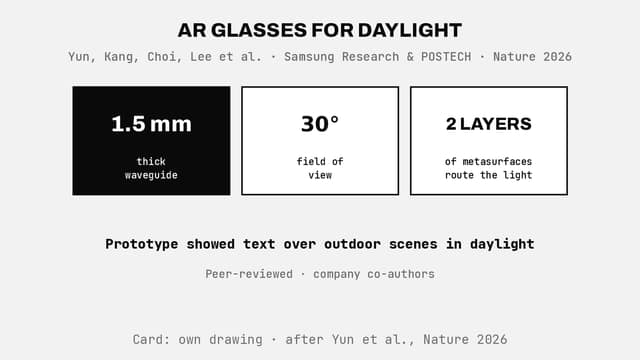
Samsung Research and POSTECH built augmented reality glasses you can read outdoors. Two stacked layers of nanostructured metasurfaces guide the light with less loss, in a waveguide just 1.5 millimeters thick with a 30 degree field of view. The prototype showed text over bright daylight scenes. Published in Nature.
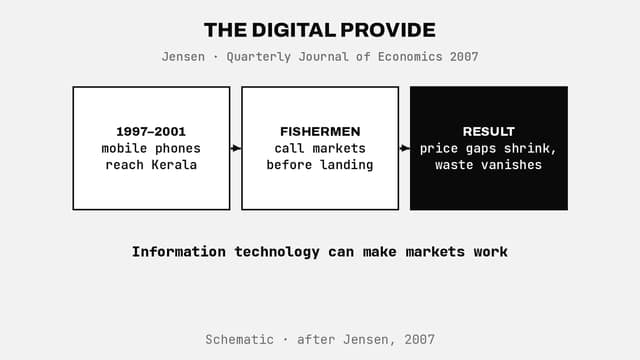
The digital provide. Between 1997 and 2001, mobile phones reached the fishermen of Kerala. Robert Jensen found that fish prices across markets evened out and waste disappeared. Cheap information transformed a market.
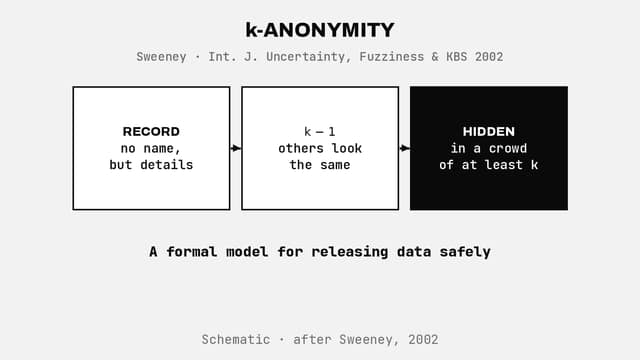
k-anonymity. In 2002, Latanya Sweeney proposed a test for released data: each person's record must be indistinguishable from at least k minus one others. Removing names is not enough, because small details can single you out. AI agents now exploit exactly that.
Sweeney · IJUFKS 2002
Schematic · after Sweeney, 2002
k-Anonymity: A Model for Protecting PrivacyInternational Journal of Uncertainty, Fuzziness and Knowledge-Based Systems · Oct 2002 · Primary · Sweeney, IJUFKS 10, 557 (2002)
Idea · Persuasion
AI Dialogues That Last
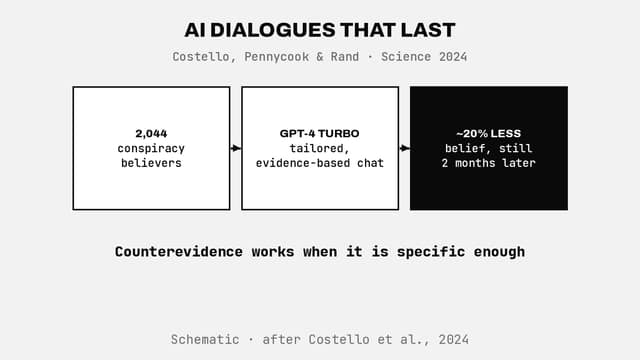
Dialogues that last. In 2024, Thomas Costello, Gordon Pennycook and David Rand had 2,044 conspiracy believers debate GPT-4 Turbo. Belief fell by about 20 percent, and the effect held two months later. Tailored evidence can change minds.