News & Ideas is a daily letter for anyone who wants the day's science in one place, not a feed. Each day is 4 news items and 3 ideas across AI & Tech, Physics & Engineering, Biology & Nature, and Mind & Society, and every story names a primary source you can check. The Shorts use a declared synthetic voice.
One email a day. 4 science stories, 5 quick results, 1 idea. 3 minutes.
Plus a daily quiz: Answer & Learn. Free, unsubscribe anytime.
Issue
24 November 2026
2 min read · 1 Short
AI & Tech: a screen only you can read, a drone that folds through gaps, muscles that feel themselves, long prompts with less memory. Then visual cryptography, attention sinks, the body computes too.
One email a day. 4 science stories, 5 quick results, 1 idea. 3 minutes.
Plus a daily quiz: Answer & Learn. Free, unsubscribe anytime.
AI & Tech
A Screen Only You Can Read
AI & Tech: a screen only you can read, a drone that folds through gaps, muscles that feel themselves, long prompts with less memory. Then visual cryptography, attention sinks, the body computes too.
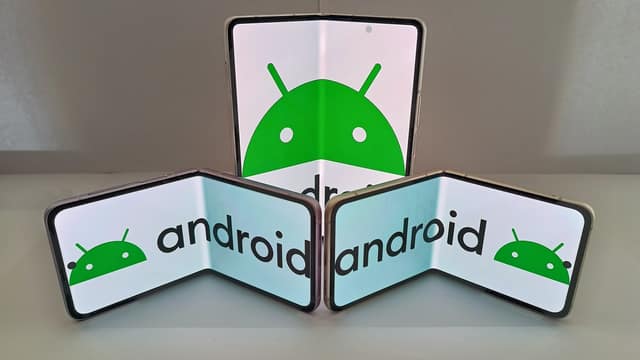
POSTECH and KAIST researchers turned screen reflections into a privacy shield. Fold2Unfold splits what a half-folded phone shows into two meaningless images, one per screen. Their reflection merges them only from your tracked eye position. In a PIN test, onlookers got on average 0.65 of ten digits. ACM's UIST conference.
Photo: Ka Kit Pang · Wikimedia Commons (public domain) · foldable phones, illustrative
One email a day. 4 science stories, 5 quick results, 1 idea. 3 minutes.
Plus a daily quiz: Answer & Learn. Free, unsubscribe anytime.
Robotics · Drones
A Drone That Folds Through Gaps
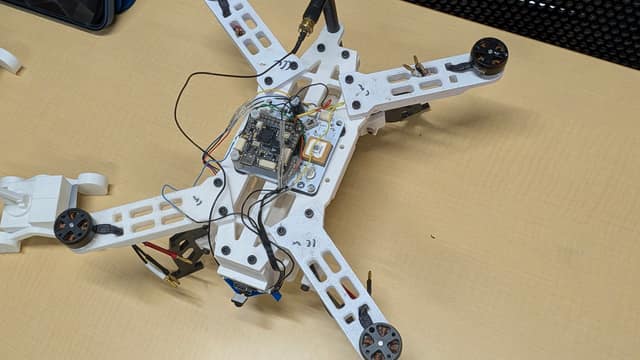
European researchers let an algorithm design a drone whose arms fold on contact. Spring-loaded joints stay stiff in normal flight but give way at a narrow gap. The prototype shrinks from 31 to 14 centimeters wide, and flew through a 15-centimeter opening at two meters per second. A preprint.
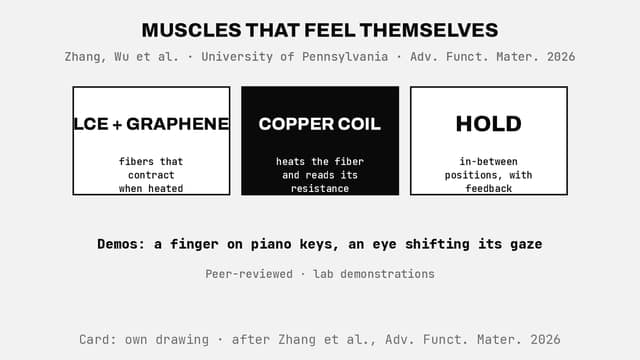
Penn engineers built artificial muscles inspired by finger and eye muscles. Fibers of liquid crystal elastomer and graphene contract when heated. An ultrathin copper coil inside heats them and reads their resistance, so each muscle can sense itself and hold in-between positions. Demos: a robot finger playing piano keys. Advanced Functional Materials.
Card: own drawing · after Zhang et al., Adv. Funct. Mater. 2026
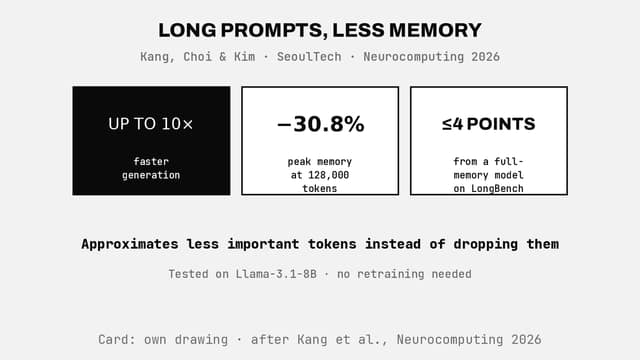
Long prompts eat memory. Researchers at Seoul National University of Science and Technology built SLAKE: instead of throwing less important tokens away, it handles them with a cheap approximation. On Llama 3.1, it generated up to ten times faster, with 31 percent less peak memory at 128,000 tokens, and no retraining. Neurocomputing.
Card: own drawing · after Kang et al., Neurocomputing 2026
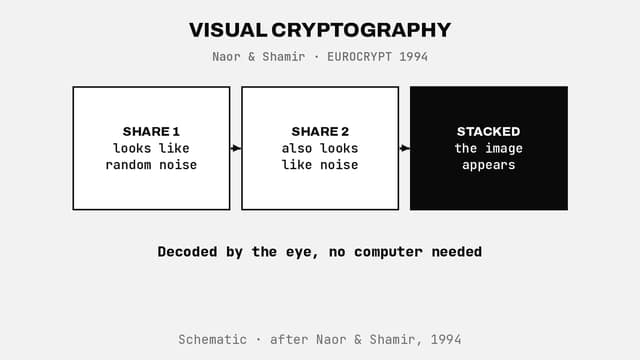
Visual cryptography. In 1994, Moni Naor and Adi Shamir showed how to split an image into two random-looking shares. Alone, each reveals nothing. Stacked, the picture appears. Fold2Unfold builds on that idea.
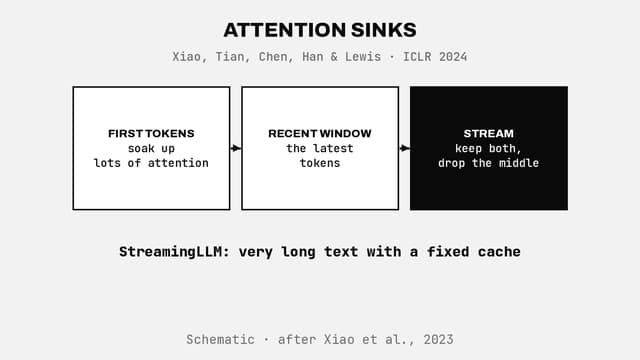
Attention sinks. In 2023, Guangxuan Xiao and colleagues noticed that language models park lots of attention on the very first tokens. Keep those, plus a window of recent ones, and a model can stream very long text with a fixed memory.
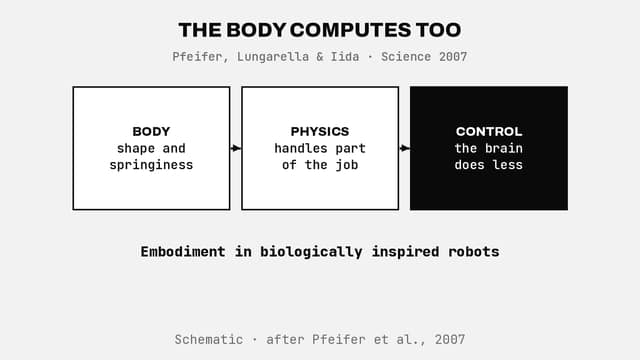
The body computes too. In 2007, Rolf Pfeifer, Max Lungarella and Fumiya Iida argued in Science that a robot's body can do part of the work: shape and springiness handle the physics, so the controller does less.