News & Ideas is a daily letter for anyone who wants the day's science in one place, not a feed. Each day is 4 news items and 3 ideas across AI & Tech, Physics & Engineering, Biology & Nature, and Mind & Society, and every story names a primary source you can check. The Shorts use a declared synthetic voice.
One email a day. 4 science stories, 5 quick results, 1 idea. 3 minutes.
Plus a daily quiz: Answer & Learn. Free, unsubscribe anytime.
Issue
24 November 2026
2 min read · 1 Short
Physics & Engineering: a star's last hours, a magnetic giant eruption, the violin myth, graphite in a flash. Then the onion star, coronal mass ejections, old versus new violins.
One email a day. 4 science stories, 5 quick results, 1 idea. 3 minutes.
Plus a daily quiz: Answer & Learn. Free, unsubscribe anytime.
Physics & Engineering
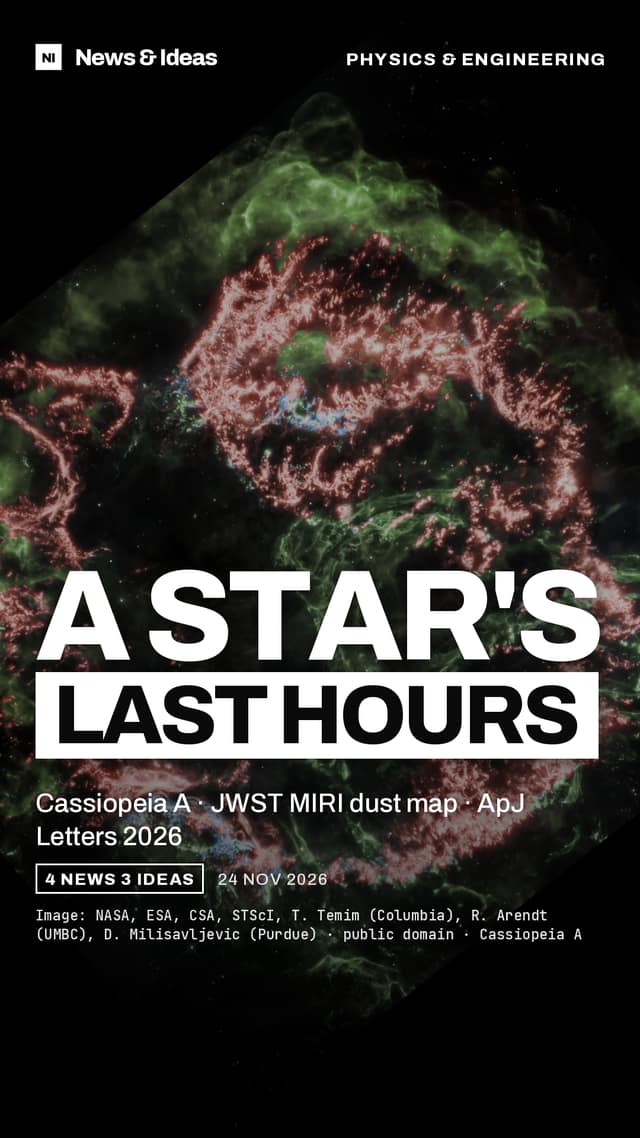
A Star's Last Hours, Seen by Webb
Physics & Engineering: a star's last hours, a magnetic giant eruption, the violin myth, graphite in a flash. Then the onion star, coronal mass ejections, old versus new violins.
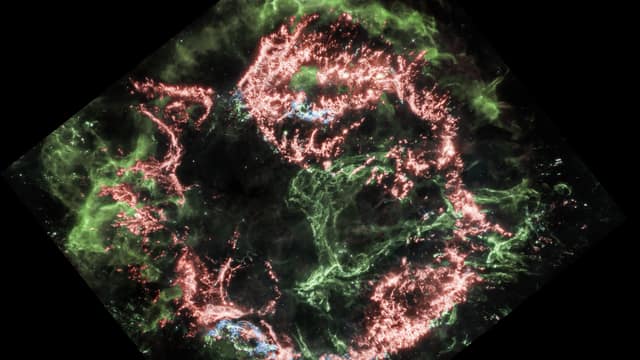
The Webb telescope mapped the dust in the supernova remnant Cassiopeia A, clump by clump, each the size of a solar system. Its chemistry points to a shell merger: the star's oxygen- and carbon-burning layers mixing, possibly just hours before the core collapsed. The Astrophysical Journal Letters.
Image: NASA, ESA, CSA, STScI, T. Temim (Columbia), R. Arendt (UMBC), D. Milisavljevic (Purdue) · public domain · Cassiopeia A dust, Webb MIRI
One email a day. 4 science stories, 5 quick results, 1 idea. 3 minutes.
Plus a daily quiz: Answer & Learn. Free, unsubscribe anytime.
Astronomy · Stars
A Giant Magnetic Eruption
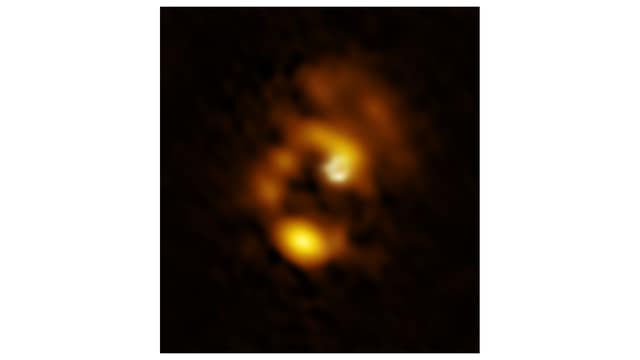
In 2023, the red giant Mira, 330 light-years away, flared. Over two years the eruption grew into a loop of gas reaching as far as Saturn is from the Sun, imaged by ALMA. Polarized signals show magnetic fields, not starlight, drove it, like a coronal mass ejection on the Sun. Astronomy and Astrophysics.
Image: ALMA (ESO/NAOJ/NRAO)/W. Vlemmings et al. · Wikimedia Commons (CC BY 4.0) · Mira A
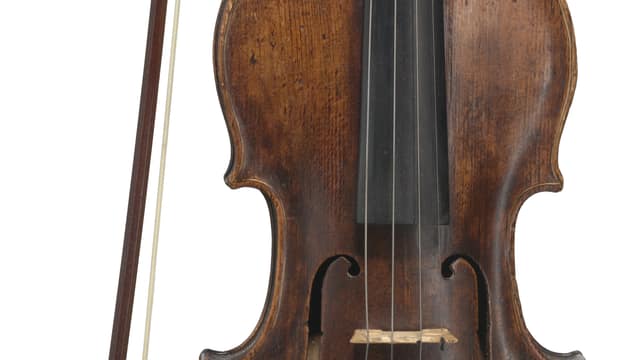
Do violins open up as you play them? A CNRS-led team had a soloist play a rarely used violin daily for about six months, while two others stayed in storage. The soloist felt it got easier to play, but blinded violinists, listeners and measurements found no change. The change was in the player. Acta Acustica.
Photo: Smithsonian · Wikimedia Commons (CC0) · a violin, illustrative
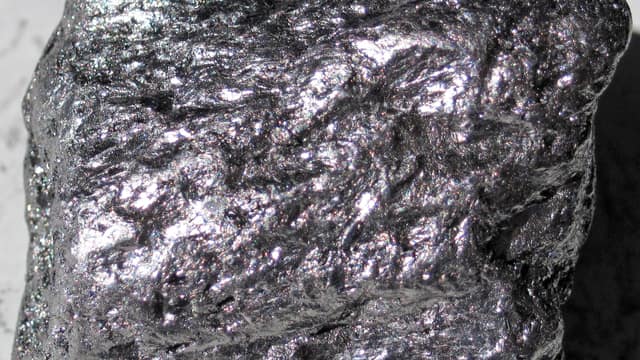
Rice University chemists made battery graphite in under a second: a trace of nickel plus a powerful electric pulse turns cheap petroleum coke into ordered graphite. It beat commercial graphite on fast charging, keeping 80 percent of its capacity after 1,000 fast cycles. They estimate over 80 percent less energy and emissions. Advanced Materials.
Photo: James St. John · Wikimedia Commons (CC BY 2.0) · natural graphite, illustrative
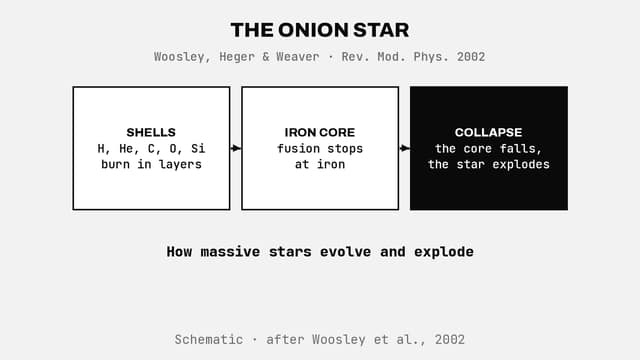
The onion star. In 2002, Stan Woosley, Alexander Heger and Tom Weaver reviewed how massive stars build shells, each burning a heavier element, down to an iron core that collapses and explodes. Cassiopeia A hints those shells can merge at the very end.
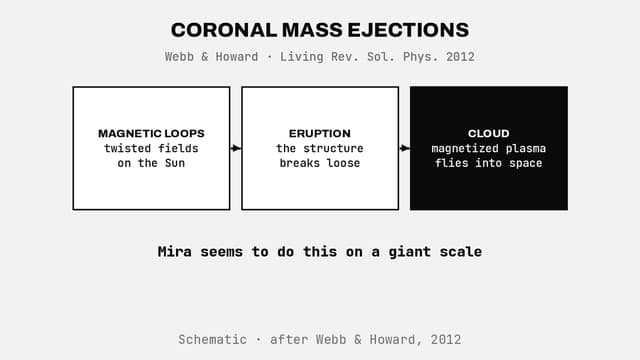
Coronal mass ejections. In 2012, David Webb and Timothy Howard reviewed these eruptions: twisted magnetic loops on the Sun break loose and hurl clouds of magnetized plasma into space. Mira seems to do the same, on a giant scale.
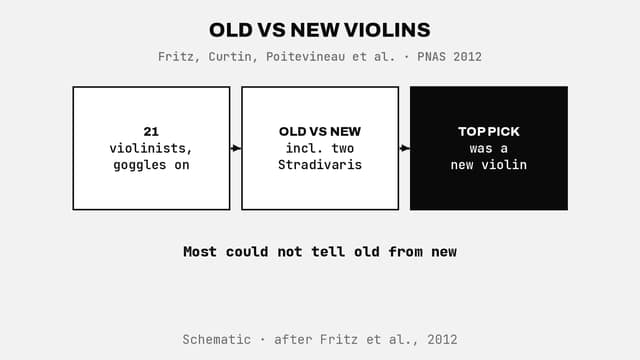
Old versus new violins. In 2012, Claudia Fritz and colleagues had 21 violinists, wearing goggles, compare old Italian violins, including two Stradivaris, with new ones. Most couldn't tell old from new, and the favorite was a new violin.
Fritz, Curtin, Poitevineau et al. · PNAS 2012
Schematic · after Fritz et al., 2012
Player preferences among new and old violinsProceedings of the National Academy of Sciences · 3 Jan 2012 · Primary · Fritz, Curtin, Poitevineau, Morrel-Samuels & Tao, PNAS 109, 760 (2012)
Credits
Image: NASA, ESA, CSA, STScI, T. Temim (Columbia), R. Arendt (UMBC), D. Milisavljevic (Purdue) · public domain · Cassiopeia A dust, Webb MIRI
Image: ALMA (ESO/NAOJ/NRAO)/W. Vlemmings et al. · Wikimedia Commons (CC BY 4.0) · Mira A
Photo: Smithsonian · Wikimedia Commons (CC0) · a violin, illustrative
Photo: James St. John · Wikimedia Commons (CC BY 2.0) · natural graphite, illustrative
Schematic · after Woosley et al., 2002
Schematic · after Webb & Howard, 2012
Schematic · after Fritz et al., 2012
Voice: synthetic (neural text-to-speech).
Scripts written from the linked sources.
News and Ideas4 News 3 IdeasscienceresearchPhysics & EngineeringJWSTWebbCassiopeia Asupernovashell mergerMirared giantALMAmagnetic eruptioncoronal mass ejectionviolinacousticsplaying-ingraphitelithium-ion batteryfast chargingflash synthesisstellar evolutionStradivari
Physics & Engineering
Question of the day
After six months of daily playing, what changed in the test violin?
It became louder
Its wood got stiffer
Listeners preferred it
Nothing measurable: the change was in the player
The ballot is in the email. Each choice there is counted once.