News & Ideas is a daily letter for anyone who wants the day's science in one place, not a feed. Each day is 4 news items and 3 ideas across AI & Tech, Physics & Engineering, Biology & Nature, and Mind & Society, and every story names a primary source you can check. The Shorts use a declared synthetic voice.
One email a day. 4 science stories, 5 quick results, 1 idea. 3 minutes.
Plus a daily quiz: Answer & Learn. Free, unsubscribe anytime.
Issue
11 November 2026
3 min read · 1 Short
Physics & Engineering: ALPS II Shines Light Through a Wall, Finds No Axions Yet, A Granular Layer Shows the Kovacs Memory Effect, Why So Many Merging Black Holes Weigh About 10 Suns, A Solid-State Lithium Battery Near Ambient Pressure. Then Light Shining Through a Wall, The Kovacs Memory Effect, Failed Supernovae.
One email a day. 4 science stories, 5 quick results, 1 idea. 3 minutes.
Plus a daily quiz: Answer & Learn. Free, unsubscribe anytime.
Physics & Engineering
Laser Fired at a Wall to Catch Axions
Physics & Engineering: ALPS II Shines Light Through a Wall, Finds No Axions Yet, A Granular Layer Shows the Kovacs Memory Effect, Why So Many Merging Black Holes Weigh About 10 Suns, A Solid-State Lithium Battery Near Ambient Pressure. Then Light Shining Through a Wall, The Kovacs Memory Effect, Failed Supernovae.
ALPS II Shines Light Through a Wall, Finds No Axions Yet
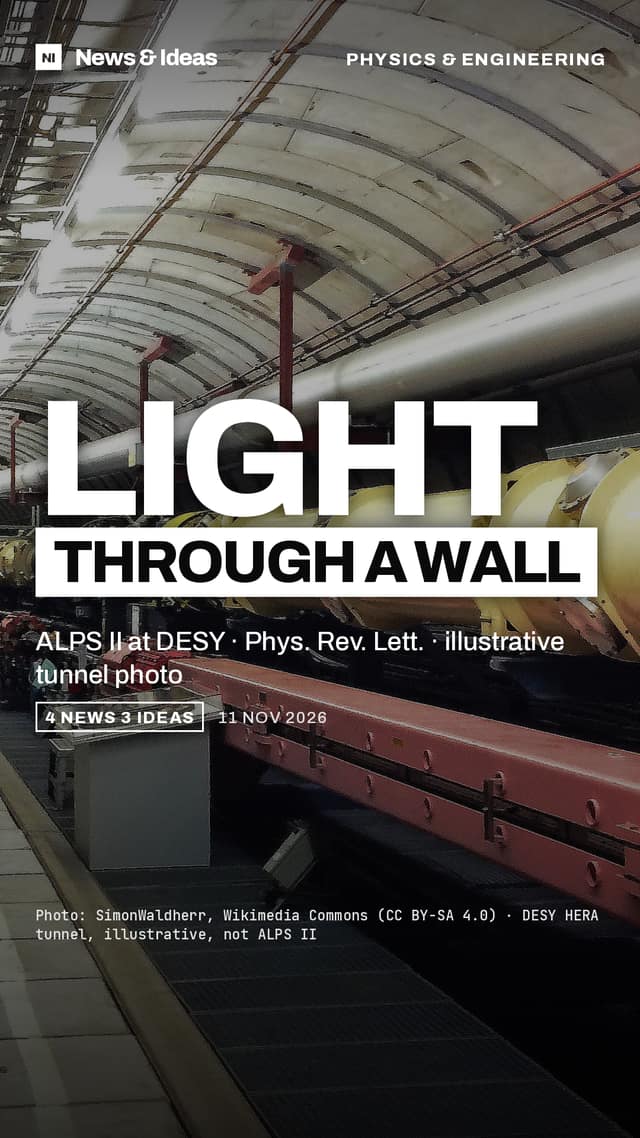
The ALPS II collaboration at DESY in Hamburg sends laser light through 12 superconducting magnets toward an opaque wall; if axion-like particles exist, some photons convert into them, cross the wall and are turned back into light by 12 more magnets inside an optical cavity. The first science campaign (February–May 2024) found no evidence of axions; a small excess was traced to stray light, about two photons per hour. The search is more than 20 times more sensitive than any similar experiment, setting |g| < 1.5×10⁻⁹ GeV⁻¹, and planned upgrades should add about two orders of magnitude (Physical Review Letters, accepted; arXiv 2512.14110).
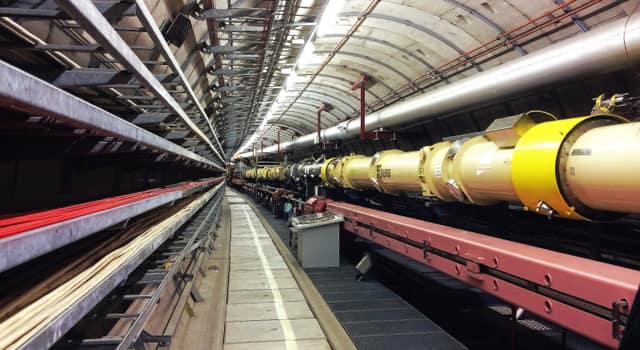
Photo: SimonWaldherr, Wikimedia Commons (CC BY-SA 4.0) · DESY HERA tunnel, illustrative, not ALPS II
One email a day. 4 science stories, 5 quick results, 1 idea. 3 minutes.
Plus a daily quiz: Answer & Learn. Free, unsubscribe anytime.
Physics & Engineering
A Granular Layer Shows the Kovacs Memory Effect
Vega Reyes and colleagues shook a thin layer of steel spheres between a plate and a lid. After the shaking was dropped and then raised so the layer matched the new temperature, it kept cooling instead of staying put: an anomalous Kovacs memory effect, seen experimentally in a granular system for the first time and explained with kinetic theory and molecular-dynamics simulations (Phys. Rev. Lett. 137, 208201, 10 Nov 2026).
Why So Many Merging Black Holes Weigh About 10 Suns
Legred, Golomb and Chatziioannou analysed more than 200 binary black hole mergers: in over 75% of them the larger black hole is about 10 solar masses, with a dip at 12–16. They propose that stars of about 12–14 solar masses collapse directly into black holes without a supernova (Phys. Rev. D 114, 103023, 10 Nov 2026). The explanation is a hypothesis.
A Solid-State Lithium Battery Near Ambient Pressure
A POSTECH team reports an all-solid-state lithium-metal battery that works at stack pressures of 0.3 MPa or less at room temperature, using a thioctic-acid composite electrolyte and a porous carbon current collector; cells reached 2.4 mAh/cm² with an NCM811 cathode at 0.1 C (Nature Communications, 7 Nov 2026).
In a strong magnetic field a photon can turn into a hypothetical axion and back (Sikivie 1983). A wall stops the light but not the axion, so light reappearing behind the wall would reveal it (Van Bibber et al. 1987). ALPS II adds optical cavities to boost both conversions.
Two systems at the same temperature can still evolve differently because temperature alone does not capture their state: their history is stored in other variables. Kovacs saw it in polymer glasses; Prados and Trizac predicted a reversed, "anomalous" version in driven granular gases, now seen in a shaken layer of steel spheres.
If the shock wave in a collapsing star stalls, the core can fall straight into a black hole with little or no explosion; how compact the core is helps predict which stars do this. Legred and colleagues use the idea to explain the 10-solar-mass peak in merging black holes.