News & Ideas is a daily letter for anyone who wants the day's science in one place, not a feed. Each day is 4 news items and 3 ideas across AI & Tech, Physics & Engineering, Biology & Nature, and Mind & Society, and every story names a primary source you can check. The Shorts use a declared synthetic voice.
One email a day. 4 science stories, 5 quick results, 1 idea. 3 minutes.
Plus a daily quiz: Answer & Learn. Free, unsubscribe anytime.
Issue
6 November 2026
2 min read · 1 Short
Physics & Engineering: FLIP finds fainter planets in JWST images, 3D maps of carbon atoms in twisted graphene, symmetry-breaking nanoparticle superlattices, a 3D-printed alloy that keeps strength and ductility. Then model-based PSF subtraction, autodiff instrument models, ptychographic tomography.
One email a day. 4 science stories, 5 quick results, 1 idea. 3 minutes.
Plus a daily quiz: Answer & Learn. Free, unsubscribe anytime.
Physics & Engineering
Software Finds Fainter Planets on Webb
Physics & Engineering: FLIP finds fainter planets in JWST images, 3D maps of carbon atoms in twisted graphene, symmetry-breaking nanoparticle superlattices, a 3D-printed alloy that keeps strength and ductility. Then model-based PSF subtraction, autodiff instrument models, ptychographic tomography.
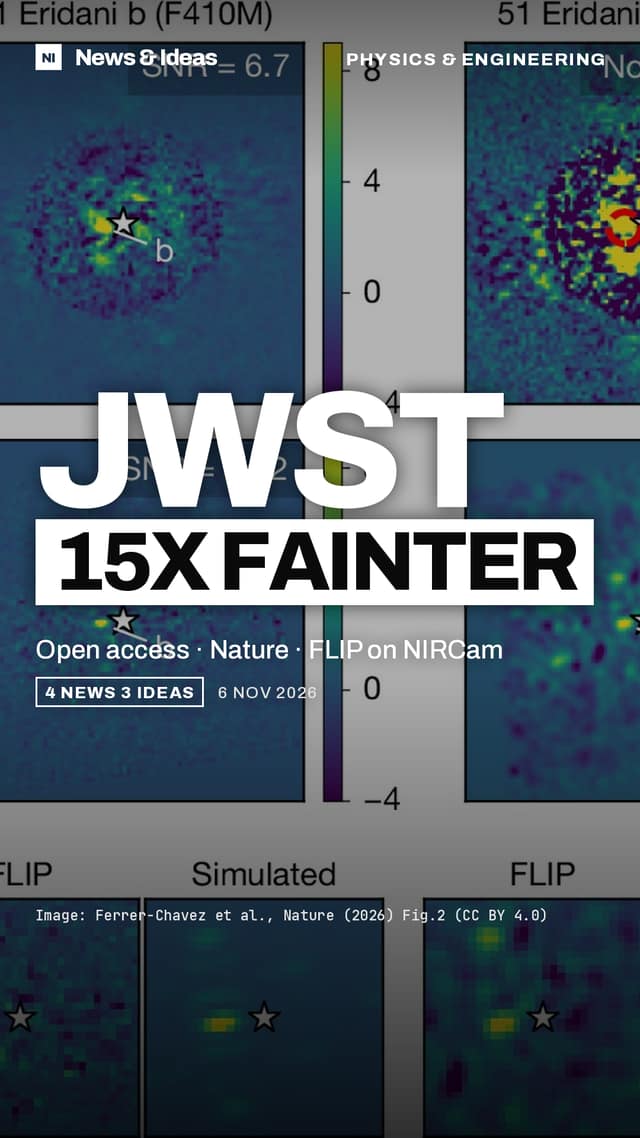
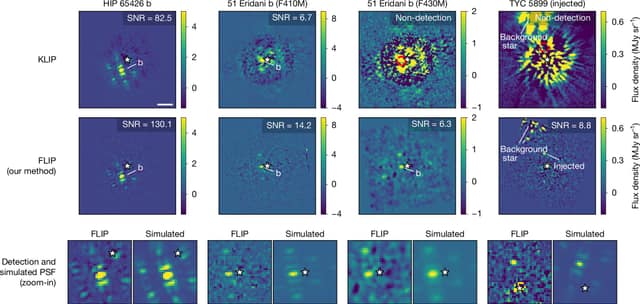
FLIP, Physics-based Learning for Imaging Planets, is a differentiable physical model of the JWST NIRCam coronagraph that tunes about a million parameters on the science image after pre-calibration on a reference. On real data the authors report detection sensitivity two to fifteen times superior to standard techniques such as KLIP, including the first detection of 51 Eridani b at 4.3 micrometers. A typical optimization took about 35 minutes on an NVIDIA A30 GPU. Peer-reviewed, open access CC BY 4.0. Code on GitHub.
Image: Ferrer-Chavez et al., Nature (2026) Fig.2 (CC BY 4.0)
One email a day. 4 science stories, 5 quick results, 1 idea. 3 minutes.
Plus a daily quiz: Answer & Learn. Free, unsubscribe anytime.
Physics · Nanomaterials
3D map of individual carbon atoms in twisted bilayer graphene
A team reports a three-dimensional map of individual carbon atoms in twisted bilayer graphene using ptychographic atomic electron tomography. They report about 0.12 angstrom precision and stacking-dependent spacing, corrugation and chiral texture; density-functional theory predicts band narrowing. Peer-reviewed in Nature Nanotechnology. Data on Zenodo.
Breaking symmetry in nanoparticle superlattices via spontaneous valency
A Nature Materials paper describes nanoparticle superlattices that break symmetry through spontaneous valency, giving a new design lever for assembled materials. Peer-reviewed.
3D-printed multi-principal-element alloy keeps strength and ductility across temperatures
A Nature Materials study reports a 3D-printed multi-principal-element alloy whose process-intrinsic cellular network sustains a strength–ductility balance across a temperature range. Peer-reviewed.
Reference-based versus model-based starlight subtraction
Methods such as KLIP build the stellar glare from reference images. If the telescope drifts between reference and science frames, the model mismatches and sensitivity falls. A physical model optimised on the science image can absorb that instability. FLIP shows the gain on JWST NIRCam.
Automatic differentiation makes a coronagraph model with about a million free parameters tractable on a single GPU. FLIP’s typical science-image tune took about thirty-five minutes on an A30. That turns post-processing into a controllable physics fit.
Ferrer-Chavez et al., Nature 2026; pyflip on GitHub
Instead of a direct image, ptychography reconstructs atomic positions from diffraction patterns. The twisted-graphene map places thousands of carbon atoms in three dimensions with reported sub-ångström precision.