News & Ideas is a daily letter for anyone who wants the day's science in one place, not a feed. Each day is 4 news items and 3 ideas across AI & Tech, Physics & Engineering, Biology & Nature, and Mind & Society, and every story names a primary source you can check. The Shorts use a declared synthetic voice.
One email a day. 4 science stories, 5 quick results, 1 idea. 3 minutes.
Plus a daily quiz: Answer & Learn. Free, unsubscribe anytime.
Issue
7 November 2026
2 min read · 1 Short
Physics & Engineering: boron nitride nanotubes emit single photons at room temperature, stacked porous NiTi for elastocaloric cooling, the cuprate pseudogap tied to pairing, the Tohoku megathrust relocked. Then solid-state photon sources, elastocaloric cooling, megathrust relocking.
One email a day. 4 science stories, 5 quick results, 1 idea. 3 minutes.
Plus a daily quiz: Answer & Learn. Free, unsubscribe anytime.
Physics & Engineering
BN Nanotubes Emit Single Photons at Room Temp
Physics & Engineering: boron nitride nanotubes emit single photons at room temperature, stacked porous NiTi for elastocaloric cooling, the cuprate pseudogap tied to pairing, the Tohoku megathrust relocked. Then solid-state photon sources, elastocaloric cooling, megathrust relocking.
Room-temperature quantum emission from boron nitride nanotubes
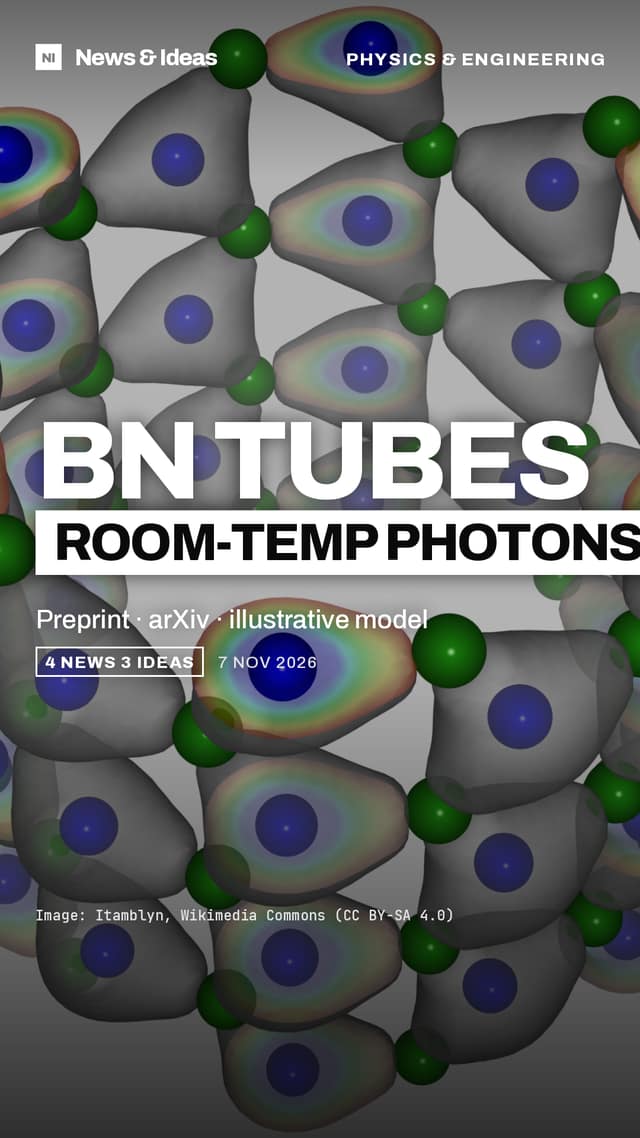
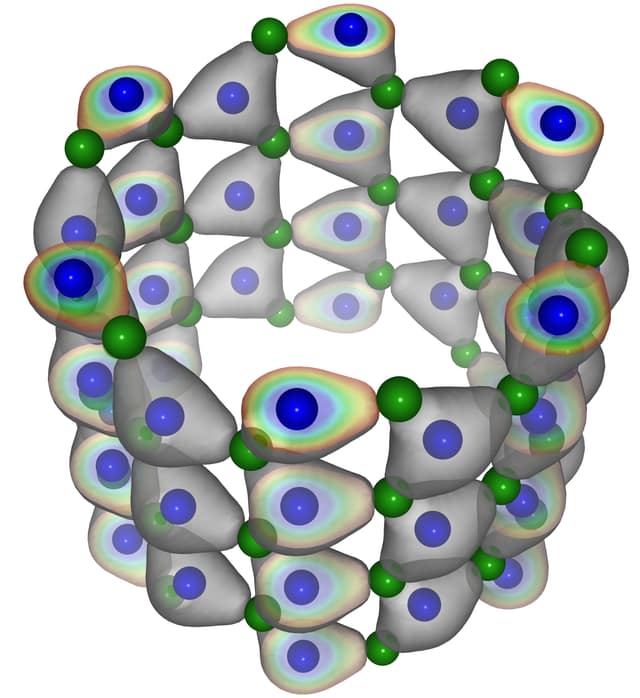
Using confocal photoluminescence and Hanbury Brown-Twiss interferometry, a team found single-photon emitters in boron nitride nanotubes across the whole visible spectrum, including regions not reported in hBN flakes. Each tube carries multiple emitters along its length, with lifetimes as fast as 0.5 nanoseconds, about two-fold faster than the fastest hBN emitters; a surface coating mitigates blinking. Preprint.
One email a day. 4 science stories, 5 quick results, 1 idea. 3 minutes.
Plus a daily quiz: Answer & Learn. Free, unsubscribe anytime.
Engineering · Cooling
Stacked porous NiTi for elastocaloric cooling
Su, Li, Deng and colleagues stamp and stack honeycomb NiTi chips into an elastocaloric cooler that survives more than 100 million compression cycles, with a specific cooling power of 3,850 watts per kilogram and fabrication costs about an order of magnitude lower. Peer-reviewed in Science.
Local shot-noise spectroscopy on the cuprate Bi2212 shows the pseudogap energy coincides with the onset of electron pairing, varying up to about 70 meV, which rules out a purely local-order origin. Peer-reviewed in Science.
Fourteen years of seafloor geodesy after the 2011 magnitude 9 Tohoku earthquake show locking on the megathrust now similar to before the quake, despite afterslip and viscoelastic relaxation of the mantle. Peer-reviewed in Science.
Quantum key distribution and on-chip photonics need bright, pure, stable single-photon sources at room temperature. One-dimensional nanotubes are a new host next to two-dimensional hBN flakes.
Squeezing a shape-memory alloy releases latent heat and unloading absorbs it, a cooling cycle without vapour-compression refrigerant gases. Stacked NiTi pushes it toward mass production.
After a great earthquake, afterslip and mantle relaxation delay but do not stop the fault from locking again. Tohoku shows it in fourteen years of seafloor data.