News & Ideas is a daily letter for anyone who wants the day's science in one place, not a feed. Each day is 4 news items and 3 ideas across AI & Tech, Physics & Engineering, Biology & Nature, and Mind & Society, and every story names a primary source you can check. The Shorts use a declared synthetic voice.
One email a day. 4 science stories, 5 quick results, 1 idea. 3 minutes.
Plus a daily quiz: Answer & Learn. Free, unsubscribe anytime.
Issue
26 November 2026
2 min read · 1 Short
Physics & Engineering: the farthest little red dot, one positron held indefinitely, 123 entangled atom qubits, wires that improve as they shrink. Then geonium, one-way quantum computing, the size effect.
One email a day. 4 science stories, 5 quick results, 1 idea. 3 minutes.
Plus a daily quiz: Answer & Learn. Free, unsubscribe anytime.
Physics & Engineering
Webb's Farthest Little Red Dot
Physics & Engineering: the farthest little red dot, one positron held indefinitely, 123 entangled atom qubits, wires that improve as they shrink. Then geonium, one-way quantum computing, the size effect.
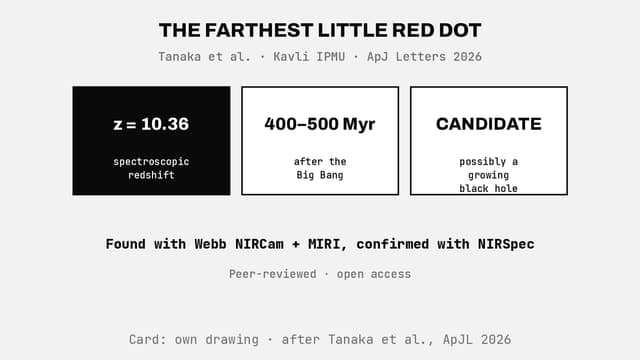
Little red dots are compact objects Webb keeps finding in the early universe, possibly fast-growing black holes. A Tokyo-led team confirmed one at redshift 10.36, a record. It's still a candidate, but it pushes black hole growth toward the era of the first seeds.
Card: own drawing · after Tanaka et al., ApJL 2026
One email a day. 4 science stories, 5 quick results, 1 idea. 3 minutes.
Plus a daily quiz: Answer & Learn. Free, unsubscribe anytime.
Physics · Antimatter
One Positron, Held Indefinitely
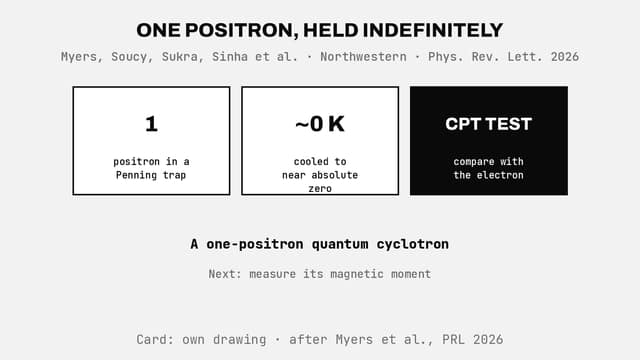
Northwestern physicists led by Gerald Gabrielse cooled a single positron, the electron's antimatter twin, to just above absolute zero and held it in a Penning trap, indefinitely. Next, they'll compare its magnetism with the electron's, a sharp test of the Standard Model.
Card: own drawing · after Myers et al., PRL 2026
One-Positron Quantum CyclotronPhysical Review Letters · 21 Oct 2026 · Primary · Myers, Soucy, Sukra, Sinha et al., Phys. Rev. Lett. (2026)
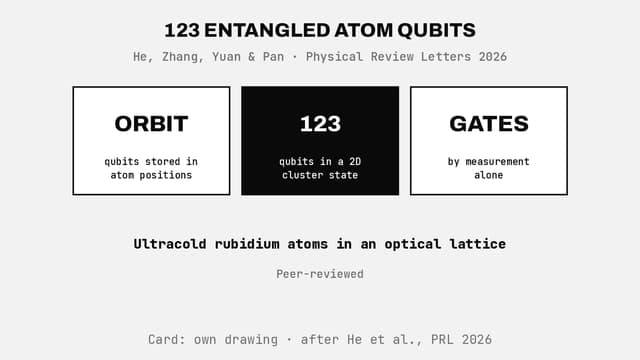
Physicists stored qubits in the position, or orbit, of ultracold rubidium atoms held in a lattice of laser light. They entangled 123 of these orbit qubits in a two-dimensional cluster state, and ran simple logic gates using measurements alone. Published in Physical Review Letters.
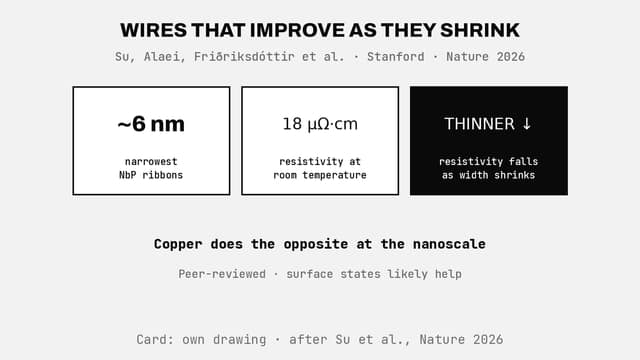
Copper wires get worse as chips shrink, because electrons scatter off surfaces. A Stanford-led team made niobium phosphide ribbons about six nanometers wide, and their resistivity fell as they got narrower, beating comparable metals. Published in Nature.
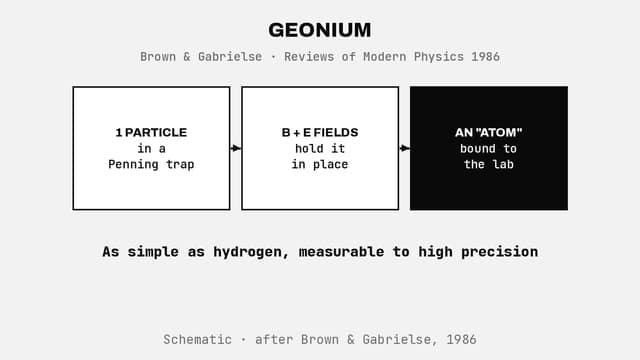
Geonium. A single charged particle in a Penning trap behaves like an atom bound to the lab, so physicists call it geonium. In 1986, Lowell Brown and Gerald Gabrielse laid out its theory: as simple as hydrogen, measurable to extreme precision.
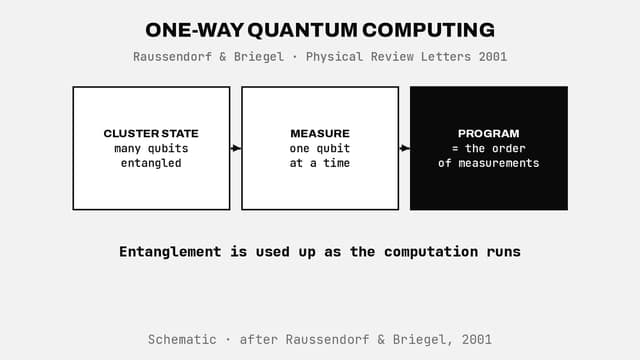
One-way quantum computing. In 2001, Robert Raussendorf and Hans Briegel showed you can compute using only single-qubit measurements on a highly entangled cluster state. The measurements are the program, and they use up the entanglement as they go. That's what a 123-qubit cluster is for.
Raussendorf & Briegel · PRL 2001
Schematic · after Raussendorf & Briegel, 2001
A One-Way Quantum ComputerPhysical Review Letters · 28 May 2001 · Primary · Raussendorf & Briegel, Phys. Rev. Lett. 86, 5188 (2001)
Idea · Materials
The Size Effect
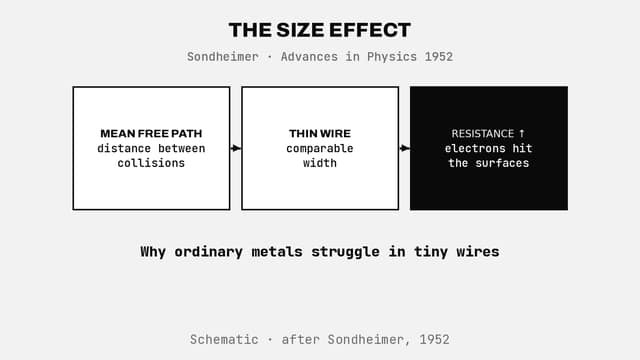
The size effect. When a metal wire gets about as thin as the distance an electron travels between collisions, bounces off the surfaces add resistance. Ernst Sondheimer reviewed the theory in 1952. Today's tiniest chip wires live in that regime, which is why new materials matter.