News & Ideas is a daily letter for anyone who wants the day's science in one place, not a feed. Each day is 4 news items and 3 ideas across AI & Tech, Physics & Engineering, Biology & Nature, and Mind & Society, and every story names a primary source you can check. The Shorts use a declared synthetic voice.
One email a day. 4 science stories, 5 quick results, 1 idea. 3 minutes.
Plus a daily quiz: Answer & Learn. Free, unsubscribe anytime.
Issue
18 November 2026
4 min read · 1 Short
Physics & Engineering: Curiosity's air samples hint at water on Mars, Hayabusa2 gets a new target, atoms imaged in ten colours, DESI weighs the Milky Way. Then premelted ice, SU(N) magnetism, planetary defence.
One email a day. 4 science stories, 5 quick results, 1 idea. 3 minutes.
Plus a daily quiz: Answer & Learn. Free, unsubscribe anytime.
Physics & Engineering
Curiosity's Air Samples Hint at Water on Mars
Physics & Engineering: Curiosity's air samples hint at water on Mars, Hayabusa2 gets a new target, atoms imaged in ten colours, DESI weighs the Milky Way. Then premelted ice, SU(N) magnetism, planetary defence.
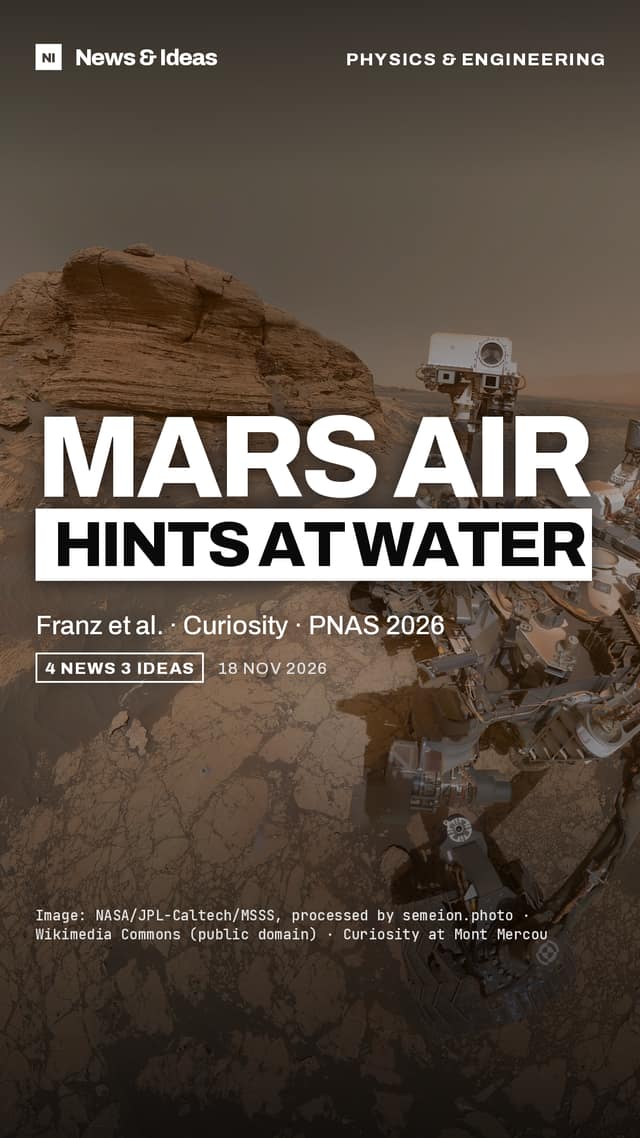
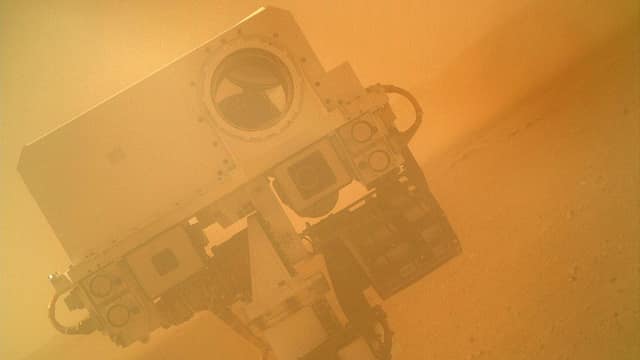
Heather Franz and colleagues assembled the first long-term in situ record of carbon and oxygen isotopes in Mars' atmospheric CO2, from repeated samples taken by the Sample Analysis at Mars (SAM) suite on NASA's Curiosity rover in Gale Crater from 2012 to 2025. Heavy oxygen (oxygen-18) in CO2 became more abundant in spring and summer, most strongly in southern spring–summer near perihelion; seasonal carbon-isotope changes were smaller and daily changes mostly insignificant. Models of polar CO2 freezing and release, surface adsorption and photochemistry could not account for the oxygen signal on their own. The authors propose oxygen-isotope exchange between CO2 and water, either adsorbed on soil grains or in extremely thin liquid-like (premelted) films, probably local or regional. All samples come from one near-equatorial crater, and the exchange is a plausible explanation, not a direct observation. PNAS (2026).
One email a day. 4 science stories, 5 quick results, 1 idea. 3 minutes.
Plus a daily quiz: Answer & Learn. Free, unsubscribe anytime.
Space · Missions
Hayabusa2 Changes Its Final Target
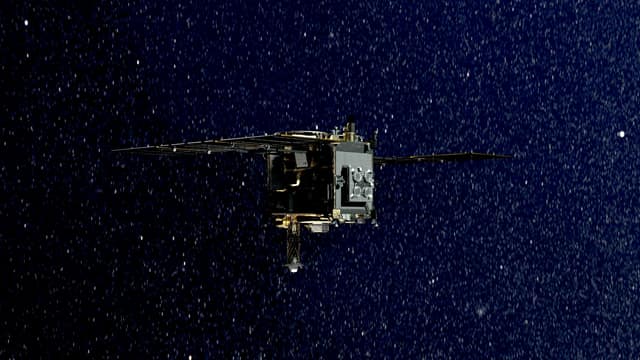
At a press briefing on 17 November 2026, JAXA explained a new plan for Hayabusa2's extended mission. After an ion-engine malfunction found in mid-August, the spacecraft can no longer reach the acceleration needed for the planned Earth swing-bys, so JAXA abandoned the 2031 rendezvous with asteroid 1998 KY26. Hayabusa2 will instead make a high-speed close flyby of near-Earth asteroid 2015 BM510 in April 2028. The new target is estimated at 17–74 m across and rotates about every 49 minutes; team leader Yuya Mimasu called it one of the most difficult flyby missions, useful for future planetary defence. Hayabusa2 returned samples from Ryugu in 2020 and flew past asteroid Torifune in July 2026. Details as reported by Kyodo, Jiji and AFP from JAXA's briefing.
Image: DLR German Aerospace Center · Wikimedia Commons (CC BY 2.0) · rendering of Hayabusa2
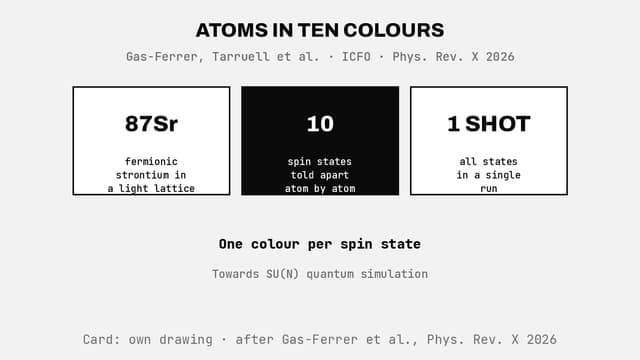
Carlos Gas-Ferrer, Leticia Tarruell and colleagues at ICFO used their strontium quantum-gas microscope to image fermionic strontium-87, which has 10 nuclear spin states, in an optical lattice. Using strontium's narrow red transition, a laser excites only atoms in one spin state; atoms in each remaining state are then transferred one by one to that addressable state and imaged, so the positions and spin of every atom across all 10 states are recorded in a single experimental run. This is the first quantum-gas microscope to resolve individual atoms with so many spin states in one shot, opening quantum simulation of SU(N) Fermi-Hubbard models and readout for qudit-based quantum computing. Physical Review X (2026), open access.
Card: own drawing · after Gas-Ferrer et al., Phys. Rev. X 2026
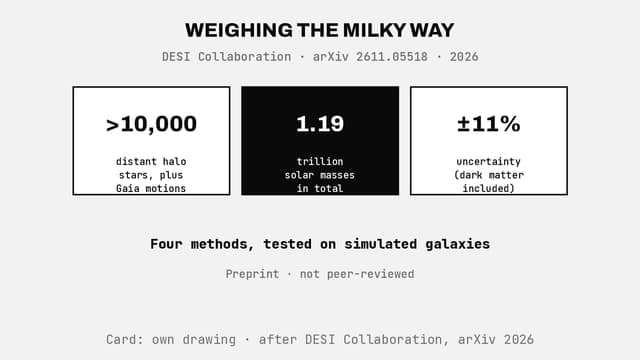
The Dark Energy Spectroscopic Instrument (DESI) collaboration analysed more than 10,000 distant halo stars of two standard-candle types (RR Lyrae and blue horizontal-branch stars), about 30,000–310,000 light-years from the Galactic centre, from DESI's DR2 data, combined with Gaia proper motions. Four modelling methods were calibrated on mock surveys of six simulated galaxies seen from four vantage points. The combined estimate puts the Milky Way's total mass (dark plus ordinary matter) at 1.19 trillion solar masses with about 11% uncertainty, about 8% within 260,000 light-years. The relatively high value could hint at a massive, extended halo. arXiv preprint, not yet peer-reviewed.
Card: own drawing · after DESI Collaboration, arXiv 2026
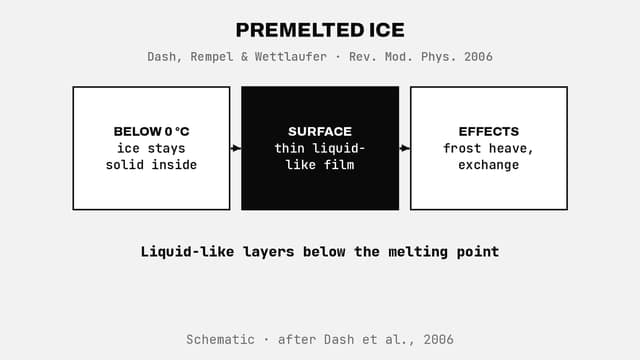
Dash, Rempel and Wettlaufer (Reviews of Modern Physics, 2006) review premelting: at temperatures below the bulk melting point, a thin liquid-like film persists at ice surfaces and at interfaces between ice and other materials. These films have broad geophysical consequences, from frost heave in soils to the behaviour of glaciers and atmospheric ice. The Curiosity study invokes such liquid-like layers as a possible site of CO2–water oxygen exchange on Mars.
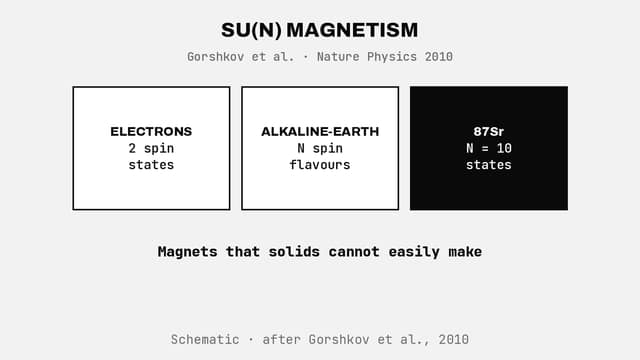
Gorshkov et al. (Nature Physics, 2010) showed that fermionic alkaline-earth atoms in optical lattices can serve as quantum simulators with SU(N) spin symmetry, N = 2I + 1 as large as 10, because their nuclear spin decouples from the electronic state. Combined with a long-lived excited state, they allow spin-orbital physics relevant to transition-metal oxides, heavy-fermion materials and spin liquids. Strontium-87 (I = 9/2) gives N = 10, the ten 'colours' imaged at ICFO.
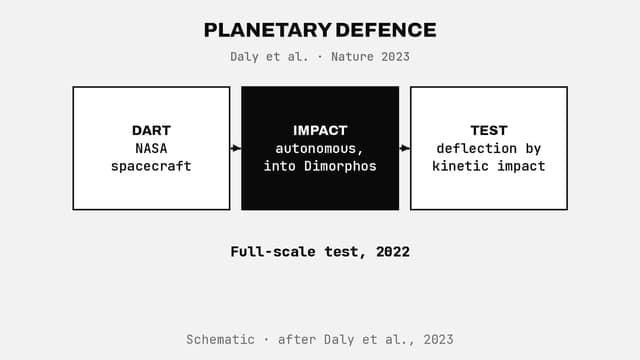
NASA's Double Asteroid Redirection Test (DART) was the first full-scale test of kinetic-impact deflection. Daly et al. (Nature, 2023) report the spacecraft's autonomous impact into Dimorphos, the secondary of the binary near-Earth asteroid (65803) Didymos, and reconstruct the timeline, the impact site and Dimorphos' size and shape. JAXA presents Hayabusa2's 2028 flyby of a 17–74 m asteroid as useful practice for such precise guidance.