News & Ideas is a daily letter for anyone who wants the day's science in one place, not a feed. Each day is 4 news items and 3 ideas across AI & Tech, Physics & Engineering, Biology & Nature, and Mind & Society, and every story names a primary source you can check. The Shorts use a declared synthetic voice.
One email a day. 4 science stories, 5 quick results, 1 idea. 3 minutes.
Plus a daily quiz: Answer & Learn. Free, unsubscribe anytime.
Issue
31 October 2026
2 min read · 1 Short
Physics & Engineering: a dwarf planet candidate from Rubin, metallic carbon ribbons, a chip that links telescopes, qubit readout at millimetre waves. Then size from brightness, the conductance quantum, interferometry.
One email a day. 4 science stories, 5 quick results, 1 idea. 3 minutes.
Plus a daily quiz: Answer & Learn. Free, unsubscribe anytime.
Physics & Engineering
A new dwarf planet candidate?
Physics & Engineering: a dwarf planet candidate from Rubin, metallic carbon ribbons, a chip that links telescopes, qubit readout at millimetre waves. Then size from brightness, the conductance quantum, interferometry.
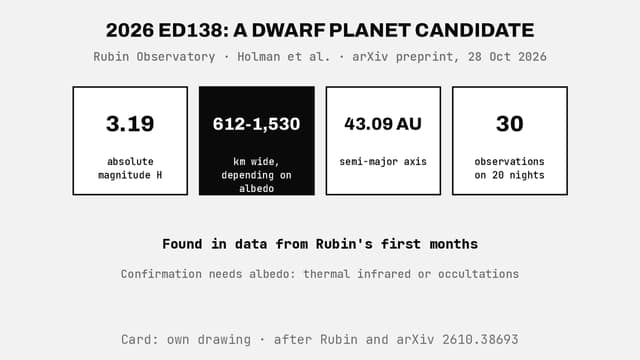
Rubin Observatory reported 2026 ED138, an object beyond Neptune seen 30 times over 20 nights. Depending on how dark it is, it is about 610 to 1,530 kilometers wide. It orbits 43 times farther from the Sun than Earth. The preprint awaits peer review.
Card: own drawing · after Holman et al., arXiv 2610.38693
One email a day. 4 science stories, 5 quick results, 1 idea. 3 minutes.
Plus a daily quiz: Answer & Learn. Free, unsubscribe anytime.
Physics · Materials
Carbon ribbons that conduct like metal
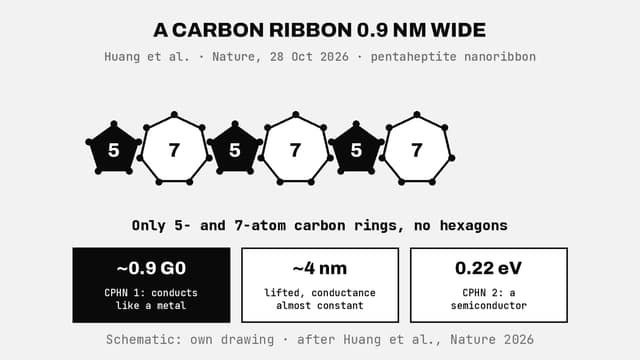
USTC researchers built carbon ribbons under one nanometer wide, made only of five- and seven-atom rings, predicted to be metallic in 1996. Lifted by a microscope tip, one version conducted about 0.9 conductance quanta, almost without scattering. Published in Nature.
Card: own drawing · after Huang, Fan, Meng et al., Nature 2026
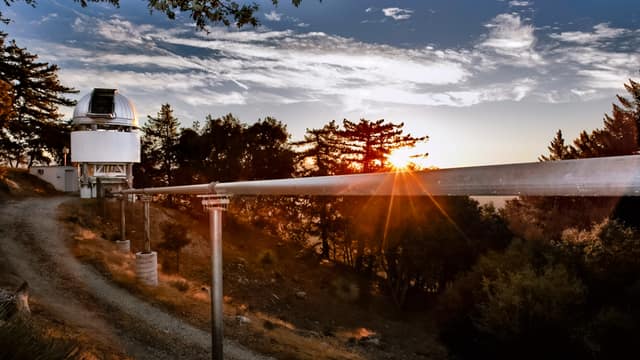
Heriot-Watt combined light from two CHARA telescopes with a chip a few centimeters long, its circuit written inside glass by a laser. Fringe precision beat one percent on bright stars. A two-telescope proof of concept, published in Monthly Notices of the Royal Astronomical Society.
Photo: NOIRLab/NSF/AURA · Wikimedia Commons (CC BY 4.0) · CHARA
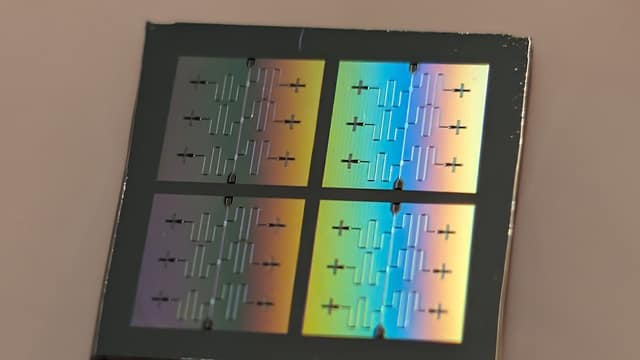
NIST read a superconducting qubit at 3.1 gigahertz through a cavity at 34.7 gigahertz, over ten times higher. That gap avoids unwanted transitions that disturb readout. Fidelity topped 99 percent, without a quantum-limited amplifier. The photo shows a generic chip. Published in Physical Review Letters.
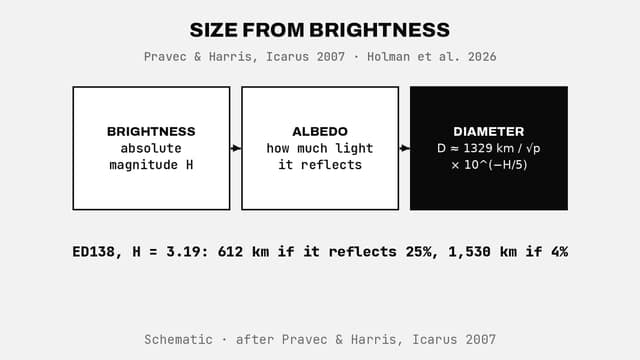
Size from brightness. A telescope measures how much light a distant body reflects, not its size. A small bright object and a large dark one can look the same. For 2026 ED138, 25 percent reflectivity means 612 kilometers; 4 percent means 1,530.
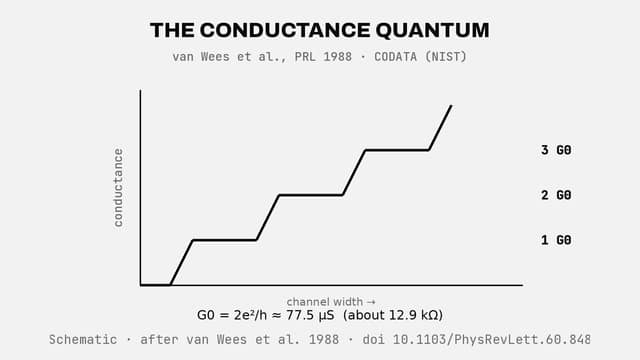
The conductance quantum. In a wire so thin that electrons pass in a few channels without scattering, conductance comes in steps of two e squared over h, about 77.5 microsiemens. First seen in 1988, in tiny point contacts.
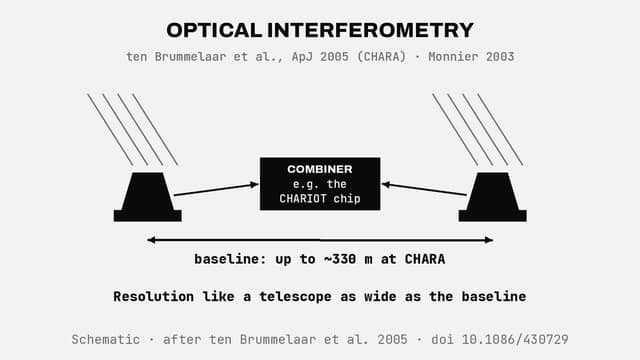
Optical interferometry. Combine light from distant telescopes, with their paths matched to within about a micron, and you get the sharpness of one telescope as wide as their separation. CHARA's telescopes stand up to about 330 meters apart.