News & Ideas is a daily letter for anyone who wants the day's science in one place, not a feed. Each day is 4 news items and 3 ideas across AI & Tech, Physics & Engineering, Biology & Nature, and Mind & Society, and every story names a primary source you can check. The Shorts use a declared synthetic voice.
One email a day. 4 science stories, 5 quick results, 1 idea. 3 minutes.
Plus a daily quiz: Answer & Learn. Free, unsubscribe anytime.
Issue
23 November 2026
2 min read · 1 Short
Physics & Engineering: Mercury catches BepiColombo, a gap in black hole masses, light that slows a sail, silver in a polonium shape. Then braking for Mercury, pushed by a laser, the other mass gap.
One email a day. 4 science stories, 5 quick results, 1 idea. 3 minutes.
Plus a daily quiz: Answer & Learn. Free, unsubscribe anytime.
Physics & Engineering
BepiColombo Is Now Orbiting Mercury
Physics & Engineering: Mercury catches BepiColombo, a gap in black hole masses, light that slows a sail, silver in a polonium shape. Then braking for Mercury, pushed by a laser, the other mass gap.
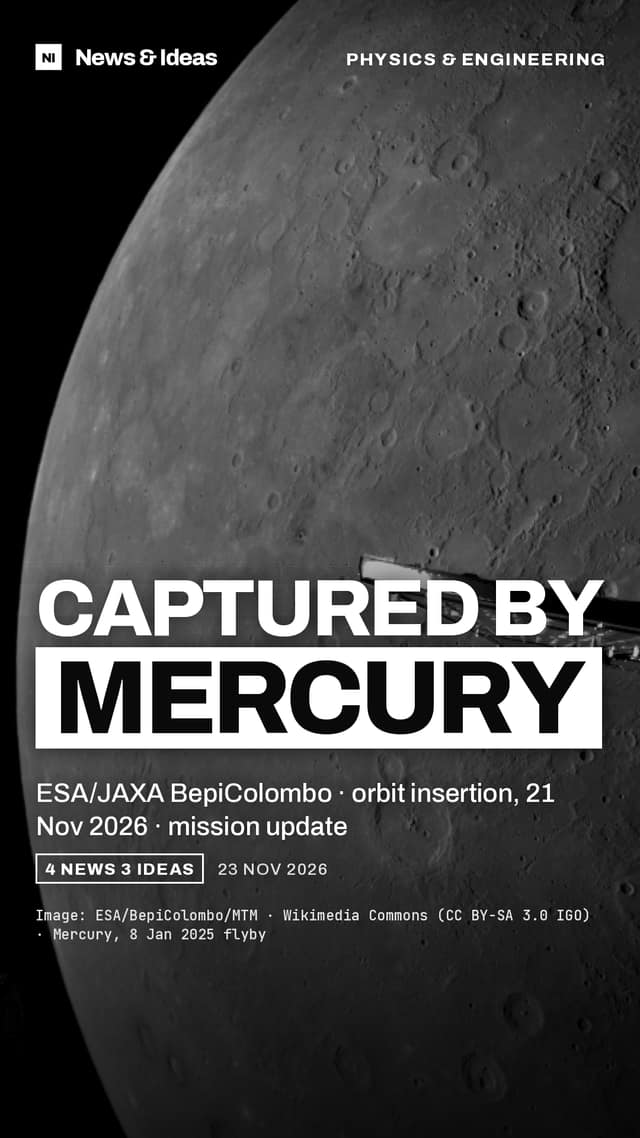
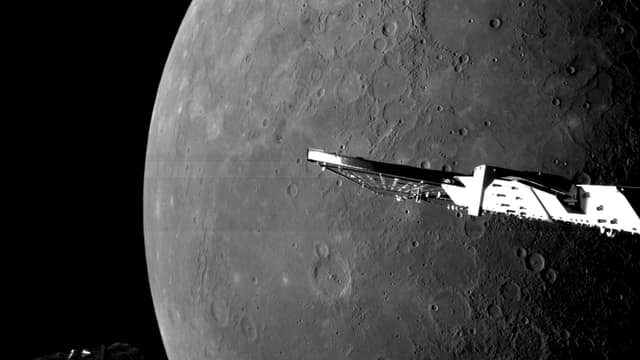
On November 21, the European-Japanese probe BepiColombo fired its thrusters and was captured into orbit around Mercury. ESA says the burn ended early because of a software issue, but the spacecraft is safe. In December, its two orbiters separate. A mission update, not a paper.
One email a day. 4 science stories, 5 quick results, 1 idea. 3 minutes.
Plus a daily quiz: Answer & Learn. Free, unsubscribe anytime.
Astrophysics · Black holes
A Gap in Black Hole Masses
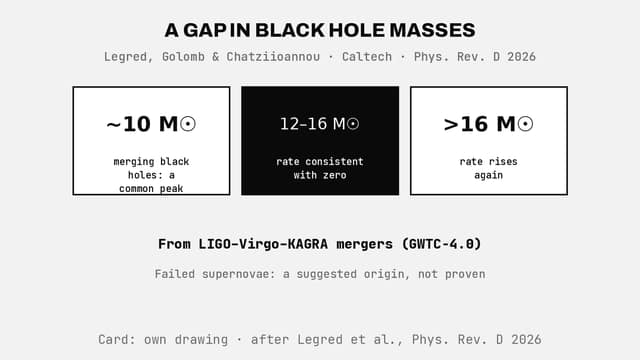
Caltech physicists studied black hole mergers seen by LIGO, Virgo and KAGRA. Black holes around ten solar masses are common, but between about 12 and 16 solar masses the merger rate is consistent with zero. They suggest the ten-solar-mass group comes from stars that collapsed without exploding, failed supernovae. Physical Review D.
Card: own drawing · after Legred et al., Phys. Rev. D 2026
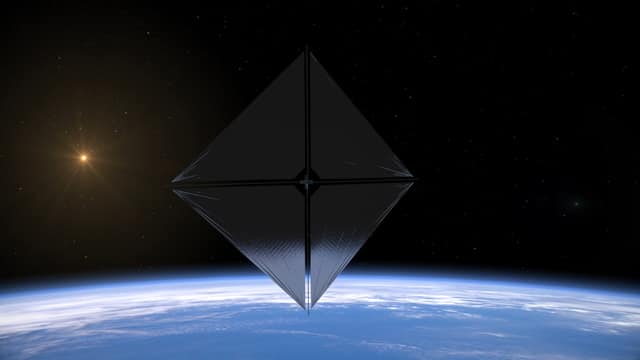
Laser-pushed light sails could one day reach other stars. Two Harbin Institute of Technology physicists calculated what happens near light speed. The beam arrives redshifted, so it pushes less. Beyond a critical speed, scattered light even becomes a drag, though the total push stays forward. An arXiv preprint.
Image: NASA Ames/Aero Animation/Ben Schweighart (public domain) · solar sail concept, illustrative
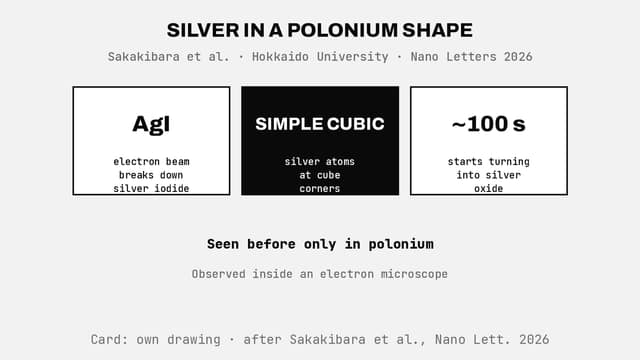
Silver atoms normally pack in a face-centered cubic pattern. At Hokkaido University, researchers broke down silver iodide with an electron beam inside a microscope, and new silver formed a simple cubic crystal, a structure confirmed before only in polonium. It began turning into silver oxide within about 100 seconds. Nano Letters.
Card: own drawing · after Sakakibara et al., Nano Lett. 2026
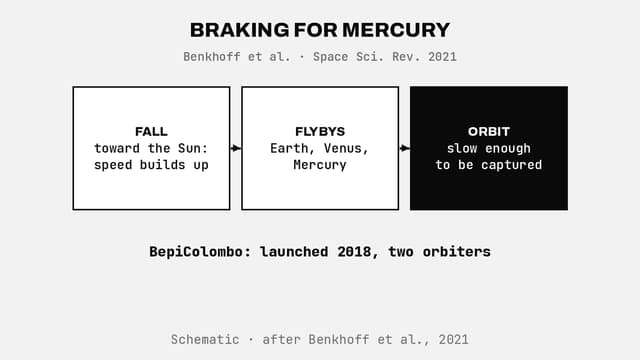
Braking for Mercury. Falling toward the Sun speeds a spacecraft up, so reaching Mercury means shedding speed. As Johannes Benkhoff and colleagues describe, BepiColombo used flybys of Earth, Venus and Mercury as brakes.
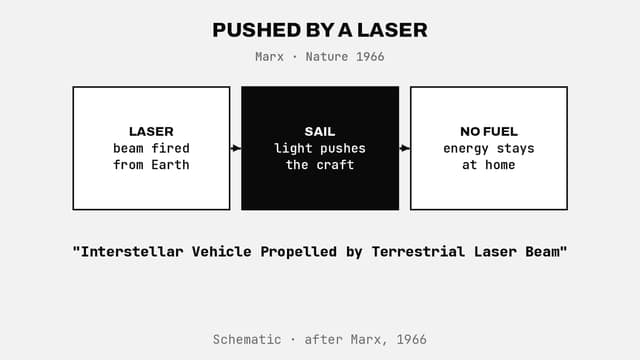
Pushed by a laser. In 1966, Hungarian physicist György Marx proposed in Nature a spacecraft pushed by a laser beam fired from Earth, so the energy source stays at home. Projects like Breakthrough Starshot revived the idea for tiny probes.
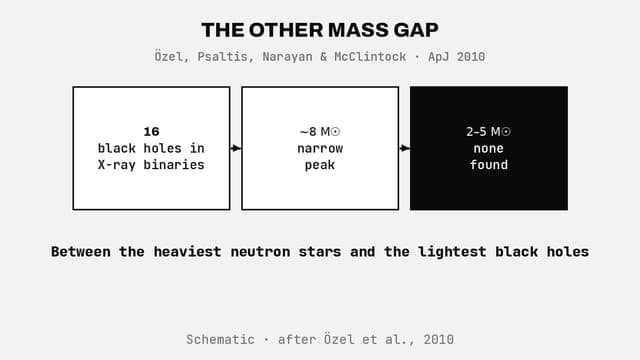
The other mass gap. In 2010, Feryal Özel and colleagues looked at 16 black holes in X-ray binaries in our galaxy. Their masses clustered near eight Suns, with none between two and five. Gaps like these are clues to how stars die.