News & Ideas is a daily letter for anyone who wants the day's science in one place, not a feed. Each day is 4 news items and 3 ideas across AI & Tech, Physics & Engineering, Biology & Nature, and Mind & Society, and every story names a primary source you can check. The Shorts use a declared synthetic voice.
One email a day. 4 science stories, 5 quick results, 1 idea. 3 minutes.
Plus a daily quiz: Answer & Learn. Free, unsubscribe anytime.
Issue
5 November 2026
3 min read · 1 Short
Physics & Engineering: a dead star with two rings of planet rubble, hard X-ray pulses timed at 170 attoseconds, a 180-qubit simulator finds resonant melting, the deep-Earth origin of the Great Unconformity. Then polluted white dwarfs, attosecond pulses, Rydberg atom arrays.
One email a day. 4 science stories, 5 quick results, 1 idea. 3 minutes.
Plus a daily quiz: Answer & Learn. Free, unsubscribe anytime.
Physics & Engineering
A Dead Star With Two Rings of Planet Rubble
Physics & Engineering: a dead star with two rings of planet rubble, hard X-ray pulses timed at 170 attoseconds, a 180-qubit simulator finds resonant melting, the deep-Earth origin of the Great Unconformity. Then polluted white dwarfs, attosecond pulses, Rydberg atom arrays.
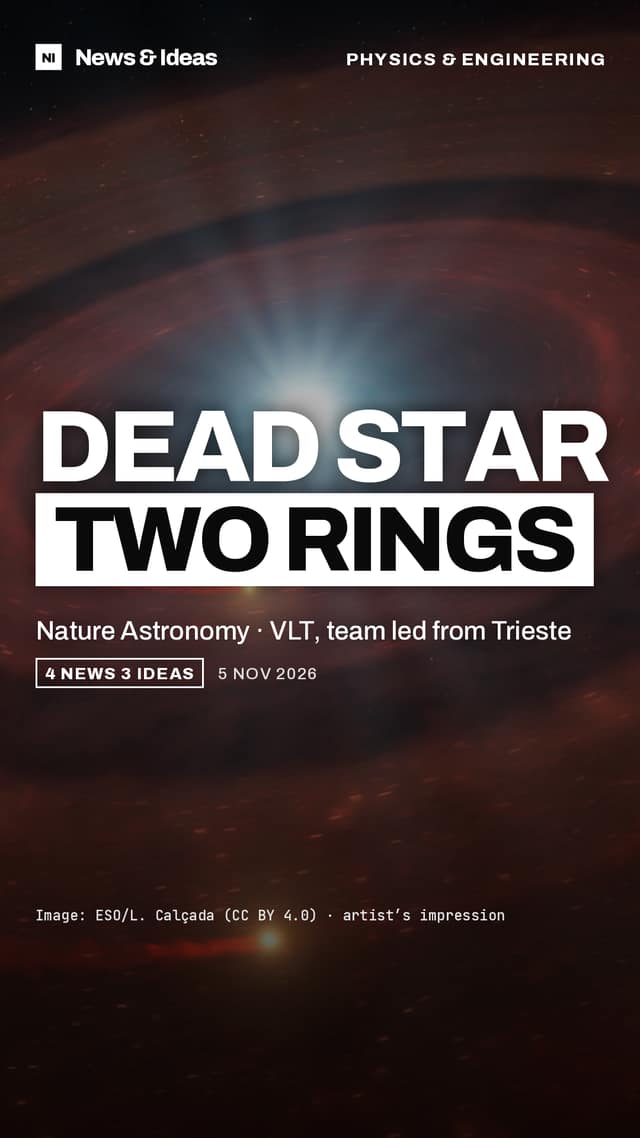
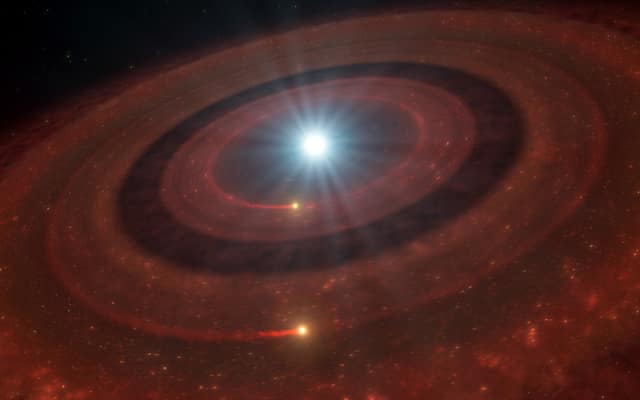
Astronomers using the X-Shooter instrument on ESO's Very Large Telescope found that the debris around the white dwarf J1328−1450 forms a double disc, two rings separated by a clear gap, unlike every debris disc known around such stars. The inner ring is rich in magnesium gas and the outer one is largely stripped of it; calcium, oxygen, magnesium and iron point to rocky planetary material. The team suggests two surviving bodies shape the rings: one the size of a typical asteroid, a few kilometres across according to ESO's release, and one that could be as large as Pluto or even the Moon. The study is led by Nicola Gentile Fusillo of the University of Trieste. Peer-reviewed, open access.
Image: ESO/L. Calçada (CC BY 4.0) · artist’s impression
One email a day. 4 science stories, 5 quick results, 1 idea. 3 minutes.
Plus a daily quiz: Answer & Learn. Free, unsubscribe anytime.
Physics · Attosecond science
Hard X-ray pulses timed at 170 attoseconds
A team from SLAC, Stanford and RIKEN reports the first time-domain characterisation of attosecond pulses of hard X-rays. Using an autocorrelation based on two-photon absorption, they measured an average pulse duration of 170 attoseconds directly. Knowing the pulse length is a precondition for reliable pump-probe experiments that follow electrons as they move. Peer-reviewed; the paper is behind a paywall, so details come from the abstract.
Researchers from Berkeley Lab, QuEra and Harvard used QuEra's Aquila neutral-atom quantum simulator, with up to 180 qubits, to study how quantum systems behave long before they reach equilibrium. They found stable prethermal regimes, peaks of what they call resonant melting, and in two dimensions a first-order dynamical phase transition, tested with a generalised Clausius-Clapeyron relation. Such dynamics are very hard to simulate on classical computers. Peer-reviewed.
In many places, Cambrian rocks sit directly on granites more than a billion years old, with between 200 million and over a billion years missing from the record. Modelling by the University of Wollongong explains this Great Unconformity with mantle convection, which lifted Laurentia, Baltica and North China in the Neoproterozoic, exposing them to erosion, and then let them sink in the Phanerozoic. Peer-reviewed modelling study.
Photo: Mikenorton · Wikimedia Commons (CC BY-SA 4.0) · the Great Unconformity, Grand Canyon
A white dwarf's strong gravity should leave only hydrogen or helium at its surface, because heavier elements sink quickly. When astronomers see metals there, the star must be accreting debris from planets or asteroids right now. That makes these stars a way to measure what other planets are made of. In J1328−1450, calcium, oxygen, magnesium and iron point to rocky material.
Farihi, "Circumstellar debris and pollution at white dwarf stars", arXiv 1604.03092 (2016)
An attosecond is a billionth of a billionth of a second. Flashes of light that short can capture electrons as they move inside atoms and molecules. The 2023 Nobel Prize in Physics went to Agostini, Krausz and L'Huillier for creating them. Today's SLAC study measures such pulses directly in the hard X-ray range.
Rydberg atom arrays: quantum simulators made of single atoms
Single atoms held by optical tweezers and excited to high-energy Rydberg states interact strongly, even at micrometre distances. Arranged in arrays, they simulate spin models that are hard to compute classically. QuEra's Aquila, with up to 180 qubits in today's study, is built this way.