News & Ideas is a daily letter for anyone who wants the day's science in one place, not a feed. Each day is 4 news items and 3 ideas across AI & Tech, Physics & Engineering, Biology & Nature, and Mind & Society, and every story names a primary source you can check. The Shorts use a declared synthetic voice.
One email a day. 4 science stories, 5 quick results, 1 idea. 3 minutes.
Plus a daily quiz: Answer & Learn. Free, unsubscribe anytime.
Issue
2 November 2026
3 min read · 1 Short
Physics & Engineering: a metre-tall titanium single crystal printed in 3D, folded aluminium origami that carries loads, deuterium-rich methane on comet 3I/ATLAS, the Sun's corona magnetic field in 3D. Then beyond-classical claims, single-crystal blades, deuterium as a thermometer.
One email a day. 4 science stories, 5 quick results, 1 idea. 3 minutes.
Plus a daily quiz: Answer & Learn. Free, unsubscribe anytime.
Physics & Engineering
A 3D printer made a metre-tall titanium single crystal
Physics & Engineering: a metre-tall titanium single crystal printed in 3D, folded aluminium origami that carries loads, deuterium-rich methane on comet 3I/ATLAS, the Sun's corona magnetic field in 3D. Then beyond-classical claims, single-crystal blades, deuterium as a thermometer.
A 3D printer made a metre-tall titanium single crystal
A 3D printer made a metre-tall titanium single crystal
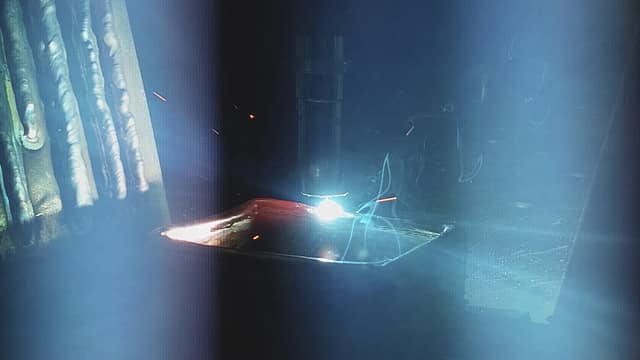
In Nature, a team from Beijing Institute of Technology, Tsinghua and UCLA printed a Ti-6Al-4V rod one metre tall and about a centimetre wide that is a single crystal. Wire-arc printing with alternating strong and weak heat pulses guided one crystal to grow layer by layer. Creep resistance was about ten times higher than standard grain-size predictions. They also printed zigzag single-crystal lattices and crystals of tungsten, molybdenum and niobium.
Photo: Alexander Panfilov · Wikimedia Commons (CC BY 4.0) · wire-arc printing in another lab
One email a day. 4 science stories, 5 quick results, 1 idea. 3 minutes.
Plus a daily quiz: Answer & Learn. Free, unsubscribe anytime.
Engineering · Structures
Folded aluminium origami that carries loads
MIT's Center for Bits and Atoms, with Bologna, Innsbruck and Tokyo, turned Ron Resch's 1960s folded tessellations into load-bearing shells. A solver designs each unique module, a CNC machine cuts it from flat aluminium, and it is assembled with hand tools. In simulation the shells are about 3.5 times stiffer than other structural origami, with about two thirds of the material. A 7-metre sculpture now hangs in the Boston Public Library.
Resch tessellations as stiff, folded modular shellsInternational Journal of Space Structures · 24 Oct 2026 · Primary · Parra Rubio, Foschi, Maleczek, Tachi & Gershenfeld, International Journal of Space Structures 2026; stiffness figures from simulation
Interstellar comet 3I/ATLAS has deuterium-rich methane
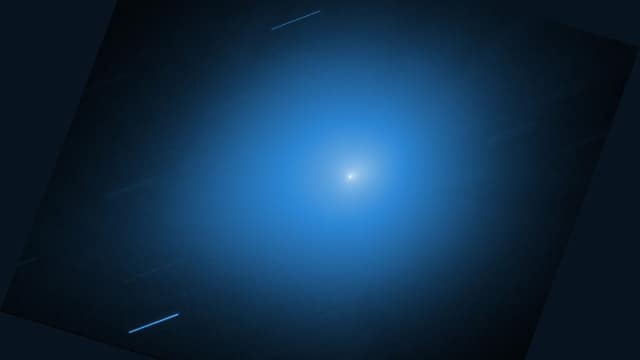
With JWST, a NASA Goddard-led team found methane and deuterated methane around interstellar comet 3I/ATLAS. The deuterium-to-hydrogen ratio in its methane is about 3.2 percent, higher than any value measured in Solar System methane and about 13 times that of comet 67P. The authors suggest its ices formed somewhere cold, metal-poor and heavily exposed to cosmic rays. Published in Nature Astronomy.
Image: NASA, ESA, STScI, D. Jewitt (UCLA), M.-T. Hui · Wikimedia Commons (public domain) · Hubble, 2025
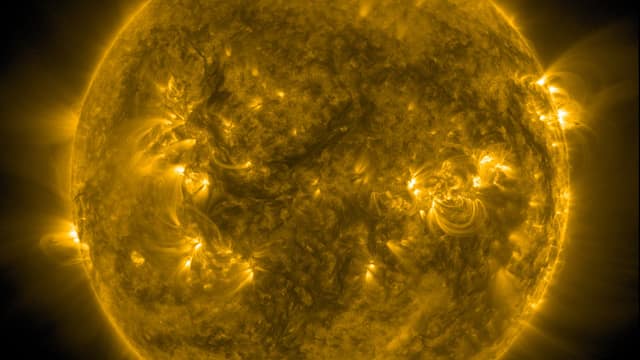
NSF National Solar Observatory and NSF NCAR scientists made the first global estimates of the strength and 3D direction of the magnetic field in the Sun's corona. They combined polarized light from the CoMP and UCoMP coronagraphs with waves travelling through the corona. The authors call it a first demonstration that still needs validation. Published in The Astrophysical Journal Letters.
Image: NASA/SDO and the AIA, EVE and HMI science teams · Wikimedia Commons (public domain)
Random circuit sampling runs random quantum circuits and asks for samples of their output; for classical computers it gets exponentially hard, which makes it an entrance test. Google's Willow chip ran such a benchmark in under five minutes that Google estimates would take the Frontier supercomputer 10 to the 25 years. Google itself says the benchmark has no known real-world applications. The remark about parallel universes is one interpretation, not a finding: the Nature paper is about error correction below the surface-code threshold.
Ordinary metal is a mosaic of grains. Hot and under load, it slowly stretches, a process called creep, much of it by sliding along grain boundaries. Remove the boundaries and creep drops sharply. That is why the hottest turbine blades are cast as single crystals, with a spiral pigtail that lets only one grain through. The printed titanium in the Nature study resisted creep about ten times better than grain-size predictions.
At the extreme cold of prestellar clouds, chemistry on icy grains favours deuterium over ordinary hydrogen. Molecules formed in the cold end up enriched in deuterium far above the cosmic average, and keep that signature for billions of years. The methane of 3I/ATLAS has a deuterium ratio about 13 times that of comet 67P, which the authors read as a birth in a cold, heavily irradiated place.