News & Ideas is a daily letter for anyone who wants the day's science in one place, not a feed. Each day is 4 news items and 3 ideas across AI & Tech, Physics & Engineering, Biology & Nature, and Mind & Society, and every story names a primary source you can check. The Shorts use a declared synthetic voice.
One email a day. 4 science stories, 5 quick results, 1 idea. 3 minutes.
Plus a daily quiz: Answer & Learn. Free, unsubscribe anytime.
Issue
10 November 2026
2 min read · 1 Short
Physics & Engineering: Squeezing a Rock Can Split It From Inside, Cadmium Hosts a Viscous Electron Fluid, A Metal Where Phonons Carry Most of the Heat, Infrared Imagers Grown Directly on Read-Out Chips. Then The Poisson Effect, Electrons That Flow Like a Liquid, Wiedemann–Franz Law and Who Carries Heat.
One email a day. 4 science stories, 5 quick results, 1 idea. 3 minutes.
Plus a daily quiz: Answer & Learn. Free, unsubscribe anytime.
Physics & Engineering
Squeezing a Rock Can Split It From Inside
Physics & Engineering: Squeezing a Rock Can Split It From Inside, Cadmium Hosts a Viscous Electron Fluid, A Metal Where Phonons Carry Most of the Heat, Infrared Imagers Grown Directly on Read-Out Chips. Then The Poisson Effect, Electrons That Flow Like a Liquid, Wiedemann–Franz Law and Who Carries Heat.
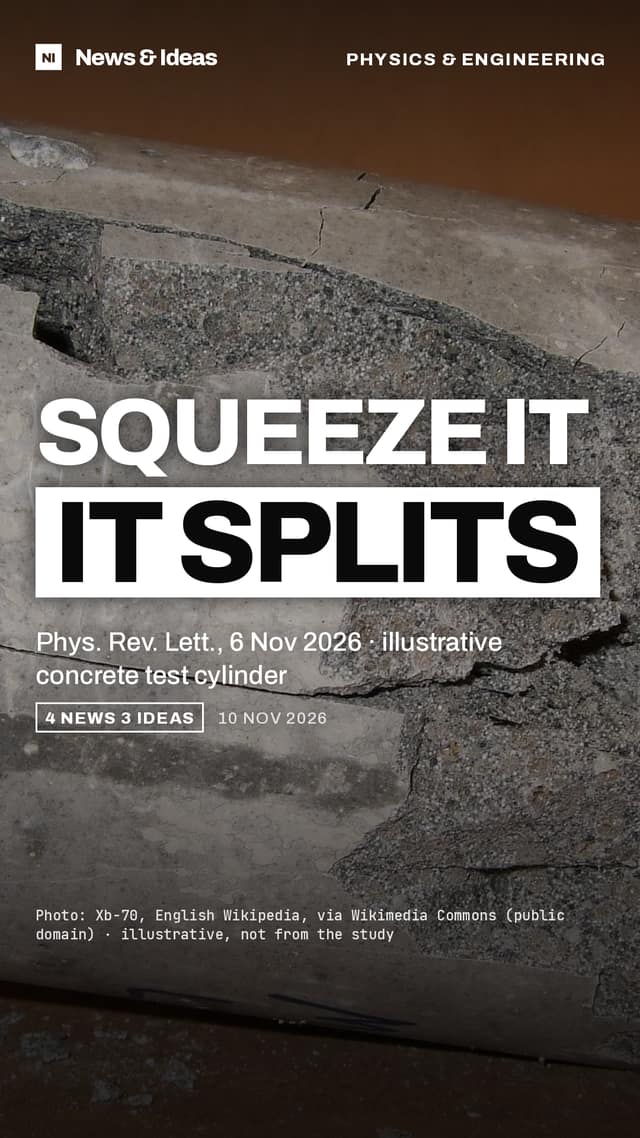
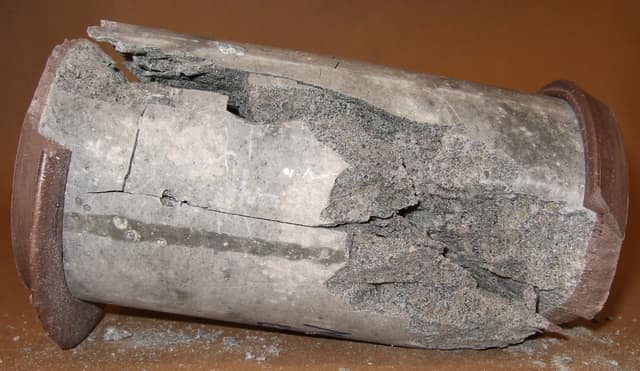
Khodadad, Barthelat, Clayton, Gazonas and Dayal propose why brittle solids squeezed along one axis often crack parallel to it (Phys. Rev. Lett. 137, 196101, 6 Nov 2026). Between two rigid plates the ends cannot widen while the middle widens most, building tensile stress inside even though the load is compressive; splitting starts when it exceeds the tensile strength. They call it the inverse of wrinkling in stretched sheets and derive a strength law from tensile strength, geometry and confining pressure, which agrees with literature data for six brittle materials from rocks to ceramics. APS Physics notes even modest sideways pressure can greatly reduce splitting.
Photo: Xb-70, English Wikipedia, via Wikimedia Commons (public domain) · illustrative, not from the study
One email a day. 4 science stories, 5 quick results, 1 idea. 3 minutes.
Plus a daily quiz: Answer & Learn. Free, unsubscribe anytime.
Physics & Engineering
Cadmium Hosts a Viscous Electron Fluid
Guo, Behnia, Zhu and colleagues report the Gurzhi effect in micrometre-scale cadmium samples (Phys. Rev. Lett. 137, 206301, 9 Nov 2026): in samples of about 65 µm or smaller the resistivity reaches a minimum near 5 K and rises on further cooling, and the hydrodynamic conductivity grows as the square of temperature and sample size. The APS Viewpoint notes the smallest calculated Fermi energy (0.5 meV) is at the limit of the band-structure accuracy.
Jung, Giustino and colleagues at UT Austin predict and report experiments on ε-TaN, a metal whose single crystals should conduct about 273 W/m·K at room temperature, between aluminium and gold, with about 80% carried by phonons and 20% by electrons (Phys. Rev. B 114, 274301, 4 Nov 2026). The predicted figures come from first-principles calculations.
Li, Tang and colleagues grew infrared-sensitive lead sulfide films directly on read-out circuits, combining material growth and electronic integration in one step; the resulting image sensor shows high infrared sensitivity (Nature 659, 83–90, 2026; Nature Research Briefing, 4 Nov 2026).
Most materials widen sideways when squeezed and narrow when stretched; Poisson's ratio measures how much. Block that widening and new stresses appear, the root of compressive splitting.
When electrons collide with each other far more often than with defects and edges, they behave like a viscous fluid; resistance then depends on channel width, as in graphene backflow and now cadmium.
In ordinary metals the same electrons carry heat and charge, so thermal and electrical conductivity are tied together (Wiedemann and Franz, 1853); when phonons or electron fluids dominate, the link breaks, as in graphene's Dirac fluid. In ε-TaN about 80% of the heat is predicted to travel on phonons.