News & Ideas is a daily letter for anyone who wants the day's science in one place, not a feed. Each day is 4 news items and 3 ideas across AI & Tech, Physics & Engineering, Biology & Nature, and Mind & Society, and every story names a primary source you can check. The Shorts use a declared synthetic voice.
One email a day. 4 science stories, 5 quick results, 1 idea. 3 minutes.
Plus a daily quiz: Answer & Learn. Free, unsubscribe anytime.
Issue
28 October 2026
2 min read · 1 Short
Physics & Engineering: a single molecule's kick, a Schwinger effect with ten atoms, water in a nano-gap, glass fibre drawn in orbit. Then Brownian motion, pairs from the vacuum, water's dielectric constant.
One email a day. 4 science stories, 5 quick results, 1 idea. 3 minutes.
Plus a daily quiz: Answer & Learn. Free, unsubscribe anytime.
Physics & Engineering
A single molecule's kick, nano-water, ZBLAN
Physics & Engineering: a single molecule's kick, a Schwinger effect with ten atoms, water in a nano-gap, glass fibre drawn in orbit. Then Brownian motion, pairs from the vacuum, water's dielectric constant.
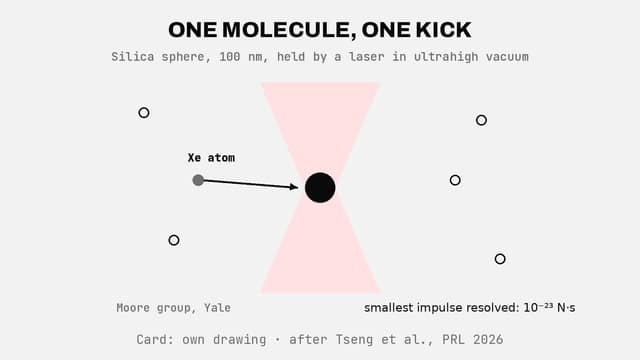
At Yale, David Moore's group levitated a silica sphere just 100 nanometres wide in a laser beam, in ultrahigh vacuum. Watching its motion, they detected kicks from individual gas molecules, one collision at a time, down to ten to the minus twenty-three newton-seconds. The same idea could help searches for dark matter.
One email a day. 4 science stories, 5 quick results, 1 idea. 3 minutes.
Plus a daily quiz: Answer & Learn. Free, unsubscribe anytime.
Physics · Quantum simulation
Simulating particle creation with ten atoms
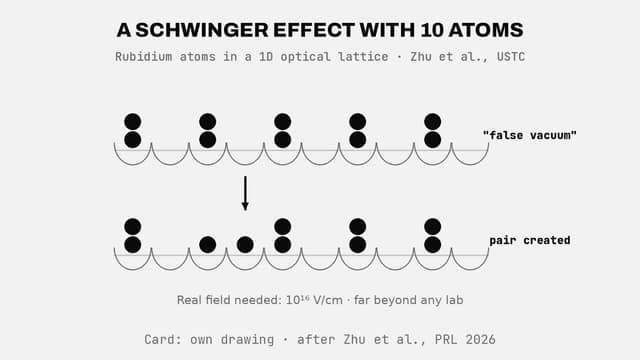
In a strong electric field, electron-positron pairs should appear out of the vacuum, but the field needed is far beyond reach. A team at the University of Science and Technology of China used ten rubidium atoms in an optical lattice to mimic it. The pair-creation rate behaved as theory predicts.
Why water squeezed into a nano-gap behaves so strangely
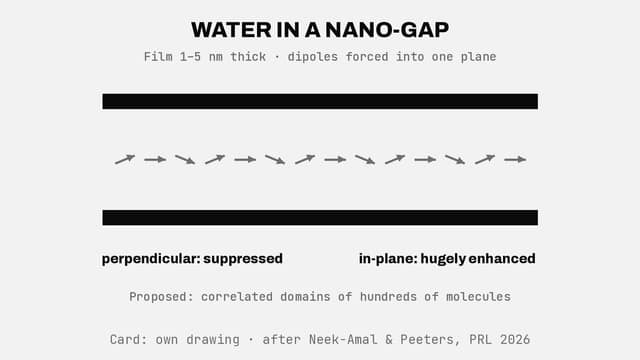
Water confined in a gap a few nanometres wide screens fields weakly across the gap but enormously along it. Physicists in Antwerp propose why: the molecules' dipoles are forced into one plane, so domains of hundreds of molecules fluctuate together. The same network explains fast proton conduction.
Card: own drawing · after Neek-Amal & Peeters, PRL 2026
Glass fibre drawn in orbit: stronger, but not yet clearer
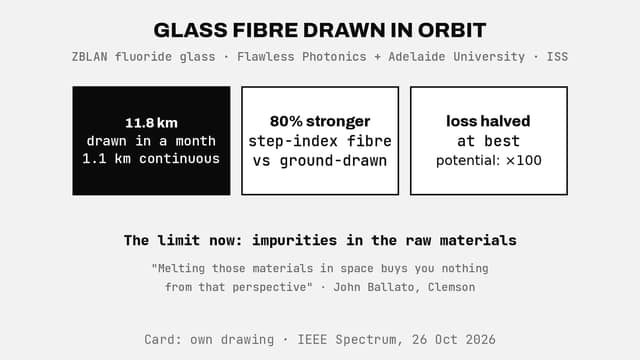
On the space station, a suitcase-sized tower drew 11.8 kilometres of ZBLAN glass fibre, with one strand of 1.1 kilometres. Some fibres were 80 percent stronger than ground-made ones. But optical loss was halved at best, far from the hundredfold potential. Impurities in the raw materials are now the limit.
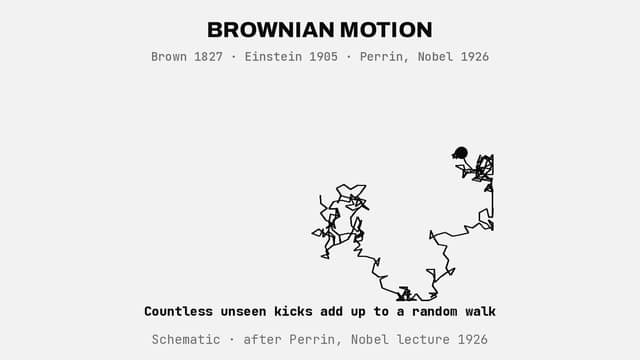
Brownian motion. Pollen in water jitters because invisible molecules keep hitting it. Einstein explained it in 1905, and Jean Perrin's measurements helped prove atoms are real. Until now, only the sum of countless kicks was visible, never a single one.
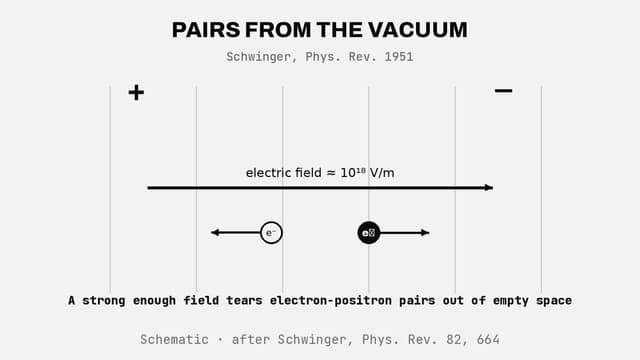
The Schwinger effect. In 1951 Julian Schwinger calculated that a strong enough electric field can tear electron-positron pairs out of empty space. The field needed is around ten to the eighteen volts per metre, which is why physicists simulate it instead.
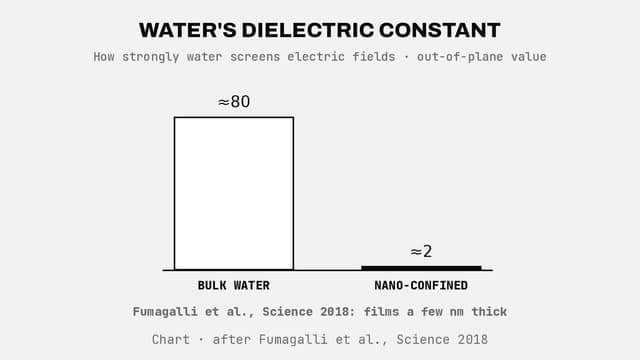
Water's dielectric constant, around 80, measures how strongly it weakens electric forces between charges. That is why it dissolves salts so well. In films a few nanometres thick, measurements in 2018 found the value across the film drops to about 2.