News & Ideas is a daily letter for anyone who wants the day's science in one place, not a feed. Each day is 4 news items and 3 ideas across AI & Tech, Physics & Engineering, Biology & Nature, and Mind & Society, and every story names a primary source you can check. The Shorts use a declared synthetic voice.
One email a day. 4 science stories, 5 quick results, 1 idea. 3 minutes.
Plus a daily quiz: Answer & Learn. Free, unsubscribe anytime.
Issue
18 November 2026
3 min read · 1 Short
Biology & Nature: parakeets that bully a returning boss, a fungal gene that lets mites eat tea, a new flying frog that lays eggs in jelly, a Neanderthal variant that shrinks a brain area. Then gene transfer, pecking orders, Neanderthal ancestry.
One email a day. 4 science stories, 5 quick results, 1 idea. 3 minutes.
Plus a daily quiz: Answer & Learn. Free, unsubscribe anytime.
Biology & Nature
Parakeets Bully the Top Bird When It Returns
Biology & Nature: parakeets that bully a returning boss, a fungal gene that lets mites eat tea, a new flying frog that lays eggs in jelly, a Neanderthal variant that shrinks a brain area. Then gene transfer, pecking orders, Neanderthal ancestry.
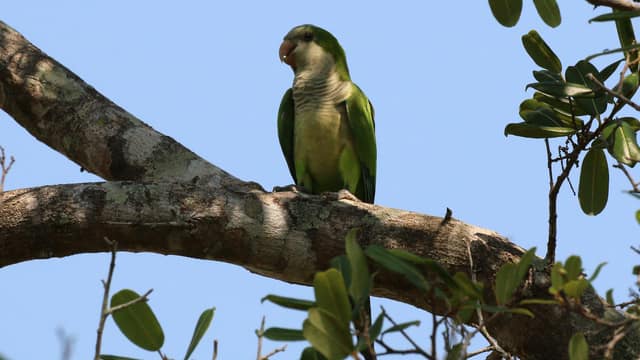
Annemarie van der Marel, Elizabeth Hobson and colleagues (University of Cincinnati) removed and later reintroduced individual monk parakeets in groups of colour-marked birds and tracked aggression. After a removal, the remaining birds updated their ranks and directed aggression at lower-ranked birds. When a removed bird returned, especially a top-ranked one, the group shifted toward a 'bullying' dominance pattern and it received much more aggression, possibly because others were defending their improved positions. The researchers had expected removals to be more disruptive than returns. The aggression is mostly harmless squabbling that rarely escalates. PLOS Computational Biology (2026), open access.
Photo: Charles J. Sharp · Wikimedia Commons (CC BY-SA 4.0) · monk parakeet, Pantanal
One email a day. 4 science stories, 5 quick results, 1 idea. 3 minutes.
Plus a daily quiz: Answer & Learn. Free, unsubscribe anytime.
Evolution · Genes
A Fungal Gene Lets Mites Eat Tea
Naoki Takeda, Takeshi Suzuki and colleagues (Tokyo University of Agriculture and Technology) compared a tea-adapted population of the Kanzawa spider mite (Tetranychus kanzawai) with a non-adapted population and the two-spotted spider mite. After 10 days on tea leaves about 90% of tea-adapted mites survived and reproduced, versus about 5% and 33% of the others. Tea-adapted mites resisted catechin toxicity, contact irritancy and feeding inhibition. The only gene up-regulated at both mRNA and protein level was DOG15, an intradiol ring-cleavage dioxygenase acquired from fungi by horizontal gene transfer: its mRNA was about 20 times higher on tea than on bean leaves, and silencing it reduced survival. The Kanzawa version breaks down catechins more efficiently than the two-spotted mite's, which differs by two amino acids. eLife (2026), CC BY 4.0.
Card: own drawing · after Takeda et al., eLife 2026
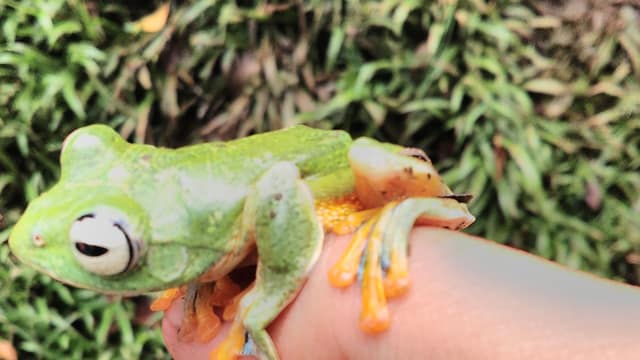
Wahyu Trilaksono (Museum Zoologicum Bogoriense), Alan Hitch, Andrew Engilis Jr. (UC Davis) and colleagues describe Rhacophorus kurniatiae, a flying frog from the Mekongga Mountains of Sulawesi, found during 2009–2013 surveys in large numbers near a small seasonal lake at more than 1,860 m. Comparing 28 physical characters, DNA and calls, they found a cryptic species with a pointed snout, distinct calls and a breeding trait new for Asian flying frogs: eggs and tadpoles develop inside a gelatinous mass on vegetation above or near water, instead of the foam nests of related species. It is named after the late herpetologist Hellen Kurniati. Zootaxa (2026).
Photo: Rabbil Pratama Aji · Wikimedia Commons (CC BY-SA 4.0) · a related species, R. reinwardtii; illustrative
Hugo Zeberg and Svante Pääbo (Max Planck Institute for Evolutionary Anthropology) examined four genetic variants known to be associated with occipital lobe volume. One, a 4-base-pair deletion on chromosome 14 near DAAM1, a gene involved in brain development, is present in all five Neanderthal genomes studied, absent in two Denisovans, and found outside Africa. Using existing genetic and brain-imaging datasets, each copy is associated with about 0.85 cm³ smaller occipital lobe and about 5% lower odds of schizophrenia; no meaningful association was found with intelligence or educational attainment. Association study, research only. PNAS (2026), CC BY 4.0.
Card: own drawing · after Zeberg & Pääbo, PNAS 2026
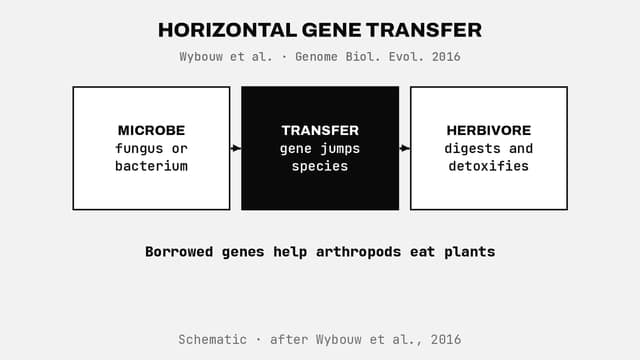
Wybouw, Pauchet, Heckel and Van Leeuwen (Genome Biology and Evolution, 2016) gathered evidence that genomes of plant-feeding insects and mites carry genes that can only be explained by horizontal gene transfer from other organisms. These laterally acquired genes underpin many adaptations to plant feeding, including assimilation and detoxification of plant metabolites, and often diversify after transfer, enabling colonisation of new host plants.
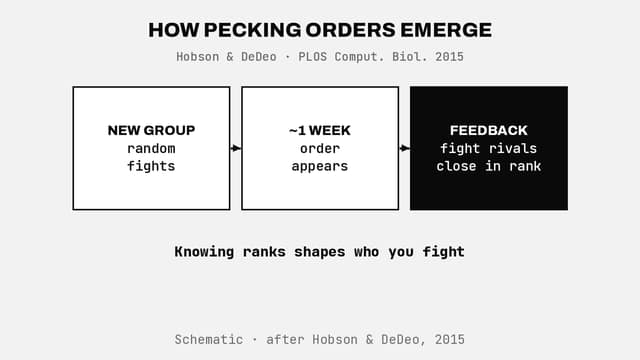
Hobson and DeDeo (PLOS Computational Biology, 2015) studied conflict in two newly formed groups of captive monk parakeets. Large-scale order in aggression appeared after about one week, after which birds preferred to aggress against others close to them in rank, best explained by inferring rank from parts of the aggression network. They propose a feedback loop between knowledge of rank and behaviour that forms and maintains dominance hierarchies, the loop the 2026 removal experiments perturb.
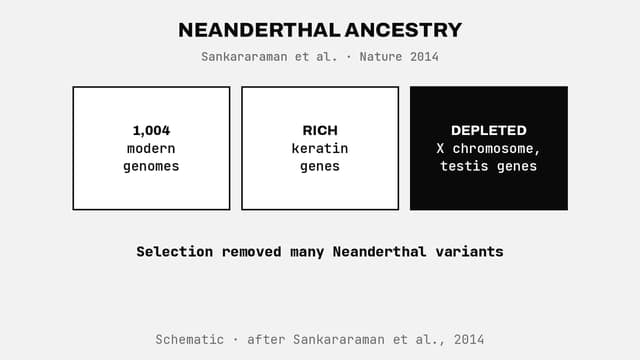
Sankararaman et al. (Nature, 2014) inferred Neanderthal haplotypes in 1,004 present-day human genomes. Regions with high Neanderthal ancestry are enriched for genes affecting keratin filaments, and several Neanderthal-derived alleles confer disease risk. Regions with reduced Neanderthal ancestry are enriched in genes, implying selection against Neanderthal material; genes highly expressed in testes and the X chromosome (about fivefold reduction) are especially depleted.