News & Ideas is a daily letter for anyone who wants the day's science in one place, not a feed. Each day is 4 news items and 3 ideas across AI & Tech, Physics & Engineering, Biology & Nature, and Mind & Society, and every story names a primary source you can check. The Shorts use a declared synthetic voice.
One email a day. 4 science stories, 5 quick results, 1 idea. 3 minutes.
Plus a daily quiz: Answer & Learn. Free, unsubscribe anytime.
Issue
20 November 2026
3 min read · 1 Short
Biology & Nature: a microbe under a sea pig's skin, the most lopsided whale skull, a new egg-eating snake, 1,742 bees found only on islands. Then shrinking genomes, lopsided skulls, island biogeography.
One email a day. 4 science stories, 5 quick results, 1 idea. 3 minutes.
Plus a daily quiz: Answer & Learn. Free, unsubscribe anytime.
Biology & Nature
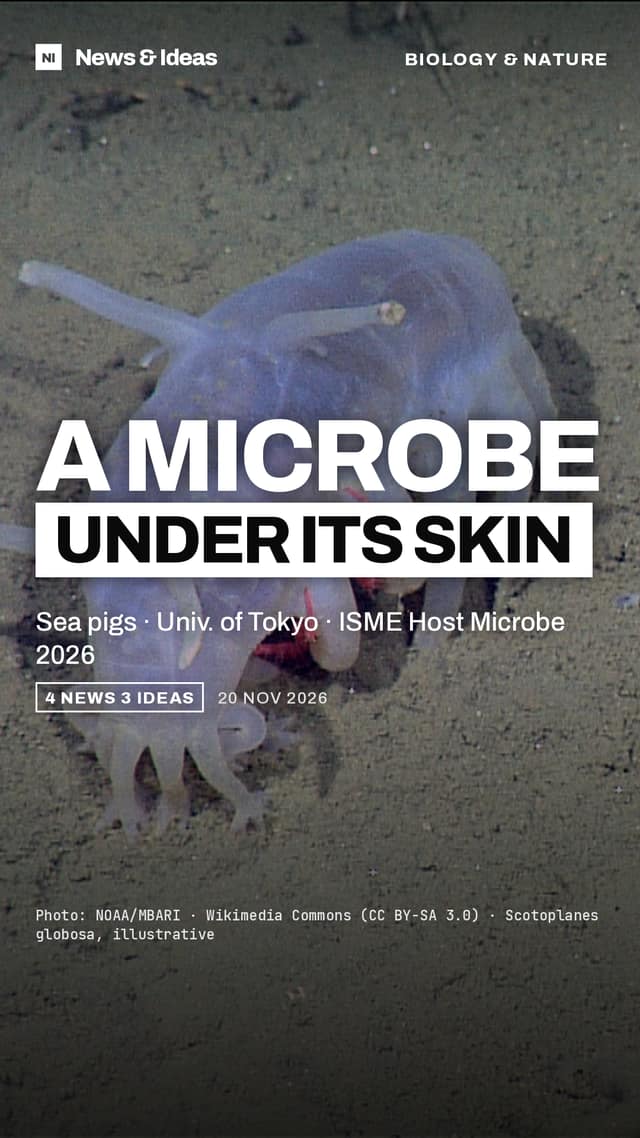
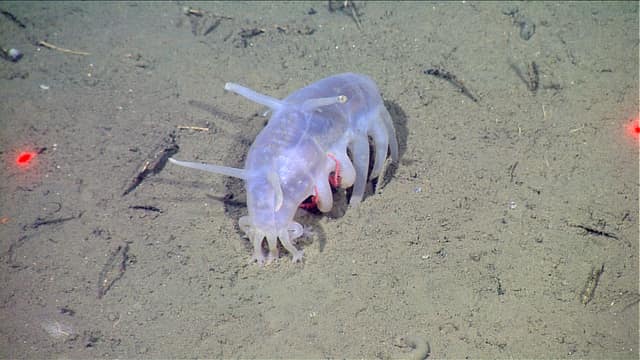
A Mystery Microbe Lives Under a Sea Pig's Skin
Biology & Nature: a microbe under a sea pig's skin, the most lopsided whale skull, a new egg-eating snake, 1,742 bees found only on islands. Then shrinking genomes, lopsided skulls, island biogeography.
Yu Yoshida and colleagues (University of Tokyo and other Japanese institutions) examined eight sea pigs, deep-sea sea cucumbers, using DNA from different tissues, genome reconstruction and fluorescence imaging. In body-wall samples from three sea pig species, one bacterium accounted for more than 70% of bacterial 16S rRNA gene sequences. They propose it as a new genus and species, Candidatus Abyssoplasma scotoplanesicola (Mycoplasmatota). Its genome has only about 649,000 bases, yet more than a quarter encodes groups of surface-associated proteins, some over 5,000 amino acids long, which may help it interact with the host or form clusters. It likely depends on its host; what the sea pigs gain is unknown.
One email a day. 4 science stories, 5 quick results, 1 idea. 3 minutes.
Plus a daily quiz: Answer & Learn. Free, unsubscribe anytime.
Palaeontology · Whales
The Most Lopsided Whale Skull
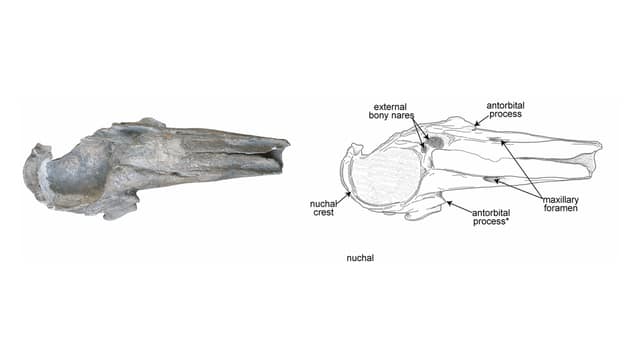
Aldo Benites-Palomino (Zurich, now FAU), Gabriel Aguirre-Fernández and colleagues described Scaphokogia huachafo, an extinct pygmy sperm whale from the Pisco Formation of southern Peru, 6.3–5.6 million years old and about 2.7 m long. Both bony nostrils are shifted entirely to the left and the facial bones differ greatly in size and position: the most extreme facial asymmetry known in any whale or dolphin, and possibly any mammal. Closed sutures and no fractures show it is not post-mortem distortion. A dense, tube-shaped snout angled 31° downward, acting as ballast, and a neck joint allowing about 55° of downward flexion suggest feeding close to the seafloor in shallow coastal waters. 'Huachafo' is Peruvian Spanish for flashy or over-the-top.
Figure: Benites-Palomino et al., Commun. Biol. 2026 (CC BY 4.0), cropped
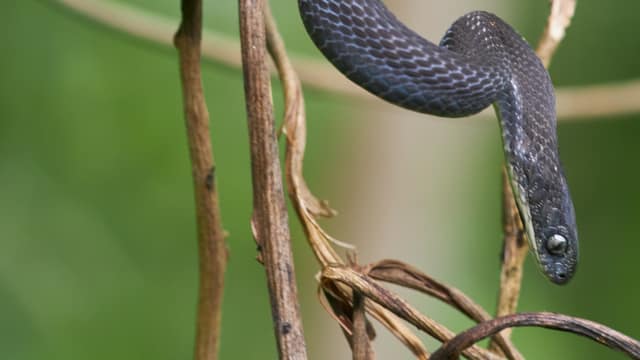
Arthur Tiutenko (FAU Erlangen-Nürnberg) with colleagues from LMU Munich and the National Museum Bloemfontein described Dasypeltis albigularis, the white-throated egg-eater, from the Harenna Forest on the southern slopes of Ethiopia's Bale Mountains. Unlike the all-black montane egg-eater it has a white patch over the throat and about the first 60 belly scales. Egg-eaters feed only on eggs: extended vertebrae reaching into the oesophagus saw the shell open and the shell is expelled through the mouth; hatchlings weigh about 1.5 g and are 20 cm long. A cross with a male montane egg-eater produced one hatchling from 21 eggs, and genetic data confirmed a separate species. Three more new species from the Horn of Africa are under study.
Photo: Wikimedia Commons (CC0) · Dasypeltis albigularis, male
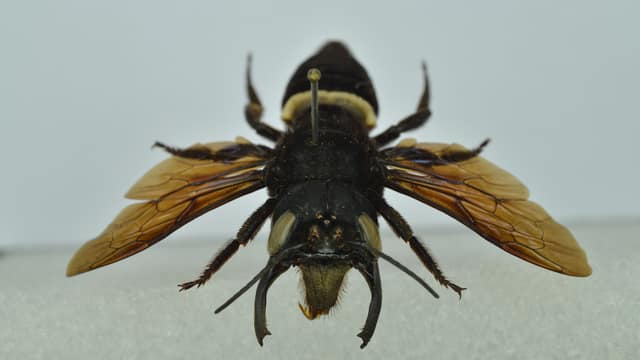
Leon Marshall (Naturalis, formerly ULB), Nicolas Vereecken (ULB), John Ascher (NUS) and colleagues compiled more than 600,000 bee records for 305 islands, tallying 4,128 native species, 1,742 of them found only on islands. Islands cover about 6% of Earth's land yet hold roughly one in five known bee species. Mediterranean islands such as Sicily and Cyprus have the highest bee diversity; Hawaii and Madagascar host many single-island endemics. Community-science photos (iNaturalist, ObsIdentify) helped document remote islands. The authors call for protection and suggest applying area-isolation thinking to fragmented habitats on land.
Photo: Naturalis Biodiversity Center · Wikimedia Commons (CC BY-SA 4.0) · Megachile pluto (Wallace's giant bee), museum specimen
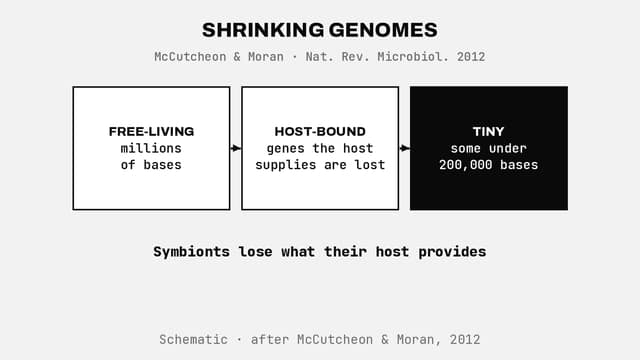
McCutcheon & Moran (Nature Reviews Microbiology, 2012) reviewed extreme genome reduction in host-restricted bacteria: free-living bacteria typically have millions of bases, while some insect symbionts retain well under 200,000, losing genes for functions the host or partner provides. The sea-pig bacterium, at about 649,000 bases, shows reduction too, but devotes over a quarter of its genome to large surface proteins.
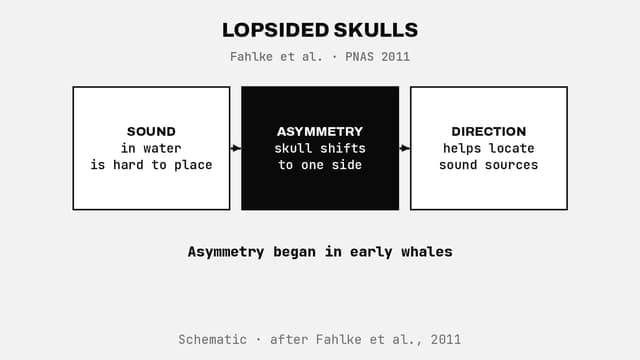
Fahlke, Gingerich, Welsh and Wood (PNAS, 2011) measured cranial asymmetry in Eocene archaeocete whales and argued it evolved for directional hearing in water. In toothed whales, as the Scaphokogia authors note, asymmetry is directly linked to the fatty structures in the forehead used for sound production; in Scaphokogia huachafo it extends far beyond the blowhole region.
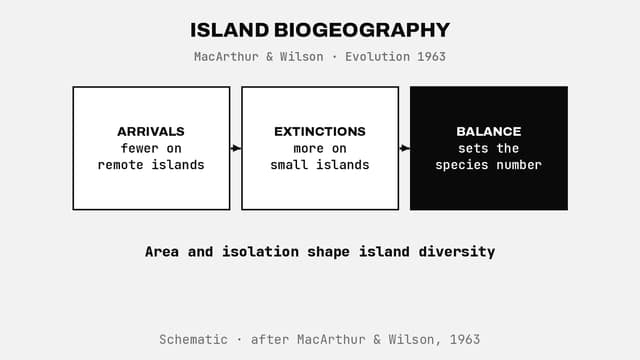
MacArthur & Wilson (Evolution, 1963) proposed an equilibrium theory: the number of species on an island settles where immigration, which falls with distance from the mainland, balances extinction, which rises as island area shrinks. The global island-bee checklist examines drivers of richness and endemism such as area and isolation, and the authors extend the idea to fragmented habitats on land.