News & Ideas is a daily letter for anyone who wants the day's science in one place, not a feed. Each day is 4 news items and 3 ideas across AI & Tech, Physics & Engineering, Biology & Nature, and Mind & Society, and every story names a primary source you can check. The Shorts use a declared synthetic voice.
One email a day. 4 science stories, 5 quick results, 1 idea. 3 minutes.
Plus a daily quiz: Answer & Learn. Free, unsubscribe anytime.
Issue
11 November 2026
2 min read · 1 Short
Biology & Nature: Fish Gained Schooling 60 Times and Lost It 320, Ethiopian Water Mouse Found Again After a Century, mRNA Pulse Helps Mouse Hearts Regrow Muscle, Watching Fights Changes Mouse Brains Like Fighting Does. Then The Selfish Herd, Lazarus Species: Lost, Then Found, Why Adult Hearts Barely Renew.
One email a day. 4 science stories, 5 quick results, 1 idea. 3 minutes.
Plus a daily quiz: Answer & Learn. Free, unsubscribe anytime.
Biology & Nature
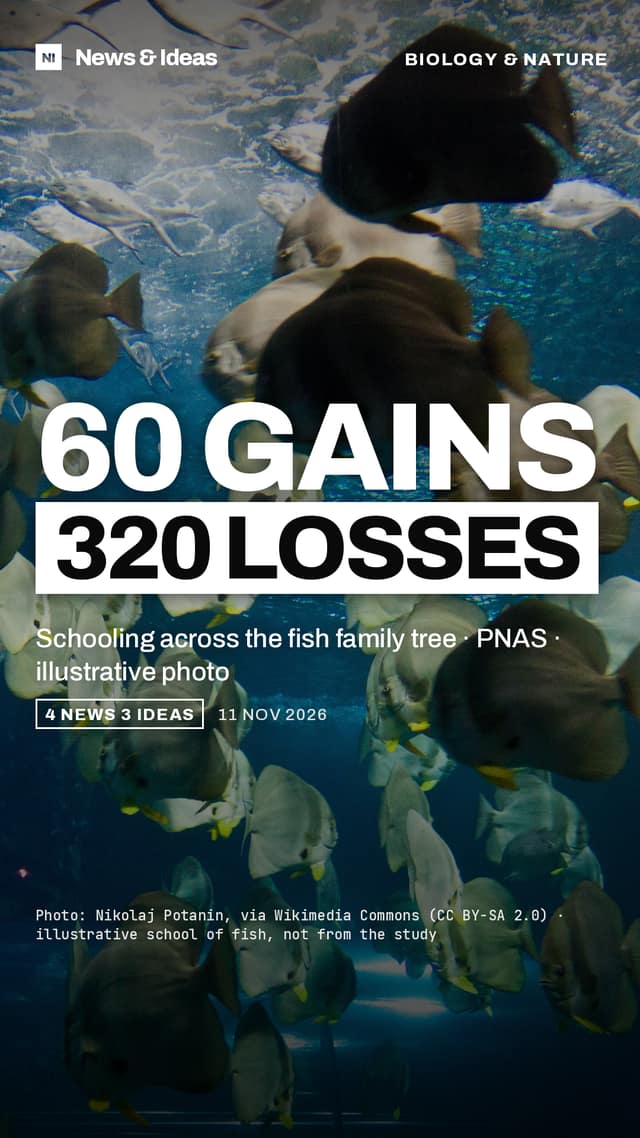
Fish Gained Schooling 60 Times, Lost It 320
Biology & Nature: Fish Gained Schooling 60 Times and Lost It 320, Ethiopian Water Mouse Found Again After a Century, mRNA Pulse Helps Mouse Hearts Regrow Muscle, Watching Fights Changes Mouse Brains Like Fighting Does. Then The Selfish Herd, Lazarus Species: Lost, Then Found, Why Adult Hearts Barely Renew.
Love, Hein and colleagues (Cornell) used machine learning on species descriptions and citizen-science images to score collective movement in 2,839 ray-finned fish species, nearly 10% of about 39,000 living species. Across 350 million years, schooling arose independently some 60 times and was lost some 320 times. Species lower in the food chain are more likely to school, though the link is not iron-clad, and schooling lineages have generated more species. Possible costs behind the losses (false alarms, competition, disease) are hypotheses. Senior author Andrew Hein: experts thought losses were rare, "but that's simply not true" (PNAS, 6 Nov 2026).
Photo: Nikolaj Potanin, via Wikimedia Commons (CC BY-SA 2.0) · illustrative school of fish, not from the study
One email a day. 4 science stories, 5 quick results, 1 idea. 3 minutes.
Plus a daily quiz: Answer & Learn. Free, unsubscribe anytime.
Biology & Nature
Ethiopian Water Mouse Found Again After a Century
Nilopegamys plumbeus, a roughly 15 cm semi-aquatic rodent known from a single specimen collected in 1927 and described in 1928, was found again in mid-October in Ethiopia's Yayu Biosphere Reserve, hundreds of kilometres from the original site, by Mengistu Wale of the Ethiopian Biodiversity Institute. Genetic confirmation is pending. NABU press release, no paper yet.
Boikova and colleagues gave mice a transient mRNA dose of Myc and Cyclin T1 after a heart attack; heart-muscle cells divided and the hearts pumped about 10% more blood per beat, with benefits lasting at 28 days and 12 weeks (Nature Cardiovascular Research; Cambridge release, 9 Nov 2026). Mouse research only, not a treatment and not medical advice.
Watching Fights Changes Mouse Brains Like Fighting Does
Iravedra-García, Falkner and colleagues report that mice that only watched other mice fight developed behavioural and neural changes resembling those of mice that fought, becoming more aggressive (Nature, 4 Nov 2026). Mouse study.
Hamilton showed that groups can form from purely selfish moves: each animal shrinks its own "domain of danger" by moving close to others, with no group benefit required. It fits today's finding that fish lower in the food chain school more often.
Geometry for the selfish herdJournal of Theoretical Biology · 1971 · Primary · Hamilton, J. Theor. Biol. 31, 295 (1971)
Idea · Biology & Nature
Lazarus Species: Lost, Then Found
At least 351 amphibian, bird and mammal species were rediscovered over 122 years, missing on average 61 years; most have small ranges and remain highly threatened. The Ethiopian water mouse joins the list.
Carbon-14 from Cold War bomb tests dates human heart-muscle cells: about 1% are renewed per year at age 25, falling to 0.45% at 75, so fewer than half are ever replaced. That scarce renewal is why treatments try to restart cell division after a heart attack.