News & Ideas is a daily letter for anyone who wants the day's science in one place, not a feed. Each day is 4 news items and 3 ideas across AI & Tech, Physics & Engineering, Biology & Nature, and Mind & Society, and every story names a primary source you can check. The Shorts use a declared synthetic voice.
One email a day. 4 science stories, 5 quick results, 1 idea. 3 minutes.
Plus a daily quiz: Answer & Learn. Free, unsubscribe anytime.
Issue
12 November 2026
3 min read · 1 Short
Biology & Nature: Harvester Ant Colonies Age in Reverse, Eels Spread a Herpesvirus by Biting, A New Bug That Lives in Spider Webs, A Mosquito's Cell Tunnels Need Their Tails. Then Negative Senescence: When Age Lowers the Risk, The Superorganism, Watching Infections Glow Inside Living Animals.
One email a day. 4 science stories, 5 quick results, 1 idea. 3 minutes.
Plus a daily quiz: Answer & Learn. Free, unsubscribe anytime.
Biology & Nature
Ant Colonies That Age in Reverse
Biology & Nature: Harvester Ant Colonies Age in Reverse, Eels Spread a Herpesvirus by Biting, A New Bug That Lives in Spider Webs, A Mosquito's Cell Tunnels Need Their Tails. Then Negative Senescence: When Age Lowers the Risk, The Superorganism, Watching Infections Glow Inside Living Animals.
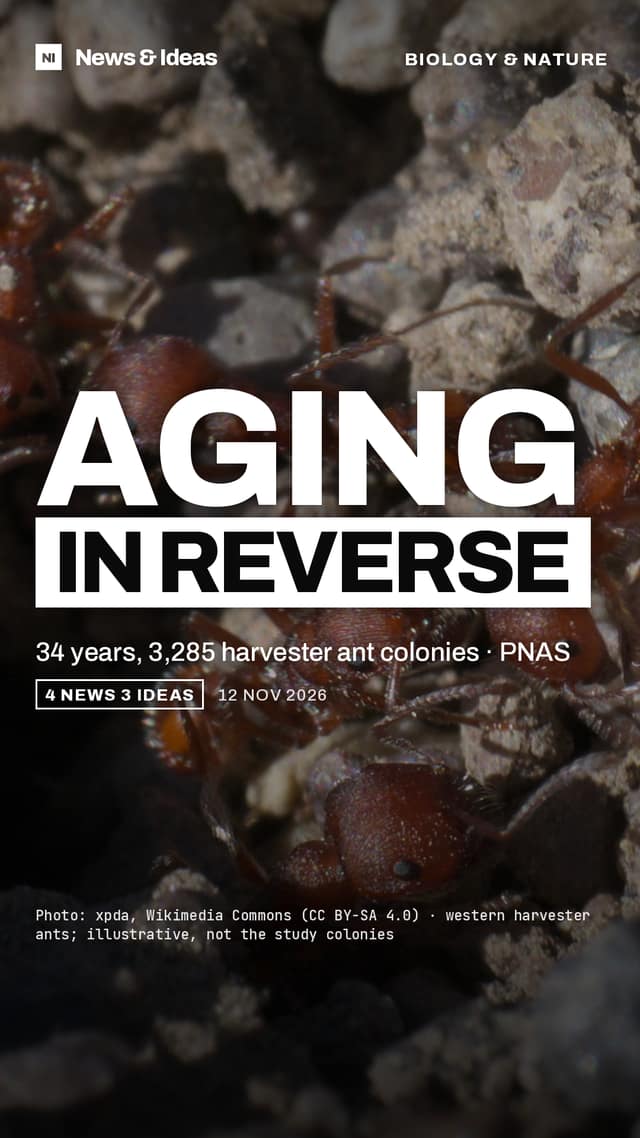
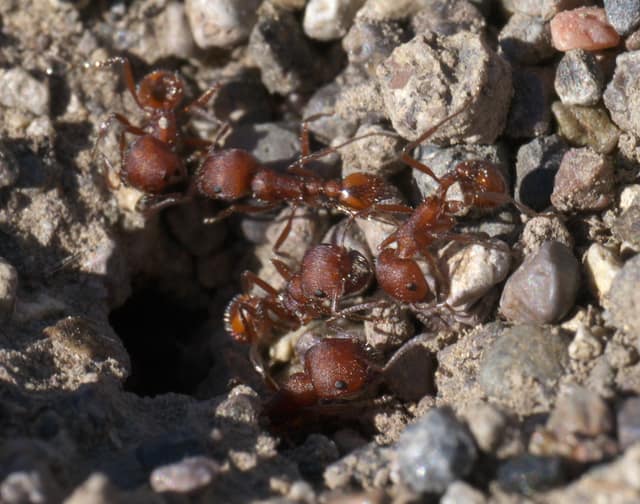
University of Houston biologists Blaine Cole and Diane Wiernasz followed 3,285 colonies of known age of the western harvester ant, Pogonomyrmex occidentalis, in Colorado for 34 years. Older colonies were less likely to die and more likely to reproduce: negative senescence. Fifty-one colonies founded before the study began were still alive in 2024, at an estimated 40 to 42 years. Colonies keep growing, and growth and reproduction were positively linked. The authors credit a replaceable soma: workers live about a year and are constantly replaced. Individual ants do not get younger; the pattern is at colony level. Peer-reviewed.
Photo: xpda, Wikimedia Commons (CC BY-SA 4.0) · western harvester ants; illustrative, not the study colonies
One email a day. 4 science stories, 5 quick results, 1 idea. 3 minutes.
Plus a daily quiz: Answer & Learn. Free, unsubscribe anytime.
Biology & Nature
Eels Spread a Herpesvirus by Biting
A University of Liège team used bioluminescent imaging in live European eels to track anguillid herpesvirus 1, a pathogen thought to contribute to the decline of this critically endangered fish. Eels became susceptible only at the freshwater yellow-eel stage. Single artificial bites from infected eels infected every exposed eel, and the virus lost infectivity quickly in water and fish mucus, challenging the idea that fish viruses spread mainly through water. Peer-reviewed, open access.
Entomologists at China Agricultural University described Heissophila sinica, a new species of web-loving bug found living in the webs of macrothelid spiders in Fujian and Guangdong, China. It is only the second known species of its genus and is smaller than its relative, mostly short-winged. Peer-reviewed, open access in ZooKeys.
Nagoya University researchers used cryo-electron microscopy to solve the first structure of an insect innexin, from the malaria mosquito Anopheles gambiae: seven identical units form a symmetric ring, and the starting ends of the protein chains link into an inner ring. Removing one amino acid there kept the channel working; removing two nearly silenced it and the ring collapsed out of shape. Peer-reviewed.
In most animals the chance of dying rises with age. But across the tree of life ageing is diverse: some plants, tortoises and fish show flat or even falling mortality as they grow. Theory says indeterminate growth and no reproductive cost to growing favour this pattern; harvester ant colonies fit both.
The case for negative senescenceTheoretical Population Biology · 2004 · Primary · Vaupel et al., Theor. Popul. Biol. 65, 339 (2004)
Idea · Biology & Nature
The Superorganism
In ant and termite colonies, queens reproduce and sterile workers do everything else, so the colony behaves like one organism with a reproductive line and a disposable body. Boomsma and Gawne argue this division of labour is a point of no return in evolution. It is why a colony's 'body' can be replaced every year while the colony itself lives for decades.
Give a pathogen a light-emitting enzyme, luciferase, and a sensitive camera can follow the infection through a living host over days, without killing the animal at each time point. Contag and colleagues showed it with glowing Salmonella in mice in 1995; the eel study used the same idea to watch a herpesvirus enter through gills and mouth and spread by bites.