News & Ideas is a daily letter for anyone who wants the day's science in one place, not a feed. Each day is 4 news items and 3 ideas across AI & Tech, Physics & Engineering, Biology & Nature, and Mind & Society, and every story names a primary source you can check. The Shorts use a declared synthetic voice.
One email a day. 4 science stories, 5 quick results, 1 idea. 3 minutes.
Plus a daily quiz: Answer & Learn. Free, unsubscribe anytime.
Issue
8 November 2026
2 min read · 1 Short
Biology & Nature: Bacteria Help Viruses End Algal Blooms, Bacterial Proteins Build Vault Nanocapsules, Plant Relatives Evolved Filaments Repeatedly, Extinct Ungulates Were Often Migratory. Then Two Fates for Bloom Carbon, Multicellularity Is Not One Leap, Migration Can Be a Fragile Strategy.
One email a day. 4 science stories, 5 quick results, 1 idea. 3 minutes.
Plus a daily quiz: Answer & Learn. Free, unsubscribe anytime.
Biology & Nature
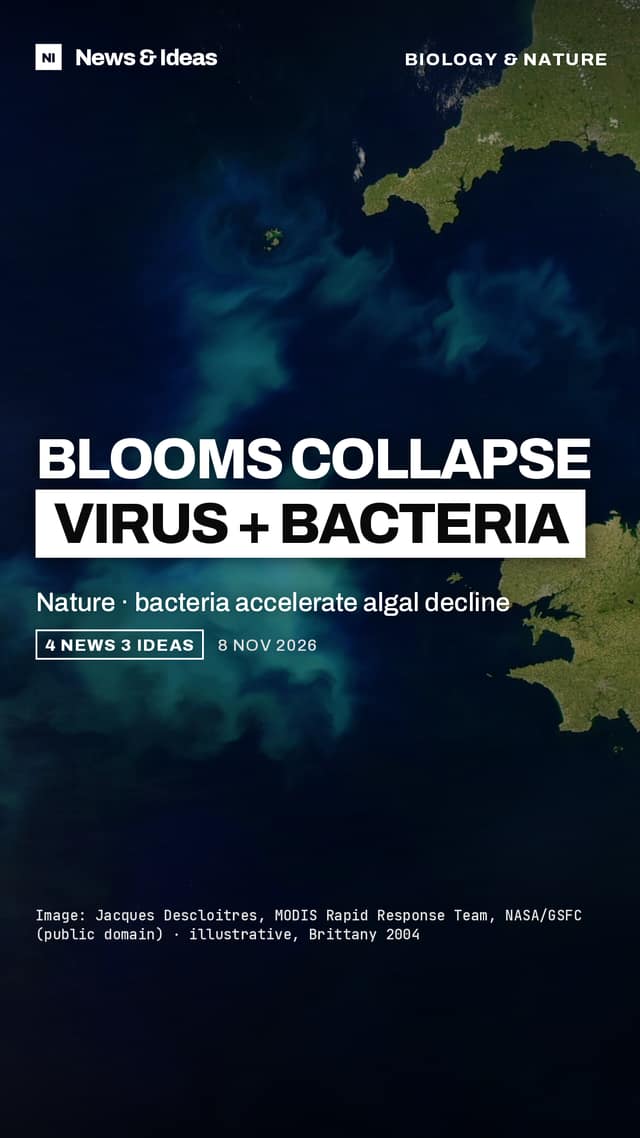
Bacteria Help Viruses Collapse Ocean Blooms
Biology & Nature: Bacteria Help Viruses End Algal Blooms, Bacterial Proteins Build Vault Nanocapsules, Plant Relatives Evolved Filaments Repeatedly, Extinct Ungulates Were Often Migratory. Then Two Fates for Bloom Carbon, Multicellularity Is Not One Leap, Migration Can Be a Fragile Strategy.
Kuhlisch and colleagues reconstructed algae–virus–bacteria communities and found bacteria accelerate virus-driven algal decline. Alteromonas bacteria were attracted to infected-cell extracts and enriched during oceanic bloom demise. This helps explain synchronous collapses when fewer than 30% of cells are actively virus-infected. Exact killing mechanisms remain unresolved; the field percentage is not a ceiling in laboratory cultures.
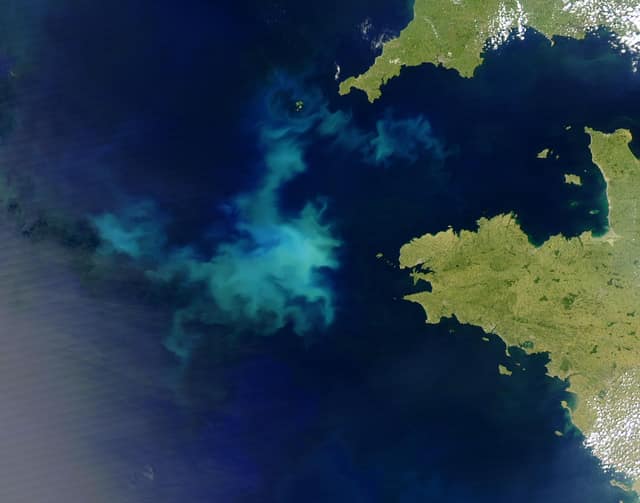
Image: Jacques Descloitres, MODIS Rapid Response Team, NASA/GSFC (public domain) · illustrative, Brittany 2004
One email a day. 4 science stories, 5 quick results, 1 idea. 3 minutes.
Plus a daily quiz: Answer & Learn. Free, unsubscribe anytime.
Biology & Nature
Bacterial Proteins Build Vault Nanocapsules
Athukoralage and colleagues expressed bacterial and phage major vault protein homologs in E. coli and isolated vault particles from eight homologs. A phage shell contained 96 protein chains with an enclosed volume about 25% larger than human vaults. Preprint; native-host function remains unknown. Claude assisted research under human direction.
Bierenbroodspot and colleagues built a phylogeny from 104 algal transcriptomes and 2,243 loci, including 43 new transcriptomes. The closest algal relatives of land plants likely had a unicellular ancestor, with seven reconstructed transitions to filamentous growth. Sampling still captures only part of the group’s diversity.
Abraham and colleagues inferred migration in 51 extinct late-Quaternary ungulates: about 80% were probably migratory, against 46% of living species. Fossil-inclusive models associate migration with higher speciation and extinction. These are phylogenetic inferences with broad definitions of migration, not direct tracking of extinct animals.
Viral lysis releases dissolved organic matter that microbes recycle near the surface: the viral shunt. Aggregated particles can instead sink and export carbon: the viral shuttle. Bacterial interactions may shift this balance; the new study does not directly quantify a global climate effect.
Kuhlisch et al., Nature, 4 Nov 2026
Nature, 4 Nov 2026nature.com · 4 Nov 2026 · Primary · Two Fates for Bloom Carbon — Kuhlisch et al.
Idea · Biology & Nature
Multicellularity Is Not One Leap
Filaments, colonies and aggregates have evolved repeatedly. The new algal phylogeny reconstructs a unicellular ancestor and several independent origins of filaments in the group closest to land plants. Visible simplicity does not mean a simple evolutionary history.
Bierenbroodspot et al., PLOS Biology, 3 Nov 2026
PLOS Biology, 3 Nov 2026PLOS ONE · 3 Nov 2026 · Primary · Multicellularity Is Not One Leap — Bierenbroodspot et al.
Idea · Biology & Nature
Migration Can Be a Fragile Strategy
Seasonal travel opens resources but depends on connected routes and predictable conditions. Fossil-inclusive ungulate models associate migration with both faster speciation and extinction. Living-species-only analyses can miss this pattern, illustrating survivorship bias in evolutionary inference.
Abraham et al., PLOS Biology, 5 Nov 2026
PLOS Biology, 5 Nov 2026PLOS ONE · 5 Nov 2026 · Primary · Migration Can Be a Fragile Strategy — Abraham et al.
Credits
Image: Jacques Descloitres, MODIS Rapid Response Team, NASA/GSFC (public domain) · illustrative, Brittany 2004
Voice: synthetic (neural text-to-speech).
Scripts written from the linked sources.
News and Ideas4 News 3 IdeasscienceBiology & Natureresearch
Biology & Nature
Question of the day
Where were the bacterial and phage vault proteins expressed to isolate particles?
Inside human neurons
In natural wild hosts only
In a telescope detector
In Escherichia coli
The ballot is in the email. Each choice there is counted once.