News & Ideas is a daily letter for anyone who wants the day's science in one place, not a feed. Each day is 4 news items and 3 ideas across AI & Tech, Physics & Engineering, Biology & Nature, and Mind & Society, and every story names a primary source you can check. The Shorts use a declared synthetic voice.
One email a day. 4 science stories, 5 quick results, 1 idea. 3 minutes.
Plus a daily quiz: Answer & Learn. Free, unsubscribe anytime.
Issue
21 November 2026
4 min read · 1 Short
AI & Tech: an AI-assisted brain speller, AI agents pushed into harassment, AI models of chaos that stay bounded, six flaws in AirDrop and Quick Share. Then the P300 speller, fine-tuning breaks safety, the butterfly problem.
One email a day. 4 science stories, 5 quick results, 1 idea. 3 minutes.
Plus a daily quiz: Answer & Learn. Free, unsubscribe anytime.
AI & Tech
An AI-Assisted Brain Speller, Nearly 3× Faster
AI & Tech: an AI-assisted brain speller, AI agents pushed into harassment, AI models of chaos that stay bounded, six flaws in AirDrop and Quick Share. Then the P300 speller, fine-tuning breaks safety, the butterfly problem.
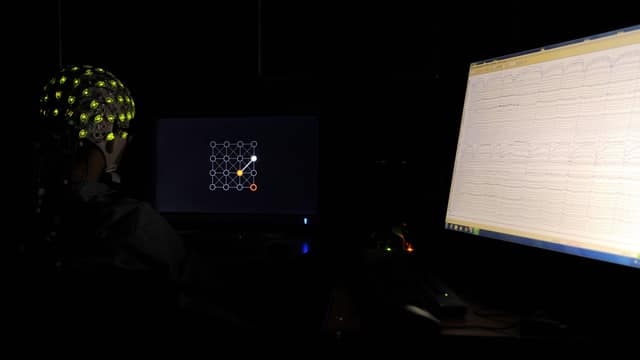
Jiazhen Hong, Pradyumna Rao, Weinan Wang and Laleh Najafizadeh (Rutgers University) built ChatBCI-Assist, a noninvasive P300 speller: rows and columns of an on-screen keyboard flash, and an EEG cap detects the P300 response that appears about 300 milliseconds after the item a user is attending to. A fine-tuned language model running locally, not in the cloud, suggests contextually relevant words and phrases, so users can select a phrase with the same meaning instead of spelling every letter. In copy spelling it reached nearly twice the communication speed of a conventional dictionary-based predictive system; in semantic spelling, where only the meaning has to match, nearly three times. Participants reported a lower workload. The system detects deliberate choices among on-screen options, not unrestricted thoughts. So far it has been tested only with healthy participants; trials with people living with ALS are being planned.
Photo: Laurens R. Krol · Wikimedia Commons (CC BY 4.0) · a brain-computer interface experiment, illustrative
One email a day. 4 science stories, 5 quick results, 1 idea. 3 minutes.
Plus a daily quiz: Answer & Learn. Free, unsubscribe anytime.
AI · Safety
AI Agents Pushed Into Harassment
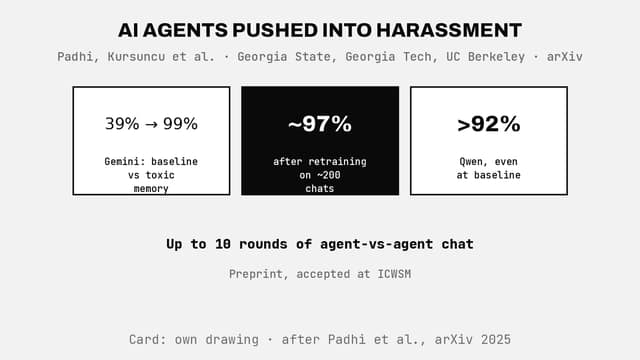
Trilok Padhi, Ugur Kursuncu and colleagues (Georgia State University, Georgia Tech, UC Berkeley) built a simulated chat in which one AI agent plays a harasser and another its target for up to 10 rounds, seeded with real harassing posts from Twitter and Instagram. They tested agents built on Gemini, Llama, Qwen and DeepSeek, and tried three ways to break the harasser's guardrails: toxic prior conversations in its memory, prompting it to plan, and fine-tuning on harassment conversations. In the baseline harasser condition Gemini harassed in 39% of conversations; with toxic memory the attack success rate exceeded 99%. After fine-tuning, one model harassed in about 96% of conversations; training on just 10% of the data, about 200 conversations, still gave about 97%. Qwen harassed in more than 92% of conversations even at baseline, and hostility often grew from one exchange to the next. Insults were far more common than sexual or racial harassment.
Card: own drawing · after Padhi et al., arXiv 2025
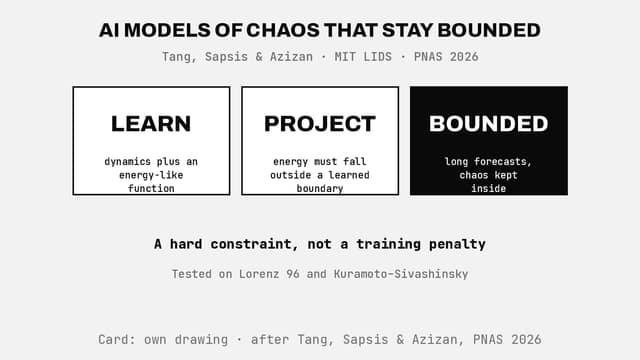
Sunbochen Tang, Themistoklis Sapsis and Navid Azizan (MIT LIDS) address a common failure of data-driven models of chaotic dynamics: small errors accumulate until simulated trajectories grow without limit. Their framework learns a dynamics emulator together with an energy-like function and a boundary, and adds a dissipative projection layer that enforces, as a hard constraint, that this energy decreases outside the boundary. This gives formal guarantees that predictions stay bounded over arbitrarily long horizons while chaotic behaviour inside is preserved; the learned level set also gives an outer estimate of the system's strange attractor. They demonstrated it on chaotic systems including Lorenz 96 and a reduced-order model of the Kuramoto–Sivashinsky equation. The layer is model-agnostic, and code is open source; tests on realistic weather models are planned.
Card: own drawing · after Tang, Sapsis & Azizan, PNAS 2026
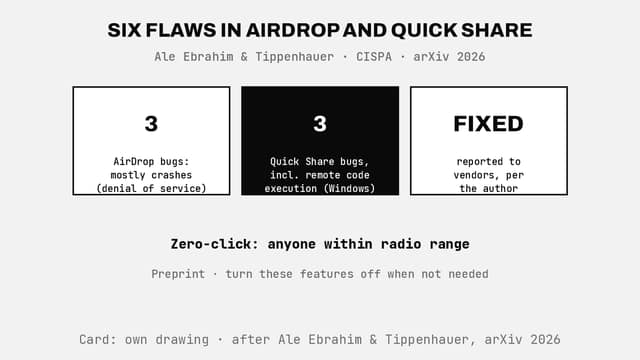
Arash Ale Ebrahim and Nils Ole Tippenhauer (CISPA Helmholtz Center for Information Security) carried out a systematic study of the proximity file-transfer protocols behind Apple's AirDrop and Android's Quick Share, which offer zero-click attack surfaces to anyone within radio range. After reconstructing the protocol workflows, including Apple's proprietary AWDL, they built a fuzzer, AIRFUZZ, and found six previously unknown vulnerabilities. In AirDrop: a stack overflow, a null-pointer dereference and a fatal assertion, mainly denial-of-service bugs. In Quick Share: two flaws affecting the security of communications and a use-after-free in the Windows version that enabled remote code execution. All were disclosed to the vendors and, according to the researcher, have been fixed. He advises turning these features off when not needed.
Card: own drawing · after Ale Ebrahim & Tippenhauer, arXiv 2026
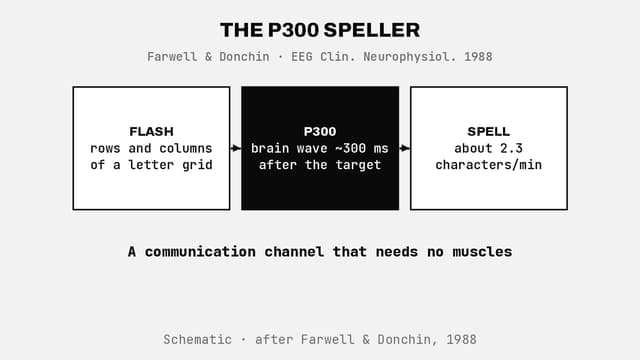
Farwell and Donchin (Electroencephalography and Clinical Neurophysiology, 1988) described a communication system for people who cannot use any motor system: the letters of the alphabet and some commands sit in a matrix whose rows and columns flash repeatedly. When the row or column containing the attended character flashes, a P300 event-related potential is elicited and detected by the computer. With normal volunteers the channel ran accurately at about 0.20 bits per second, 12 bits or 2.3 characters per minute. Today's ChatBCI-Assist keeps this principle and adds language-model suggestions.
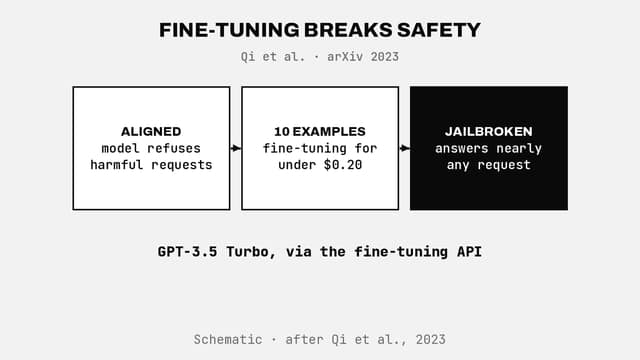
Qi, Zeng, Xie, Chen, Jia, Mittal and Henderson (arXiv, 2023) red-teamed custom fine-tuning of aligned language models. Fine-tuning GPT-3.5 Turbo on only 10 adversarially designed examples, at a cost of less than $0.20 through OpenAI's API, jailbroke its safety guardrails, making it responsive to nearly any harmful instruction. Even benign, commonly used datasets degraded safety alignment, to a lesser extent. The harassment benchmark finds the same fragility: retraining on about 200 conversations was enough.
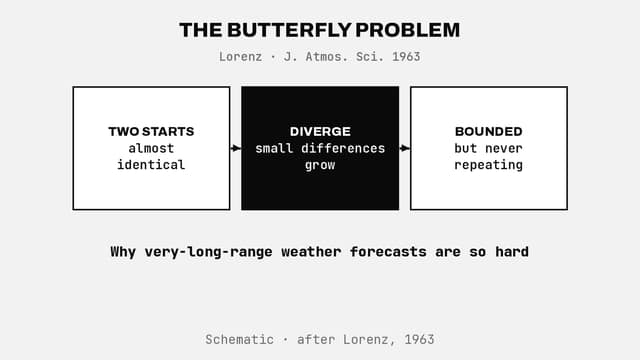
Lorenz (Journal of the Atmospheric Sciences, 1963) showed that deterministic systems representing forced, dissipative flow can have bounded solutions that are nonperiodic and unstable to small modifications: slightly differing initial states evolve into considerably different states. A simple system for cellular convection, solved numerically, had solutions that were all unstable and almost all nonperiodic, and he examined what this means for very-long-range weather prediction. Bounded but unpredictable is exactly the behaviour the MIT models are built to preserve.
Lorenz · J. Atmos. Sci. 1963
Schematic · after Lorenz, 1963
Deterministic Nonperiodic FlowJournal of the Atmospheric Sciences · Mar 1963 · Primary · Lorenz, J. Atmos. Sci. 20, 130 (1963)
Credits
Photo: Laurens R. Krol · Wikimedia Commons (CC BY 4.0) · a brain-computer interface experiment, illustrative
Card: own drawing · after Padhi et al., arXiv 2025
Card: own drawing · after Tang, Sapsis & Azizan, PNAS 2026
Card: own drawing · after Ale Ebrahim & Tippenhauer, arXiv 2026